
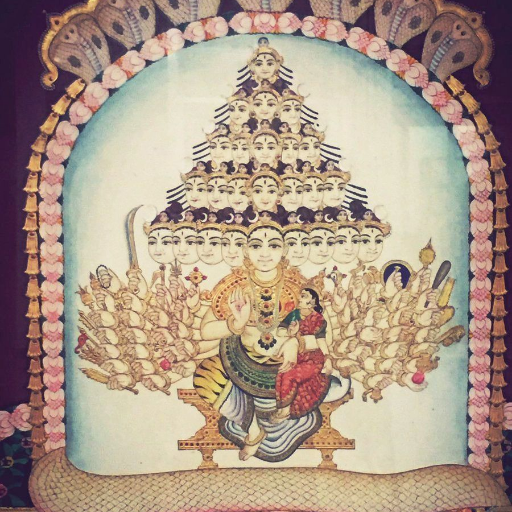
@GaRudan_S @brakoo @DDuraiswamy It’s not that simplistic. Every portrayal of Īśvara is limiting Him. Every portrayal that can fit Hara in a picture frame is suggesting that He is finite, no?
There are 2 points here, which you should note carefully:
There are 2 points here, which you should note carefully:
@GaRudan_S @brakoo @DDuraiswamy 1. Īśvara takes upon forms for the sake of meditation. Interestingly, the Śvetaśvatropaniṣat says:
eṣa ha devaḥ pradiśo 'nu sarvāḥ pūrvo ha jātaḥ sa u garbhe antaḥ /
sa eva jātaḥ sa janiṣyamānaḥ pratyaṅ janās tiṣṭhati sarvatomukhaḥ // 2.16 //
eṣa ha devaḥ pradiśo 'nu sarvāḥ pūrvo ha jātaḥ sa u garbhe antaḥ /
sa eva jātaḥ sa janiṣyamānaḥ pratyaṅ janās tiṣṭhati sarvatomukhaḥ // 2.16 //
@GaRudan_S @brakoo @DDuraiswamy He is the one who is originally born (the first born). He is the one who is born & one who will be born. (Rough paraphrase).
The Āgamas say that He truly has no form, no birth, or death.
How are we to understand all this?
The Āgamas say that He truly has no form, no birth, or death.
How are we to understand all this?
@GaRudan_S @brakoo @DDuraiswamy As explained, He causes a agitation in the Śakti that is innate to Him. As a result, the changeless one appears to be “relative” to us: As “our creator”, as “our preserver” & so on.
@GaRudan_S @brakoo @DDuraiswamy This internal differentiation within Śiva (due to the activities He performs—the Āgama calls this internal differentiation as Laya, Bhoga & Adhikāra) is not real. But inasmuch it appears to us to be so, we speak of this or that form of Īśvara “coming into being”.
@GaRudan_S @brakoo @DDuraiswamy On another level, we also say that Hara is all-pervasive. He therefore pervades, from without & within, every existent in existence. It’s a complete pervasion, with no gaps. Thus, the birth, growth, decay & death of bonded beings are all happening within Him eternally.
@GaRudan_S @brakoo @DDuraiswamy In this sense, we speak of Him becoming the sun, the earth, food, humans who eat that food & soon. We speak of Him as who is being born, who is growing old & so on.
@GaRudan_S @brakoo @DDuraiswamy 2. As mentioned, another way to understand this is that the child form is NOT attributable to Paramaśiva; you call it Śiva but it is Śrīkaṇṭharudra. I cannot but stress the ontological distinction between these two.
Loading suggestions...