

In the summer of 2020, I got into a huge internet fight about math.
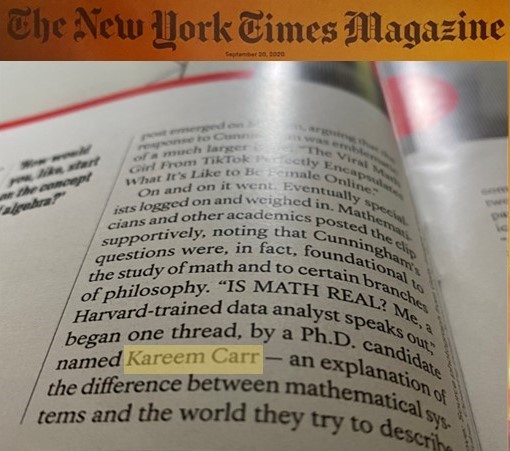
It was such a big controversy that I ended up being profiled in Popular Mechanics. It was even discussed by the New York Times.
Read this thread to find out why a little skepticism about math is good for you.
It was such a big controversy that I ended up being profiled in Popular Mechanics. It was even discussed by the New York Times.
Read this thread to find out why a little skepticism about math is good for you.
Why do we believe "2+2=4"? I think we believe it because it's an extremely strong match with our daily experiences of physical reality.
But I started wondering about physical situations where 2+2 did not equal 4. For instance, if we add 2 cups of water to 2 cups of ethanol, we get less than 4 cups of clear fluid.
Is that fair? One potential objection you might have is we ought to add things that are the "same".
Is that fair? One potential objection you might have is we ought to add things that are the "same".
Could you ever add two cups of water to two more cups of water and not get four cups of water?
Turns out you can. If you add 2 cups of water at 20°C and 2 cups of water at 40°C, what you'll get is slightly less than 4 cups of water at 30°C.
Turns out you can. If you add 2 cups of water at 20°C and 2 cups of water at 40°C, what you'll get is slightly less than 4 cups of water at 30°C.
Again, you might object that they're not the same. But at this point, it's starting to feel pretty tedious.
We basically have to do a deep dive into making sure *every* single thing is the same. Otherwise, this supposedly universal truth that "2+2=4" might fail to be true.
We basically have to do a deep dive into making sure *every* single thing is the same. Otherwise, this supposedly universal truth that "2+2=4" might fail to be true.
Besides, in other situations, "sameness" doesn't actually seem to matter that much at all.
Two apples plus two apples equals four apples even when the apples are different sizes, shapes or colors.
Sometimes differences matter. Sometimes they don't. Curious.
Two apples plus two apples equals four apples even when the apples are different sizes, shapes or colors.
Sometimes differences matter. Sometimes they don't. Curious.
You might be wondering if this is all pointless philosophy or does it relate to anything real.
Well, let's say I'm a data scientist at the CDC and I'm trying to count the number of people who were diagnosed by any hospital in the US as having covid so I can make an official count.
I naively try adding the totals from every hospital in the US.
I naively try adding the totals from every hospital in the US.
This ends up not working because some patients went to multiple hospitals. I can't just add 200 patients from hospital A and 200 patients from hospital B and get a total of 400 people with covid.
Mathematically, I could do it, but the total wouldn't meaningfully reflect reality.
Mathematically, I could do it, but the total wouldn't meaningfully reflect reality.
The solution here is to do what we did back when we were adding fluids.
I need to dig into the properties of what I'm adding (patients in this case) to figure out what matters for my count.
I need to dig into the properties of what I'm adding (patients in this case) to figure out what matters for my count.
Let's say my goal wasn't to measure the number of people with covid but instead to measure the level of hospital utilization.
Now, the same patient visiting two different hospitals should be counted as two separate utilizations of the available healthcare resources.
Now, the same patient visiting two different hospitals should be counted as two separate utilizations of the available healthcare resources.
The lesson for me is you can't just thoughtlessly apply mathematical truths to the world.
Additionally, your goals can affect what mathematical operations make sense for your application.
Not all mathematical truths can be expected to translate in a given context.
Additionally, your goals can affect what mathematical operations make sense for your application.
Not all mathematical truths can be expected to translate in a given context.
Even a very simple conceptual framework like arithmetic can turn out be a lot more complicated than most of us realize.
So, in my opinion, outside of a math classroom, "2+2=4" is a meaningless statement until you tell me what we're actually adding.
Follow me for more musings from the interface between math and reality (which is where statisticians like me live).
Loading suggestions...