

A ₹1.64-lakh crore revival package for BSNL has been approved by the Union Cabinet.
There are 2 main ways in which the viability of a telecom business can be assessed. The traditional way was to compare the ARPU (average revenue per user) with the cost per subscriber (combining acquisition and ongoing care costs).
In early 2000s when Reliance (infocomm and not Jio) entered the market, it created a new way to assess viability - volume. Metrics like net margin per minute, cost per minute, and capacity utilisation on airtime capacity were created.
This focus on volume and margin made sense for the geographically large Indian market in which there were millions of low-income consumers who needed mobile services. But with the entry of players like Jio, margins have declined and users have also switched platforms.
With low margins and volumes, there have been profitability problems for operators like Vodafone, Airtel.
The cost of acquiring customers was also super low previously when the penetration was low and players were fragmented. However, competition has grown more intense in recent years.
However, players like BSNL were already struggling with profits and good service. BSNL hasn't even rolled out 4G services. And there is a lot of debt on its balance sheet.
To solve these issues, the revival package focuses on 3 main areas -
To solve these issues, the revival package focuses on 3 main areas -
• improving the quality of BSNL services,
• to de-stress the balance sheet,
• expand the company's fiber reach by merging with Bharat Broadband Network Limited (BBNL).
The package will have a cash component of ₹43,964 crore and non-cash support of ₹1.20 lakh crore.
• to de-stress the balance sheet,
• expand the company's fiber reach by merging with Bharat Broadband Network Limited (BBNL).
The package will have a cash component of ₹43,964 crore and non-cash support of ₹1.20 lakh crore.
The cash proponent will be used for spectrum allocation, capital expenditure and viability gap funding (a grant to support projects that make sense from societal point of view but are not financially viable).
BSNL will be allotted Spectrum in 900/1800 MHz band administratively at the cost of Rs 44,993 crore through equity infusion. so BSNL can provide 4G services. The merger with BBNL will facilitate wider utilisation of infrastructure laid under BharatNet.
The BSNL-BBNL's combined fiber network will be of ~14 lakh km.
Post the revival package, since BSNL will be able to offer 4G services and offer better connectivity, it is expected that ARPU (average revenue per user) will grow to ₹170-180.
This improves the unit economics but PSUs are generally associated with inefficiency. The operating costs may still end up higher than ARPU.
BSNL is also deploying the "Atmanirbhar 4G" tech stack. The aim is to deliver 4G mobile services in all uncovered villages of the country. This enables e-governance, banking, tele-medicine, tele-education etc.
As inefficient as PSUs are, this shows how their distribution can be used for government initiatives. The government will fund this over the course of the project.
The authorised capital of BSNL will be increased from ₹40,000 to 1,50,000 crores against the AGR dues owed to the government, provision of capex and allotment of spectrum. BSNL will re-issue preference shares of ₹7,500 crore to the government.
BSNL has ~₹33,000 crore as bank debt. The government is approving a sovereign guarantee bond issuance for BSNL to repay the bank loans. Similar bonds have also been approved for MTNL which is a subsidiary of BSNL.
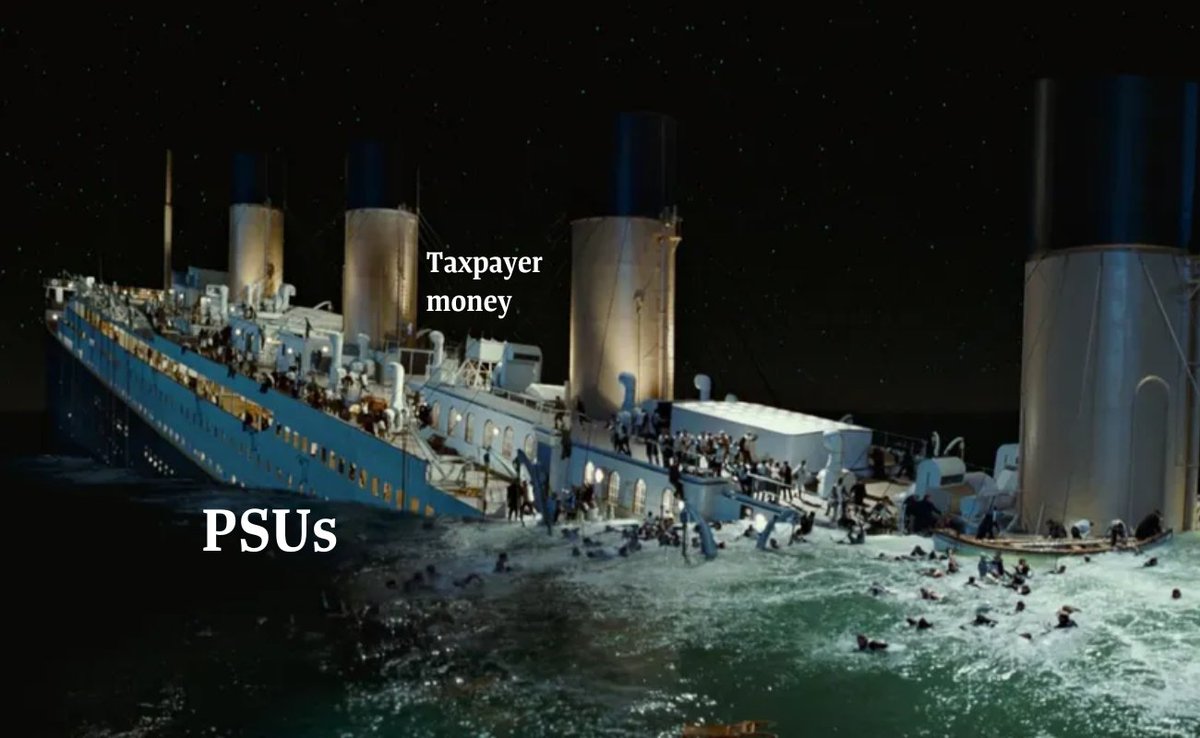
Generally PSU bodies have been considered a waste of taxpayer money. Here too there is a lot of apprehension since an effective cost of ₹1.6 lakh crore for the package is quite substantial when there is no guarantee that the scheme will work.
Assuming 2 crore tax payers, effective cost per taxpayer comes to ~₹80k.
BSNL will not only have to improve its efficiency, service quality and acquire enough users to build sufficient scale and volume. And this doesn’t take into account increased competition from players like Jio, Airtel and newer players if any.
Let's see how this pans out.
Let's see how this pans out.
Loading suggestions...