

Machine learning, you say.
Who’s teaching these machines what to learn?
In many cases––it’s young Indian women.
Let me tell you the story.
(Image credit: Karishma Mehrotra)
Who’s teaching these machines what to learn?
In many cases––it’s young Indian women.
Let me tell you the story.
(Image credit: Karishma Mehrotra)

Chandmuni is a 24-year-old Santhal woman from Jharkhand. Everyday, from 6am to 2pm, she sits down to work in front of her computer.
Her job is to mark the joints of a hand: four per finger, 20 in all.
Her job is to mark the joints of a hand: four per finger, 20 in all.
Her dotted images, along with a mass of others, funnel to a US-based company. That uses the data to train its artificial intelligence models.
So when the algorithms are shown a hand? They’ll have enough past inputs to know what they’re looking at.
Eventually, they may be ready to conduct robotic surgeries.
Eventually, they may be ready to conduct robotic surgeries.
Chandmuni herself is only vaguely aware of the end goal, she says.
“We do the work, we get money for it, so we don’t ask anything more.”
“We do the work, we get money for it, so we don’t ask anything more.”
But she is among the growing number of Indian women who are tasked with data annotation, or labelling—perhaps the most pressing, albeit unglamorous, work of the artificial intelligence pipeline.
(Image credit: Karishma Mehrotra)
(Image credit: Karishma Mehrotra)
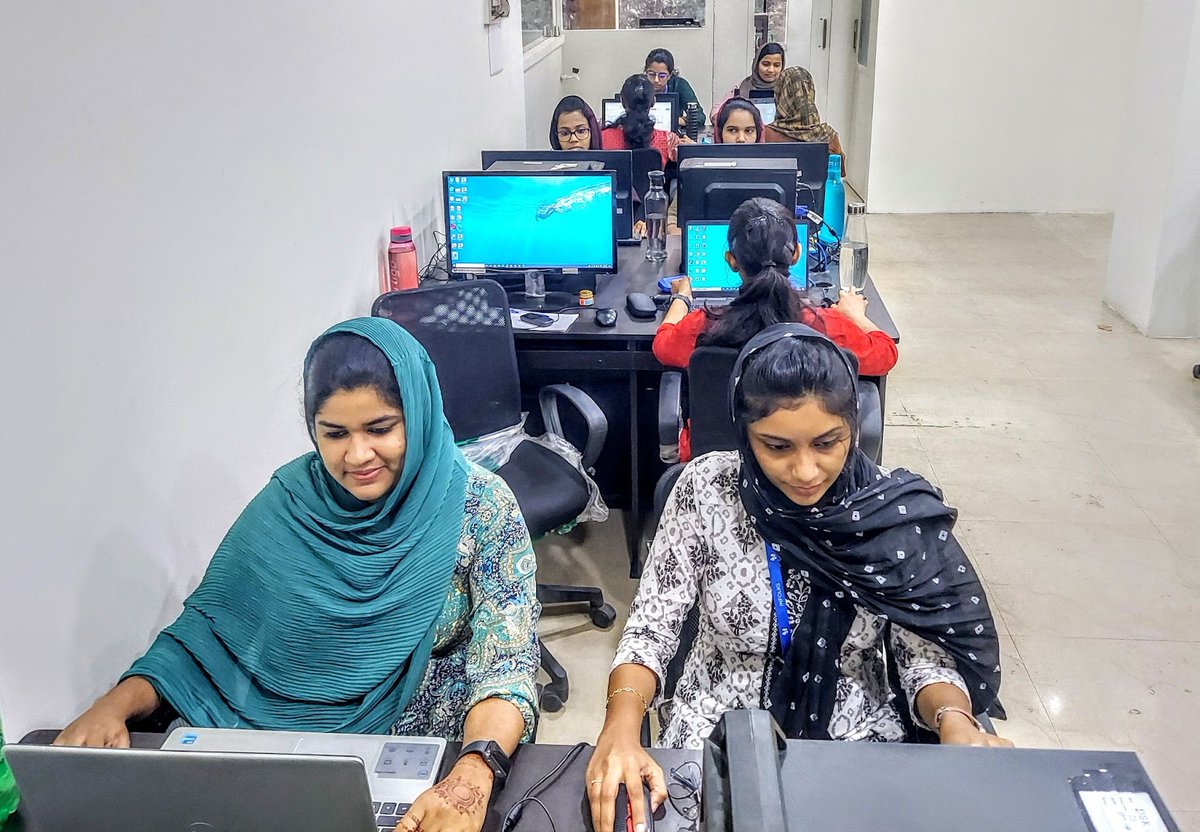
Of course, India isn’t new to this. This is back-end work done for tech companies in the West. Indians did that with software, and then with BPOs.
The call centre era of the 1990s was centred around cities like Gurgaon, Mumbai and Chennai.
But this time, the labelling wave has moved away from the metro cities.
But this time, the labelling wave has moved away from the metro cities.
Data labelling companies have mushroomed in India’s smaller towns, from Yemmiganur in Andhra Pradesh to Shillong in Meghalaya.
Today, there are about 70,000 people working in the field. More than 80 percent come from rural and semi-rural backgrounds.
Today, there are about 70,000 people working in the field. More than 80 percent come from rural and semi-rural backgrounds.
This has opened up opportunities for first-generation workers, especially women workers like Chandmuni. Here's why:
One, they don't have to move to bigger cities far away from their homes for employment.
One, they don't have to move to bigger cities far away from their homes for employment.
And two, the work of labelling images doesn’t require proficiency in spoken English.
Most labelling companies in India are currently in the early growth stage. The industry is here to stay, at least for a decade or so.
Most labelling companies in India are currently in the early growth stage. The industry is here to stay, at least for a decade or so.
And as for the women, their newfound purchasing power and confidence have propelled the women to dream further.
Like Pushpi Shankar—the 29-year-old data labeller from Ranchi, who hopes to start her own business someday.
Like Pushpi Shankar—the 29-year-old data labeller from Ranchi, who hopes to start her own business someday.
Everyday, Pushpi brings her 6-month-old baby to work. Her parents-in-law, based in Bhagalpur, were against her working. They asked her to take two years off to take care of the child, she said.
Her own parents were upset that she chose a love marriage.
Her own parents were upset that she chose a love marriage.
“I understood that if I don’t save for myself, then anyone, anywhere can push me around. Tomorrow, even my husband could leave me. I fear this sometimes. But I don’t get scared if I am earning.”
—Pushpi Shankar, 29, Ranchi
—Pushpi Shankar, 29, Ranchi
Change happens in unexpected ways, through unexpected means. This story changes something we thought we knew about India, its women and their future.
By @karishma__m__
fiftytwo.in
By @karishma__m__
fiftytwo.in
Correction:
Chandmuni is from the Oraon tribal community in Jharkhand. We sincerely regret the error.
Chandmuni is from the Oraon tribal community in Jharkhand. We sincerely regret the error.
Loading suggestions...