
Turns out every "substratum" feature in Sanskrit that was allegedly due to Dravidian has occurred independently in other IE languages who have no contact with Dravidian. In short, there is no such thing as Dravidian substratum (Hock)
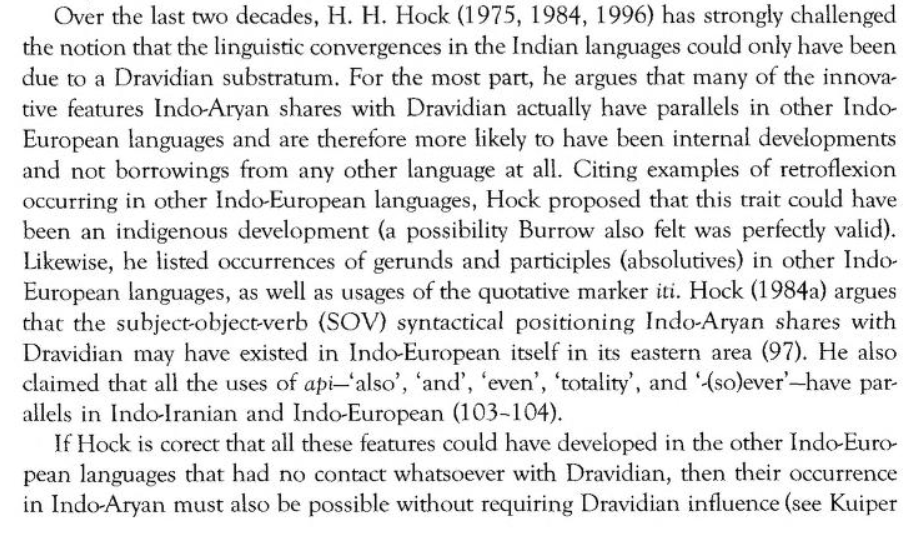
But it begs the question, how did Dravidian develop all those things common with not just Sanskrit but many western IE languages?
1. Dravidian is a newcomer and actually has a Sanskrit substratum!
2. Dravidian is a partially differentiated language group of IE
1. Dravidian is a newcomer and actually has a Sanskrit substratum!
2. Dravidian is a partially differentiated language group of IE
I remember asking why retroflexes must be borrowed in Sanskrit but spontaneously occur in Swedish and Norweigian. The answer I got was "you don't know historical linguistics". Today, retroflexes in Sanskrit are described as being born from RUKI law, independent of Dravidian.
Hock describes the common phonology of Aryan/Dravidian as "adstratum", they converged to the same sound because people lived close together. He claims retroflexion is probably an adstratum process.
Bloch and Witzel both say that its possible that Aryans existed first and Dravidians entered later. This would explain the river names in North (and much of south) being Sanskrit. ie, Dravidian migration theory!
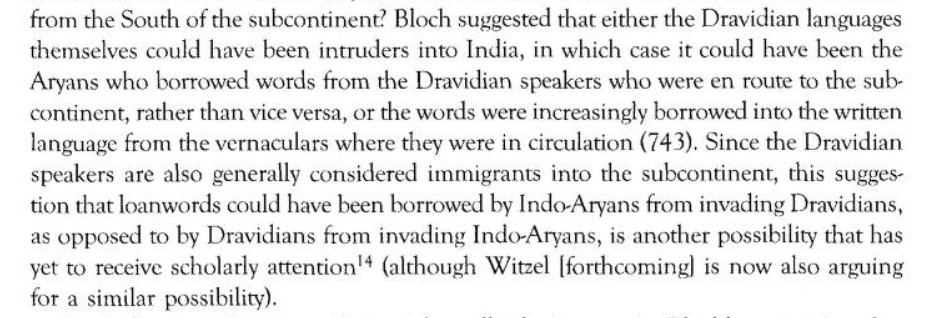
Bloch also says that Dravidian borrowings by individual Brahmans in classical Sanskrit did not survive in Hindi, which shows that the Dravidian words were innovations, and the original terms must be Sanskrit.
Patanjali and Yaska give no indication of borrowed words. When it comes to borrowings, Sanskrit is always the lender, Dravidian is always the borrower.
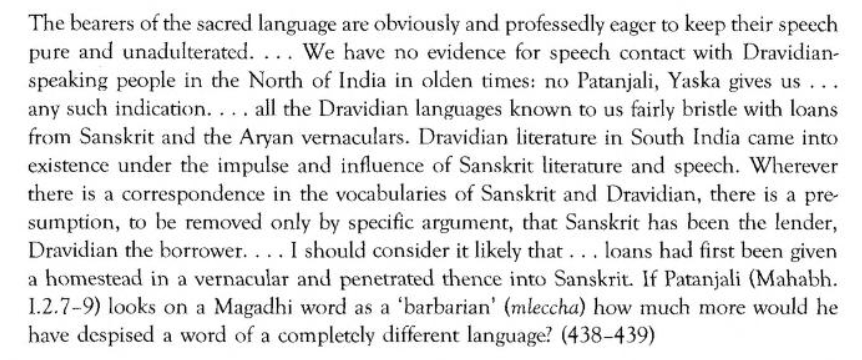
Early Greek and Chinese visitors do not mention a subjugated population that speaks a different language,
In other words:
There is no attestation of non-IA languages in North India, no attestation of subjugation, no invader/invaded dynamic.
In other words:
There is no attestation of non-IA languages in North India, no attestation of subjugation, no invader/invaded dynamic.
Loading suggestions...