

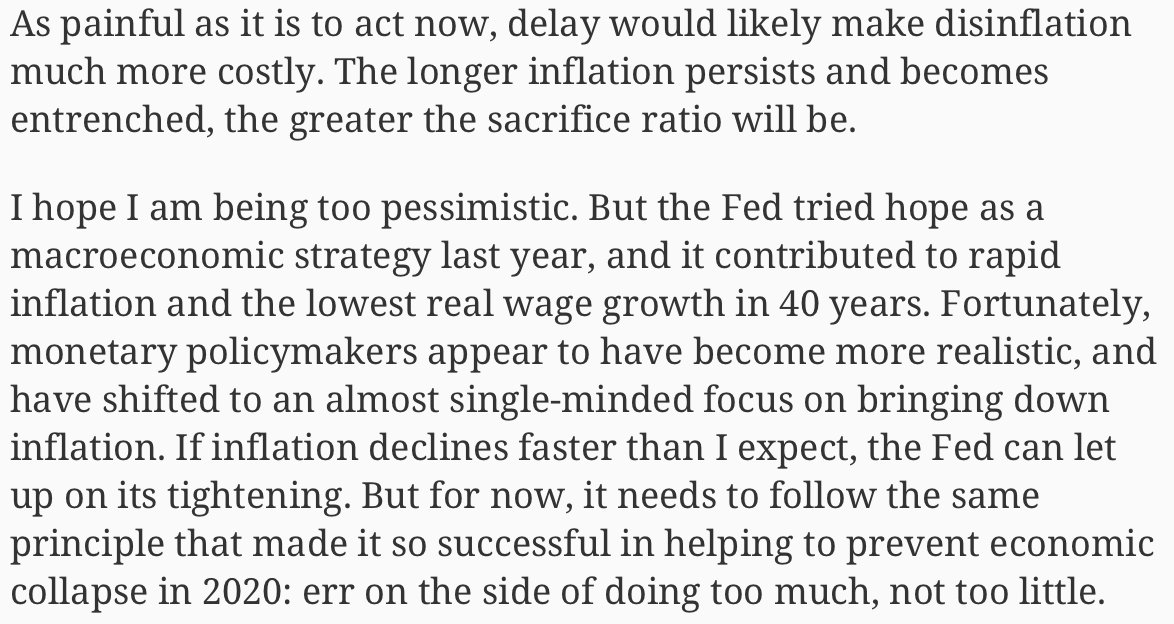
My latest @ProSyn tries to make sense of the last data & Fed actions. My conclusion: the Fed needs to follow the same principle that made it so successful in helping to prevent economic collapse in 2020: err on the side of doing too much, not too little.
project-syndicate.org
project-syndicate.org
It is tempting--and I succumb to this myself sometimes--to describe the world as we would like it to be not as it actually is.
Unfortunately right now it is clear that underlying PCE inflation is at least 4%, likely much higher, and it is easier to see it rising from there.
Unfortunately right now it is clear that underlying PCE inflation is at least 4%, likely much higher, and it is easier to see it rising from there.
So far this year core PCE inflation has been a 4.8% annual rate. You could take out some for transitory/volatility. But you also want to add because recent inflation rates have been even higher.
Wage growth is also consistent with 4.5% PCE inflation or even higher. Again, I would love it if employers would just eat the wage growth and not pass it along to prices. But is silly to ignore clear theory and historical evidence to make policy based on this hope.
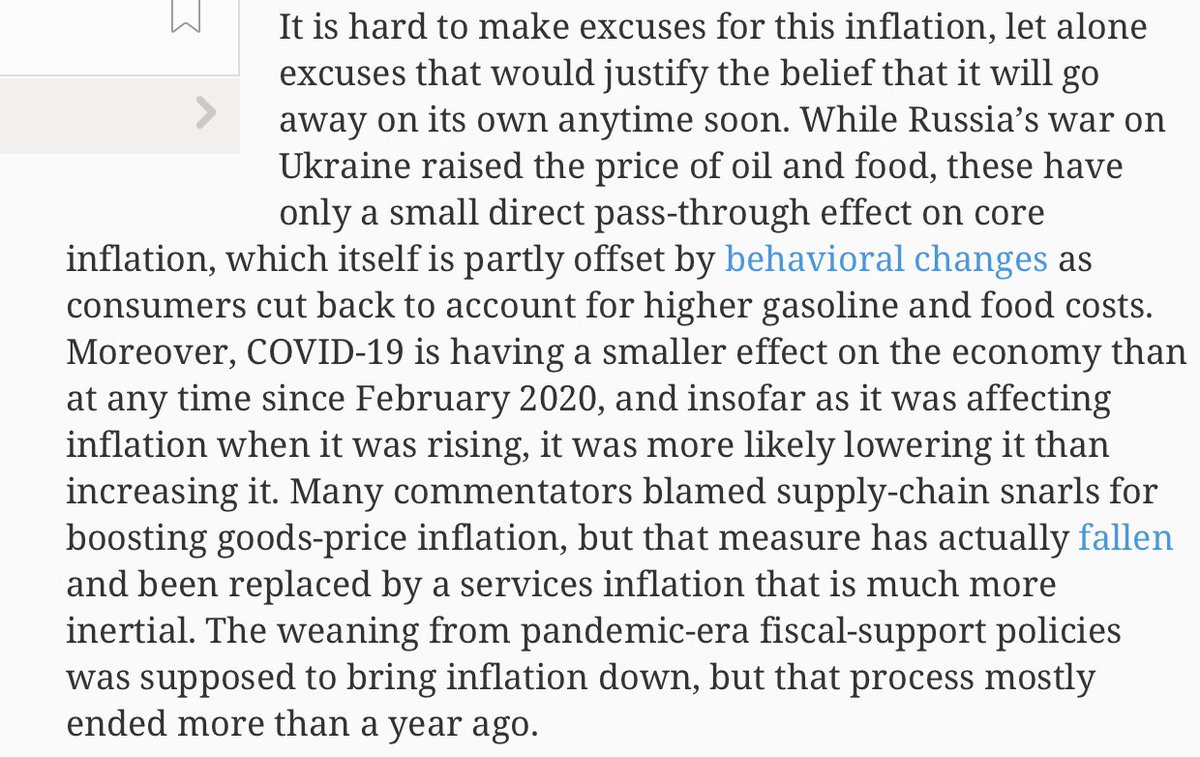
A lot of the excuses for inflation (supply chain, pandemic, war) really don't apply to this underlying inflation rate. Nor do they give much reason to expect it to decline.
It might be possible for wage and price growth (or even better, just price growth) to slow on their own. But again, hard to make that the best guess.
At least some demand reduction is needed.
At least some demand reduction is needed.
I don't know how much and the Fed doesn't actually pick an unemployment rate so silly debating what it will *need* to be. But it could be high. We might get lucky with the Fed's nonlinear hopes. If so an inflation eases great, should adjust accordingly.
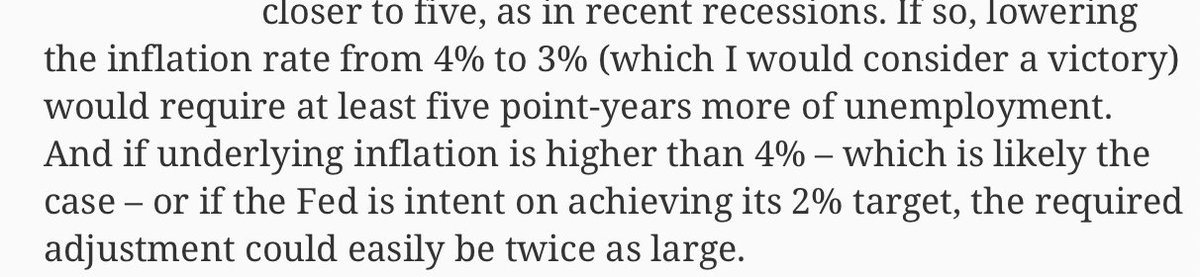
But in recent decades the sacrifice ratio has been ~5, meaning 5 point-years of unemployment to lower inflation by 1 point.
Optimistically inflation is 4, I think it only needs to get to 3, that could be pretty tough. And if inflation is higher or want to get to 2 even worse.
Optimistically inflation is 4, I think it only needs to get to 3, that could be pretty tough. And if inflation is higher or want to get to 2 even worse.
In addition to a best guess one needs a risk analysis. What is the cost of doing too much? What is the cost of doing too little? Both are bad.
But, the least painful inflation reduction is when the Fed has credibility and expectations more anchored. More now means less later.
But, the least painful inflation reduction is when the Fed has credibility and expectations more anchored. More now means less later.
Here's the full piece. project-syndicate.org
Loading suggestions...