

A Brief Thread on this Ḥadīth often used to misrepresent Islām.
Let's 1st look at the yellow highlighted text. There are several opinions on the meaning:
1. It can mean to fight a specific group (ibn Ḥajr).
2. Fight those at war with you (ibn Taymiyyah).
1/5
Let's 1st look at the yellow highlighted text. There are several opinions on the meaning:
1. It can mean to fight a specific group (ibn Ḥajr).
2. Fight those at war with you (ibn Taymiyyah).
1/5
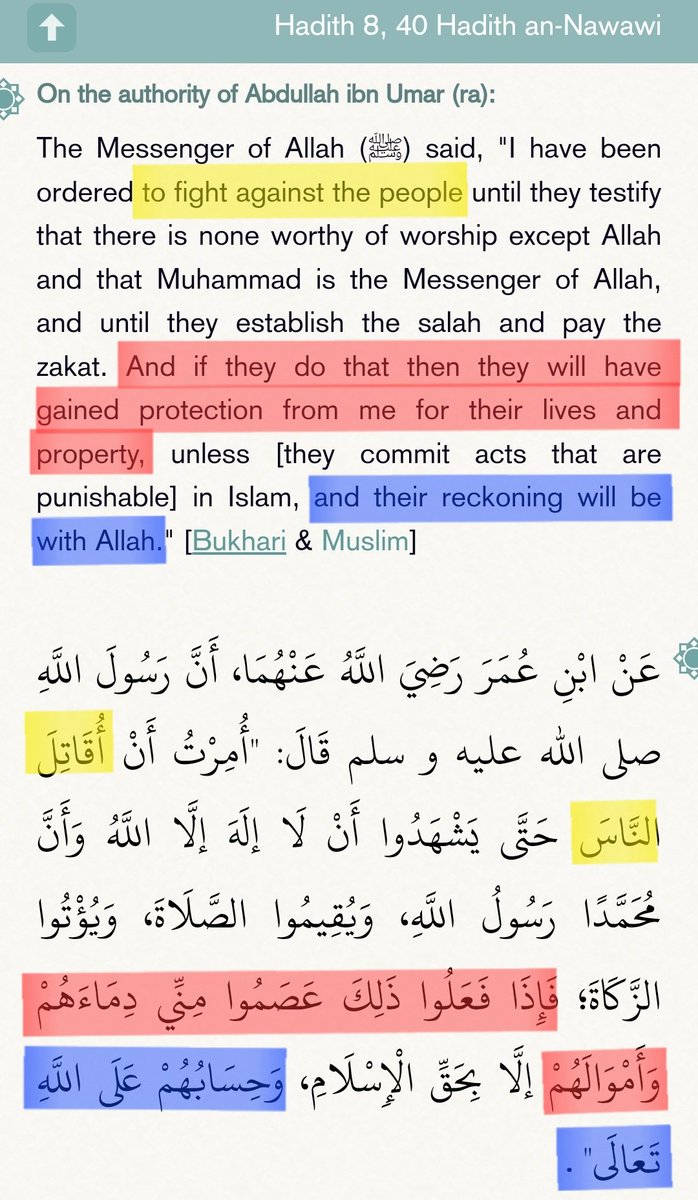
Both opinions #1 & #2 are via the permission of the Ḥākim (ruler or governing authority), not on an individual basis or by a group's discretion.
3. To *strive* against the people.
This encompasses #1 & #2, & includes doing daʿwah, giving ṣadaqah. I hold to this view.
2/5
3. To *strive* against the people.
This encompasses #1 & #2, & includes doing daʿwah, giving ṣadaqah. I hold to this view.
2/5
The third view (#3) gives a sequence:
1st ʾĪmān (belief in Allāh & His Messenger)
2nd Ṣalāh
3rd Zakāt
This striving includes teaching, encouraging, praying with each other, building communities, paying the required charity (zakāt).
Only the living do these.
3/5
1st ʾĪmān (belief in Allāh & His Messenger)
2nd Ṣalāh
3rd Zakāt
This striving includes teaching, encouraging, praying with each other, building communities, paying the required charity (zakāt).
Only the living do these.
3/5
Next, the text in red.
Should a non-Muslim look at the text in yellow & claim that it means to kill everyone who does not believe in Islām, this is contradicted by the text in red.
After all, if everyone is killed, how can they believe or their lives be protected?
4/5
Should a non-Muslim look at the text in yellow & claim that it means to kill everyone who does not believe in Islām, this is contradicted by the text in red.
After all, if everyone is killed, how can they believe or their lives be protected?
4/5
Finally, the text in blue.
The judgement of the people is ultimately done by Allāh.
None of us can know what is in the heart of the other, nor what a person truly believes or intends.
If we deliver the message & it's rejected, we have done our jobs. Leave it to Allāh.
5/5
The judgement of the people is ultimately done by Allāh.
None of us can know what is in the heart of the other, nor what a person truly believes or intends.
If we deliver the message & it's rejected, we have done our jobs. Leave it to Allāh.
5/5
Loading suggestions...