

1/
Get a cup of coffee.
In this thread, I'll help you understand how the TIMING of Cash Flows within a business can have a BIG impact on the returns that shareholders get from owning the business.
Get a cup of coffee.
In this thread, I'll help you understand how the TIMING of Cash Flows within a business can have a BIG impact on the returns that shareholders get from owning the business.

2/
Imagine a big, highly sought after, university.
There are many departments in this university. They are spread out across a large and lovely campus.
5000 students study in this campus. Many of them stay in dorm rooms. Some of these dorm rooms even have windows.
Imagine a big, highly sought after, university.
There are many departments in this university. They are spread out across a large and lovely campus.
5000 students study in this campus. Many of them stay in dorm rooms. Some of these dorm rooms even have windows.

3/
There's only ONE bookstore on campus.
EVERY semester, ALL 5000 students buy their textbooks from this bookstore.
And luckily for us, we OWN this bookstore.
There's only ONE bookstore on campus.
EVERY semester, ALL 5000 students buy their textbooks from this bookstore.
And luckily for us, we OWN this bookstore.

4/
Our business is simple.
Just before each semester starts, we buy a bunch of textbooks -- in physics, engineering, architecture, law, etc. -- from various publishers.
And during the semester, we sell those textbooks to our 5000 students at a decent profit.
Our business is simple.
Just before each semester starts, we buy a bunch of textbooks -- in physics, engineering, architecture, law, etc. -- from various publishers.
And during the semester, we sell those textbooks to our 5000 students at a decent profit.
5/
Let's say each student takes 4 courses per semester.
That's 4 textbooks they buy from us.
So, we sell (5000 students) * (4 textbooks per student per semester) = 20,000 textbooks per semester.
Let's say each student takes 4 courses per semester.
That's 4 textbooks they buy from us.
So, we sell (5000 students) * (4 textbooks per student per semester) = 20,000 textbooks per semester.
6/
Suppose we buy each textbook for $80 and sell it for $100.
That nets us $100 - $80 = $20 of PROFIT per textbook.
And as we sell 20,000 of these textbooks per semester, we make (20,000 textbooks per semester) * ($20 per textbook) = $400K of profit per semester.
Neat!
Suppose we buy each textbook for $80 and sell it for $100.
That nets us $100 - $80 = $20 of PROFIT per textbook.
And as we sell 20,000 of these textbooks per semester, we make (20,000 textbooks per semester) * ($20 per textbook) = $400K of profit per semester.
Neat!
7/
Now, of course, we'll have other costs: maintaining the store, paying our staff, paying taxes, etc.
But for this thread, let's ignore all that. They're tangential to the point I want to make.
So, let's just say our net income is $400K per semester.
Now, of course, we'll have other costs: maintaining the store, paying our staff, paying taxes, etc.
But for this thread, let's ignore all that. They're tangential to the point I want to make.
So, let's just say our net income is $400K per semester.
8/
Here's the question: what is our Return On Investment (ROI) from this store?
That is, how much cash do we have to PUT IN to run our store?
And once we PUT IN this cash, how much cash do we get to TAKE OUT every year from our store?
Here's the question: what is our Return On Investment (ROI) from this store?
That is, how much cash do we have to PUT IN to run our store?
And once we PUT IN this cash, how much cash do we get to TAKE OUT every year from our store?
9/
Well, at the start of every semester, we need to buy 20,000 textbooks at $80 apiece to stock our store.
That'll require (20,000 textbooks) * ($80 per textbook) = $1.6M of CASH from us.
Once we PUT IN this $1.6M, we get to TAKE OUT $400K per semester in profits.
Well, at the start of every semester, we need to buy 20,000 textbooks at $80 apiece to stock our store.
That'll require (20,000 textbooks) * ($80 per textbook) = $1.6M of CASH from us.
Once we PUT IN this $1.6M, we get to TAKE OUT $400K per semester in profits.
10/
Let's say there are 2 semesters per year.
So, we get to TAKE OUT (2 semesters per year) * ($400K per semester) = $800K per year -- EVERY year -- for a ONE TIME investment of $1.6M.
That's an ROI of ($800K cash OUT) / ($1.6M cash IN) = about 50% per year.
Not bad!
Let's say there are 2 semesters per year.
So, we get to TAKE OUT (2 semesters per year) * ($400K per semester) = $800K per year -- EVERY year -- for a ONE TIME investment of $1.6M.
That's an ROI of ($800K cash OUT) / ($1.6M cash IN) = about 50% per year.
Not bad!
11/
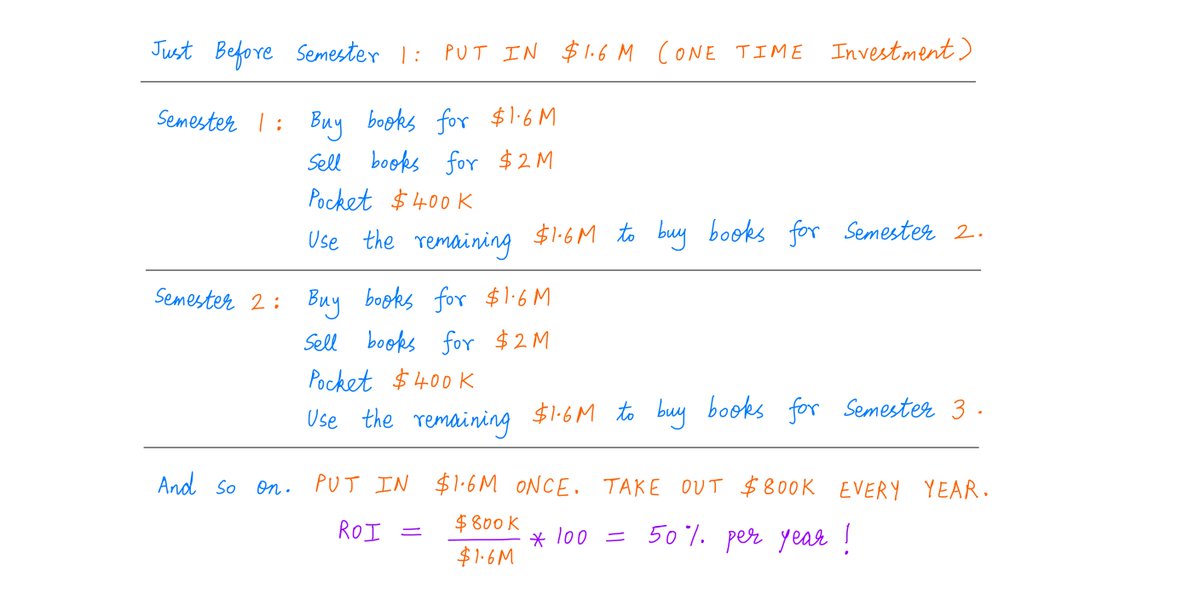
Why do I call this $1.6M a ONE TIME investment?
Isn't it required EVERY semester?
No. Because each semester, we RECYCLE the cash collected from students (minus our profits, which we pocket), and use this cash to buy books for the next semester.
Like so:
Why do I call this $1.6M a ONE TIME investment?
Isn't it required EVERY semester?
No. Because each semester, we RECYCLE the cash collected from students (minus our profits, which we pocket), and use this cash to buy books for the next semester.
Like so:
12/
Now, 50% per year is a terrific return.
But to *make* this return, we need to PUT IN $1.6M of cash upfront.
That's a rather steep commitment.
We may not have that kind of cash lying around.
Now, 50% per year is a terrific return.
But to *make* this return, we need to PUT IN $1.6M of cash upfront.
That's a rather steep commitment.
We may not have that kind of cash lying around.
13/
Here's one way we can get around that.
We go to the publishers who supply our textbooks. And we tell them:
Could you give us $1.6M worth of textbooks ON CREDIT? We'll sell those textbooks to our 5000 students. And as soon as they pay us, we'll pay you.
Here's one way we can get around that.
We go to the publishers who supply our textbooks. And we tell them:
Could you give us $1.6M worth of textbooks ON CREDIT? We'll sell those textbooks to our 5000 students. And as soon as they pay us, we'll pay you.
14/
Suppose our publishers agree to this.
After all, most textbooks get sold within 1 or 2 weeks of the semester starting.
So, the publishers probably won't have to wait very long before getting paid. They may be OK with that.
Suppose our publishers agree to this.
After all, most textbooks get sold within 1 or 2 weeks of the semester starting.
So, the publishers probably won't have to wait very long before getting paid. They may be OK with that.
15/
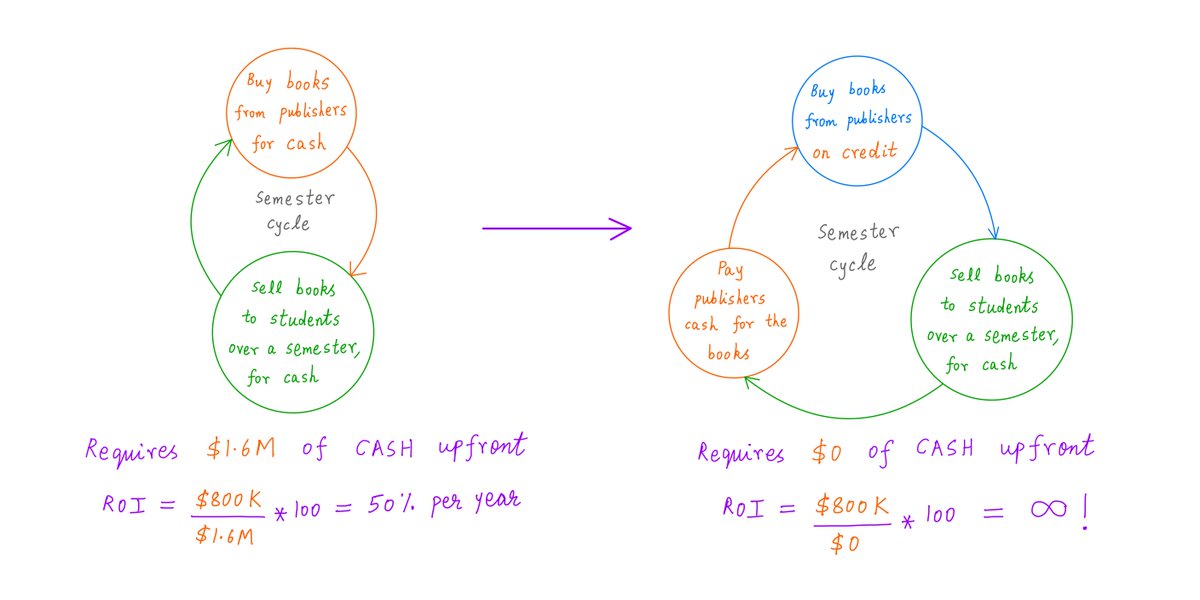
So, all we've done is change the TIMING of our cash flows.
Previously, we used to PAY cash UPFRONT to buy books and THEN COLLECT cash, as we sell those books.
Now, we FIRST COLLECT cash from our customers, and ONLY THEN PAY our suppliers -- after pocketing a profit.
So, all we've done is change the TIMING of our cash flows.
Previously, we used to PAY cash UPFRONT to buy books and THEN COLLECT cash, as we sell those books.
Now, we FIRST COLLECT cash from our customers, and ONLY THEN PAY our suppliers -- after pocketing a profit.
16/
But what a difference this change in TIMING makes!
Previously, our business required us to PUT IN $1.6M of cash upfront.
Now, we require $0.
And still, we get to TAKE OUT the SAME $800K in profits per year.
That's an ROI of INFINITY!
But what a difference this change in TIMING makes!
Previously, our business required us to PUT IN $1.6M of cash upfront.
Now, we require $0.
And still, we get to TAKE OUT the SAME $800K in profits per year.
That's an ROI of INFINITY!
17/
That's the power of TIMING our cash flows well.
The SOONER we get to COLLECT cash from customers,
And the LATER we get to pay our suppliers,
The LESS capital our business will need US to put up,
And the HIGHER our returns will be from owning the business.
That's the power of TIMING our cash flows well.
The SOONER we get to COLLECT cash from customers,
And the LATER we get to pay our suppliers,
The LESS capital our business will need US to put up,
And the HIGHER our returns will be from owning the business.
18/
And this is EVEN MORE powerful in GROWING businesses.
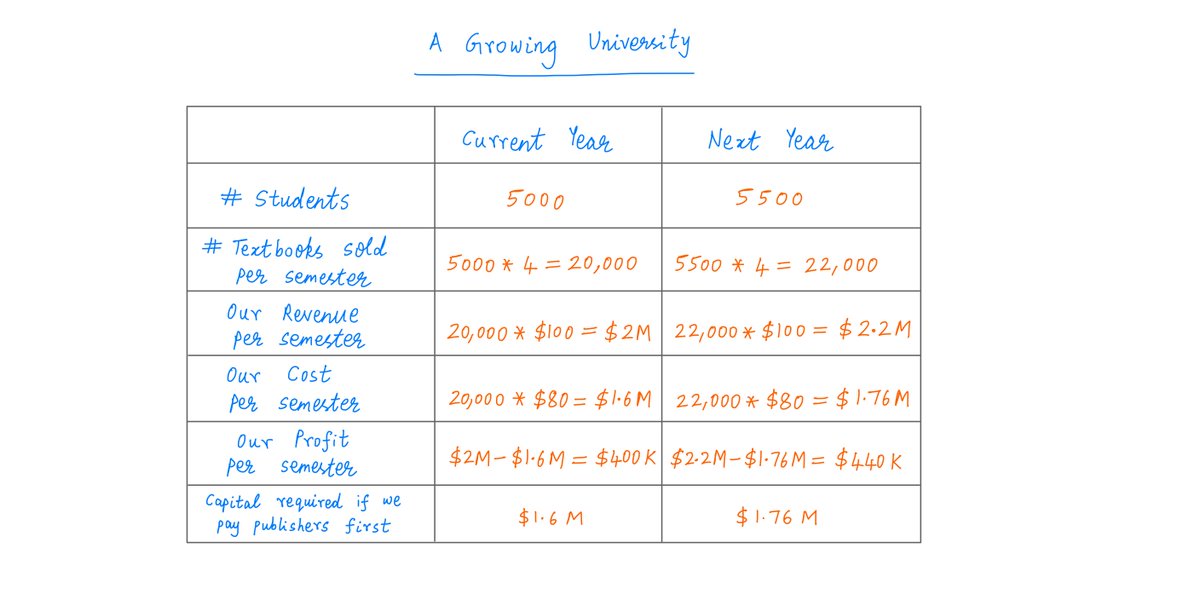
For example, suppose our university decides to admit 500 MORE students next year.
That's 10% more students on campus.
Which will translate to 10% higher revenues and profits for us:
And this is EVEN MORE powerful in GROWING businesses.
For example, suppose our university decides to admit 500 MORE students next year.
That's 10% more students on campus.
Which will translate to 10% higher revenues and profits for us:
19/
But this GROWTH comes at a price:
10% more CASH is needed upfront -- IF we follow the "PAY suppliers FIRST, THEN COLLECT cash from customers" model.
That is, we'll need to put up an EXTRA 10% of $1.6M = $160K of cash -- to buy 10% more books at the start of next year.
But this GROWTH comes at a price:
10% more CASH is needed upfront -- IF we follow the "PAY suppliers FIRST, THEN COLLECT cash from customers" model.
That is, we'll need to put up an EXTRA 10% of $1.6M = $160K of cash -- to buy 10% more books at the start of next year.
20/
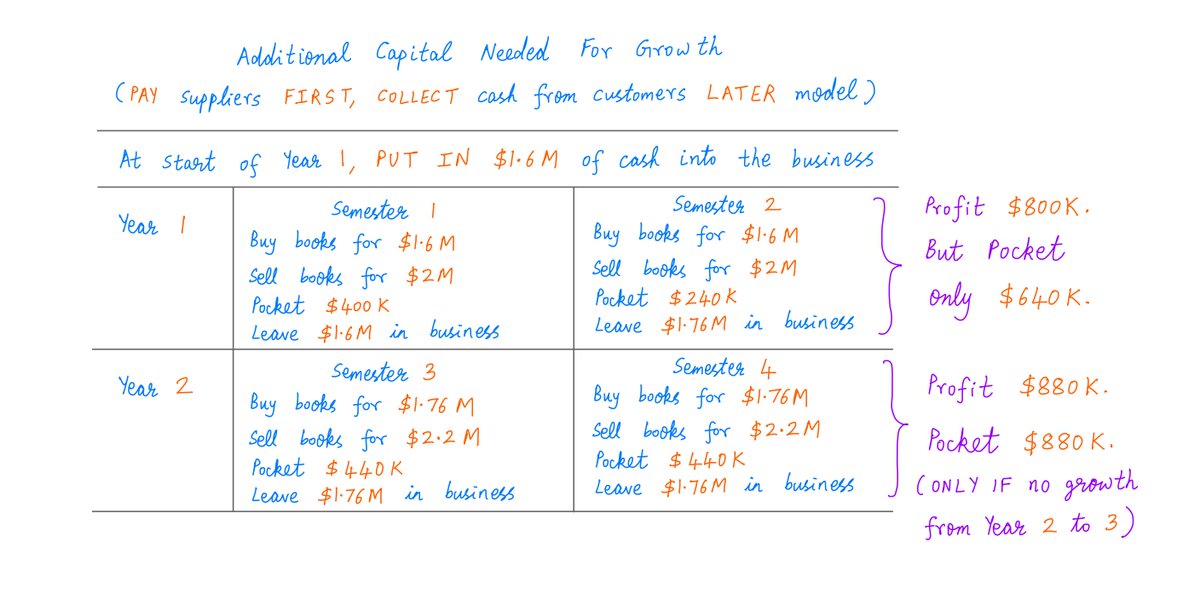
This extra $160K has to come from *this* year's profits.
That is, we WON'T be able to pocket ALL of our $800K of profits this year. $160K of that will have to go right back into our business -- to GROW it next year.
So, we can only TAKE OUT $800K - $160K = $640K this year.
This extra $160K has to come from *this* year's profits.
That is, we WON'T be able to pocket ALL of our $800K of profits this year. $160K of that will have to go right back into our business -- to GROW it next year.
So, we can only TAKE OUT $800K - $160K = $640K this year.
21/
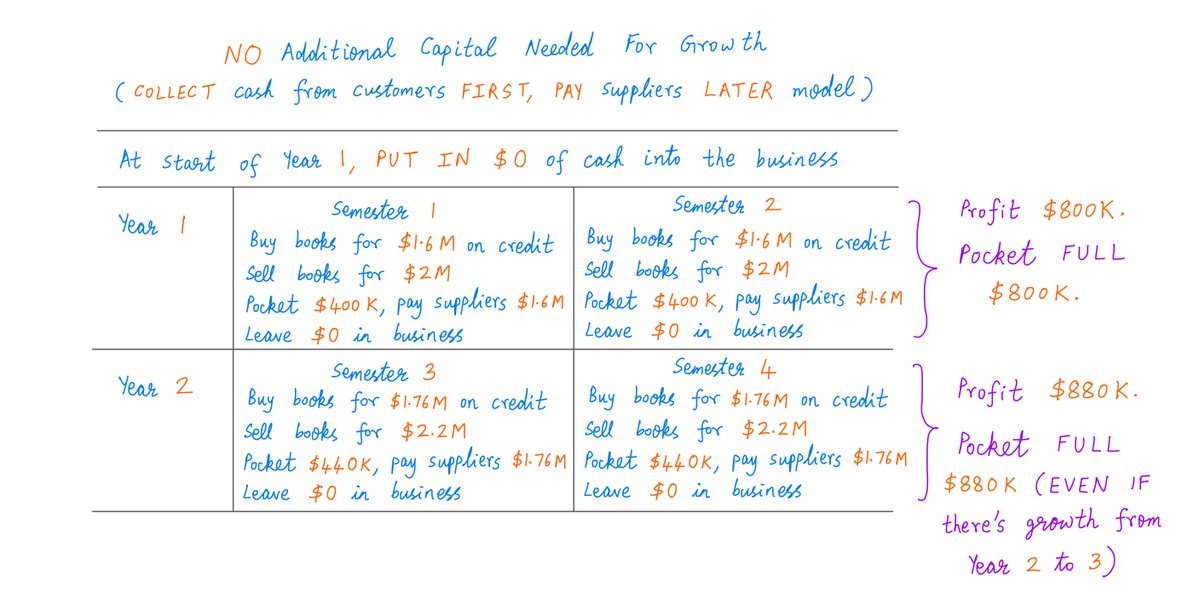
By contrast, IF we time our cash flows well and follow the "COLLECT cash from customers FIRST, THEN PAY suppliers" model, our growth comes for free!
We WON'T need to put up ANY additional cash.
And we get to TAKE OUT ALL of our profits -- this year, and all future years!
By contrast, IF we time our cash flows well and follow the "COLLECT cash from customers FIRST, THEN PAY suppliers" model, our growth comes for free!
We WON'T need to put up ANY additional cash.
And we get to TAKE OUT ALL of our profits -- this year, and all future years!
22/
So, TIMING our cash flows well gets us the following benefits:
1) We PUT IN less cash upfront,
2) We TAKE OUT more of our profits as cash,
3) And we may get GROWTH for FREE!
Businesses with these traits tend to produce extraordinary results for their owners over time.
So, TIMING our cash flows well gets us the following benefits:
1) We PUT IN less cash upfront,
2) We TAKE OUT more of our profits as cash,
3) And we may get GROWTH for FREE!
Businesses with these traits tend to produce extraordinary results for their owners over time.
23/
So, what real life businesses have these characteristics?
I'll give you 3 examples.
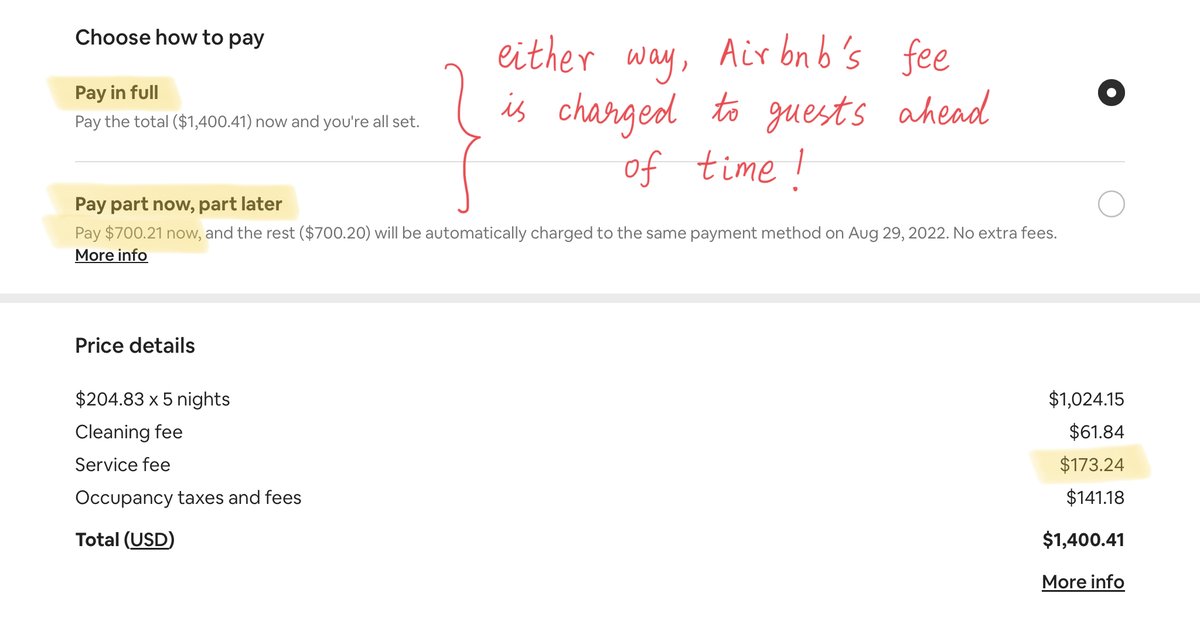
Example 1: Airbnb.
They charge guests and pocket cash upfront -- at the time of booking. They only pay hosts after check-in, which is usually months later.
So, what real life businesses have these characteristics?
I'll give you 3 examples.
Example 1: Airbnb.
They charge guests and pocket cash upfront -- at the time of booking. They only pay hosts after check-in, which is usually months later.
24/
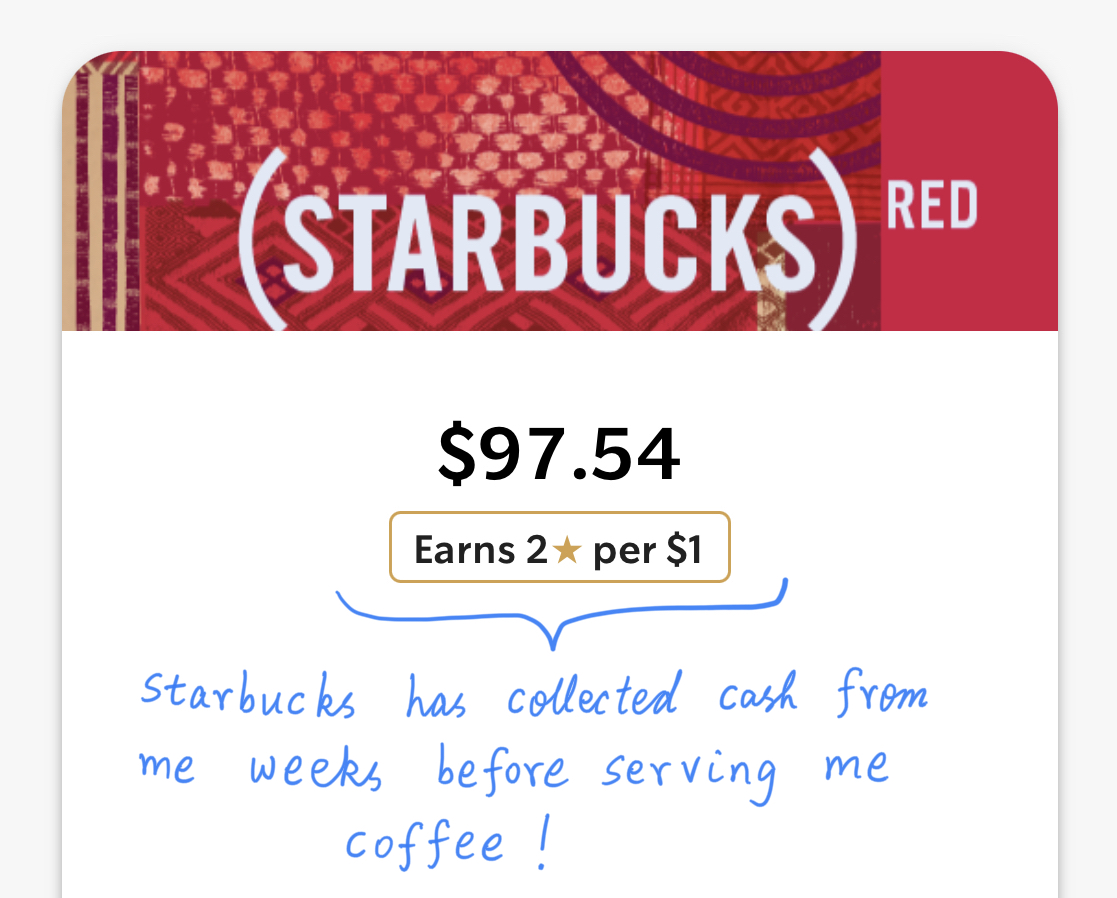
Example 2: Starbucks.
They have millions of Rewards members who give them cash ahead of time, and redeem it for coffee only weeks/months later -- and sometimes never.
Example 2: Starbucks.
They have millions of Rewards members who give them cash ahead of time, and redeem it for coffee only weeks/months later -- and sometimes never.
25/
Example 3: AutoZone
They are a retailer of auto parts in the US.
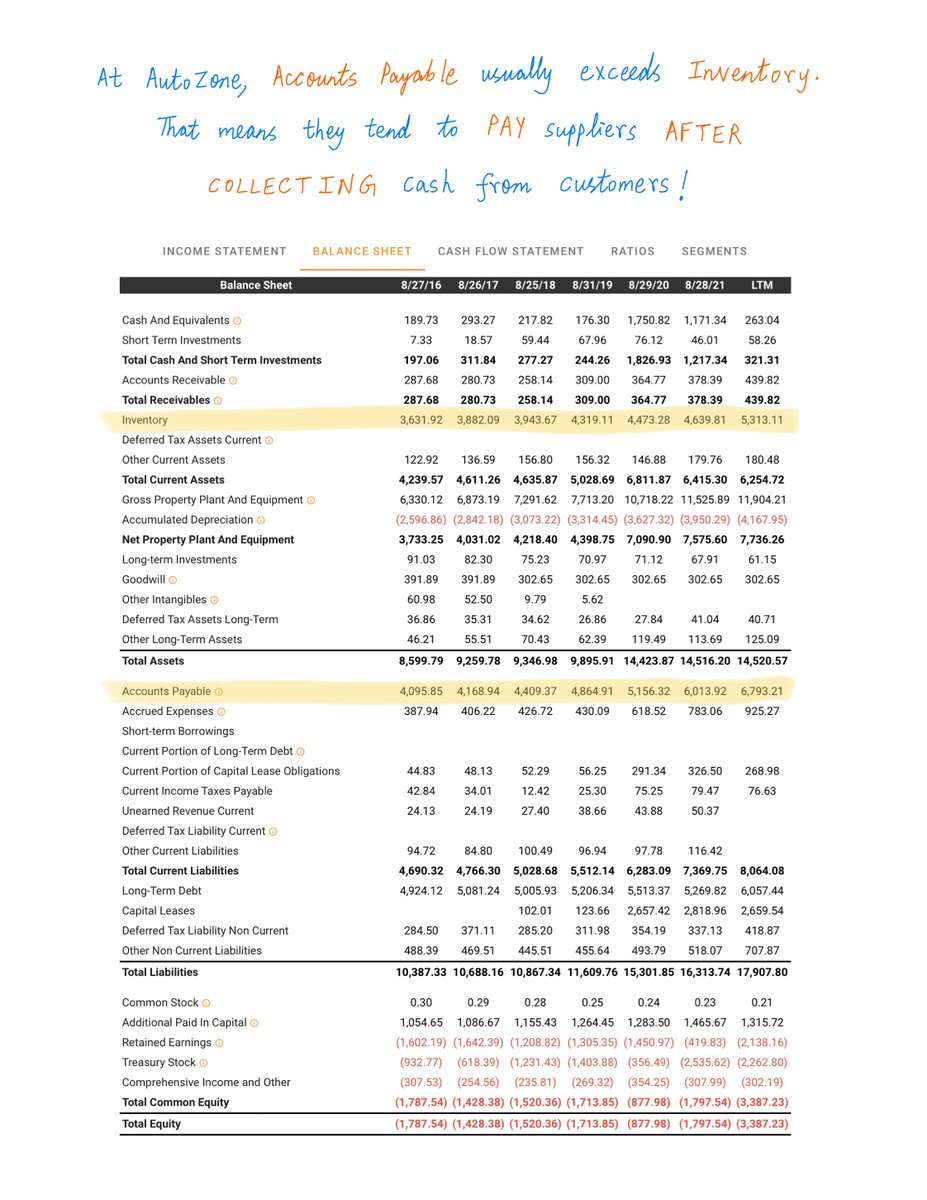
Typically, they buy these parts from suppliers on credit.
And they pay these suppliers only AFTER selling the parts -- at a nice profit margin! -- to customers and collecting cash from them.
Example 3: AutoZone
They are a retailer of auto parts in the US.
Typically, they buy these parts from suppliers on credit.
And they pay these suppliers only AFTER selling the parts -- at a nice profit margin! -- to customers and collecting cash from them.
26/
But note this caveat:
Trying to time cash flows "just right" can be RISKY.
For example, if we buy stuff from suppliers on credit, and aren't able to sell enough of it in time, we may find ourselves on the hook for cash we don't have.
Some "fat" in the system may be good.
But note this caveat:
Trying to time cash flows "just right" can be RISKY.
For example, if we buy stuff from suppliers on credit, and aren't able to sell enough of it in time, we may find ourselves on the hook for cash we don't have.
Some "fat" in the system may be good.
27/
If you liked this thread, please consider joining the course I'm teaching with Ali Ladha (@AliTheCFO).
In this course, we'll go over many more qualities that wonderful businesses tend to exhibit, and how they show up in the financial statements.
10kdiver.com
If you liked this thread, please consider joining the course I'm teaching with Ali Ladha (@AliTheCFO).
In this course, we'll go over many more qualities that wonderful businesses tend to exhibit, and how they show up in the financial statements.
10kdiver.com
28/
Thank you very much for reading all the way to the end.
I hope this thread showed you the importance of going beyond reported earnings -- to also study how CASH moves IN and OUT of a business.
Have a great weekend!
/End
Thank you very much for reading all the way to the end.
I hope this thread showed you the importance of going beyond reported earnings -- to also study how CASH moves IN and OUT of a business.
Have a great weekend!
/End
Loading suggestions...