
What is Bretton Woods?
Talk of the BRICS nations creating a new reserve currency introduced the idea of "Bretton Woods 3.0".
Before tackling 3.0, it's helpful to understand the original agreement.
🧵 A thread that breaks down Bretton Woods in easy to understand terms.
Talk of the BRICS nations creating a new reserve currency introduced the idea of "Bretton Woods 3.0".
Before tackling 3.0, it's helpful to understand the original agreement.
🧵 A thread that breaks down Bretton Woods in easy to understand terms.
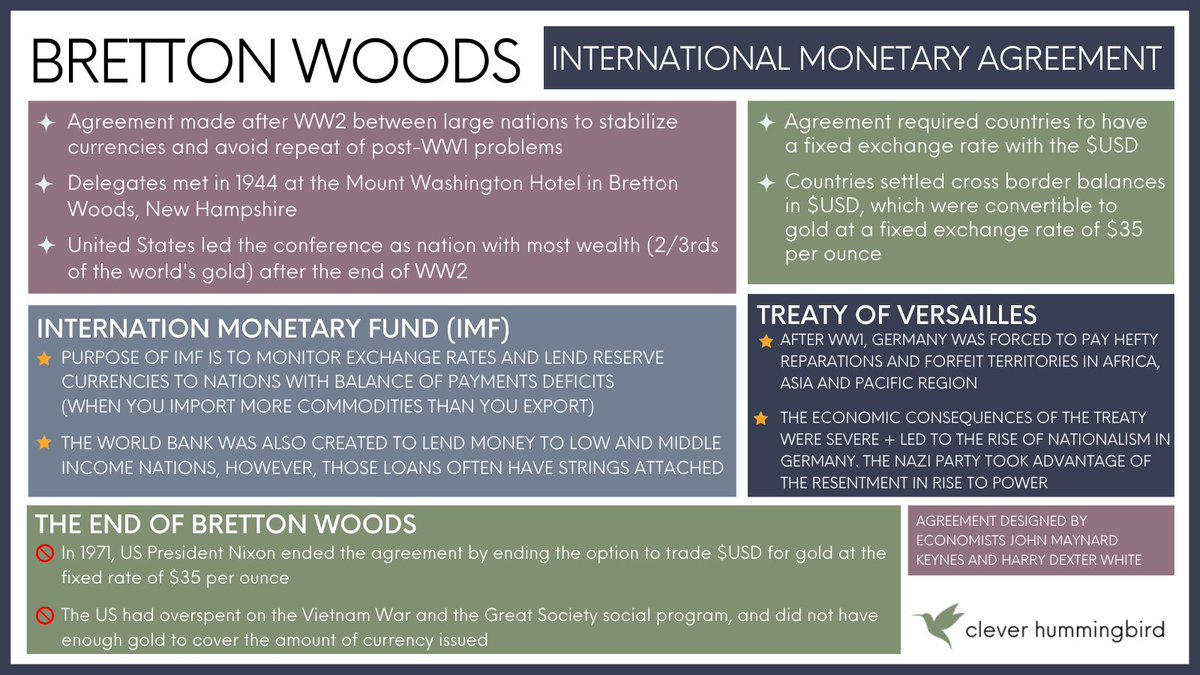
1. After WW1, the Treaty of Versailles had harsh consequences for Germany.
Regardless of whether or not they were fair, the penalties led to economic hardship (high inflation + poverty) and resentment among the German people.
Regardless of whether or not they were fair, the penalties led to economic hardship (high inflation + poverty) and resentment among the German people.
2. As a result, German nationalism grew, and the Nazi party (under Hitler) took advantage of that anger in their rise to power.
World leaders, after WW2, didn't want to make the same mistake & created an agreement to foster financial prosperity among the western nations + Japan
World leaders, after WW2, didn't want to make the same mistake & created an agreement to foster financial prosperity among the western nations + Japan
3. The United States had the most wealth at the end of the war, owning two-thirds of the world's gold supply, and was in a position of power to dictate the terms of the agreement.
The agreement set the USDr as the reserve currency, and all global trade would be transacted in USD
The agreement set the USDr as the reserve currency, and all global trade would be transacted in USD
4. Any nation holding dollars could redeem those for gold at a fixed rate of $35/oz.
Exchange rates between those various nation's currencies, and the dollar, was fixed.
In return, the US opened its large market to exports from overseas which helped them recover financially.
Exchange rates between those various nation's currencies, and the dollar, was fixed.
In return, the US opened its large market to exports from overseas which helped them recover financially.
5. This was the birth of a global economy where products were shipped from producing counties to consuming countries (primarily to the US due its size and wealth).
The US also agreed to protect the global trade system via its strong military, specifically the US Navy.
The US also agreed to protect the global trade system via its strong military, specifically the US Navy.
6. Most trade is conducted by ship and the Navy ensures safe passage.
However, the US racked up a lot of expenses in the 1960s through the Vietnam War, and LBJ's Great Society social program.
Other countries that held US dollars caught wind of this.
However, the US racked up a lot of expenses in the 1960s through the Vietnam War, and LBJ's Great Society social program.
Other countries that held US dollars caught wind of this.
7. In 1971 France sent a large ship to the US to exchange their dollars for gold.
Knowing that the US did not have enough gold to cover the amount of US Dollars in circulation, Nixon ended the agreement.
Knowing that the US did not have enough gold to cover the amount of US Dollars in circulation, Nixon ended the agreement.
8. It was announced as temporary, but the US never returned to a system where dollars could be redeemed for gold.
Therefore, in 1971, the original Bretton Woods Agreement (1.0) ended.
Therefore, in 1971, the original Bretton Woods Agreement (1.0) ended.
9. A new agreement took its place that is the current system using fiat dollars, with variable exchange rates between countries
(sometimes referred to as Bretton Woods 2.0)
If you found this thread helpful, please follow me and retweet to share with others.🙏
(sometimes referred to as Bretton Woods 2.0)
If you found this thread helpful, please follow me and retweet to share with others.🙏
Loading suggestions...