
Politics
Economy
Economics
Trade
Asia
Currency
Crisis
Inflation
Energy crisis
Trade Deficit
Bangladesh

Is Bangladesh in trouble?
Just a couple years back, there was news of Bangladesh overtaking India in Nominal GDP per capita and now Bangladesh is facing a severe economic crisis with a record high trade deficit.
How did Asia's rising star reach this situation?
A 🧵
Just a couple years back, there was news of Bangladesh overtaking India in Nominal GDP per capita and now Bangladesh is facing a severe economic crisis with a record high trade deficit.
How did Asia's rising star reach this situation?
A 🧵
Despite the government's claims, the country's forex reserves are shrinking, the trade deficit is growing, inflation is at record highs, and the local currency is seeing huge daily depreciation and an intense energy crisis.
According to Dhaka-based Business Standard, production is down by 40-50% in ceramics, 30% in steel mills and 5-10% in readymade garments. One to two hours of scheduled power cuts have become a routine.
How did we get here?
How did we get here?
However, there 5 main areas of concern in the economy
• High Borrowings
• High cost of infrastructure projects, often described as “mega projects”
• Crisis in the banking sector due to widespread default of loans
• Waste of resources in the energy sector
• Capital flight
• High Borrowings
• High cost of infrastructure projects, often described as “mega projects”
• Crisis in the banking sector due to widespread default of loans
• Waste of resources in the energy sector
• Capital flight
High Borrowing
Despite claims of robust economic growth, the government has been taking many loans in recent years. Bangladesh borrowed >$1.7 billion from multilateral agencies and>$3 billion from development partners as budget support to combat the pandemic.
Despite claims of robust economic growth, the government has been taking many loans in recent years. Bangladesh borrowed >$1.7 billion from multilateral agencies and>$3 billion from development partners as budget support to combat the pandemic.
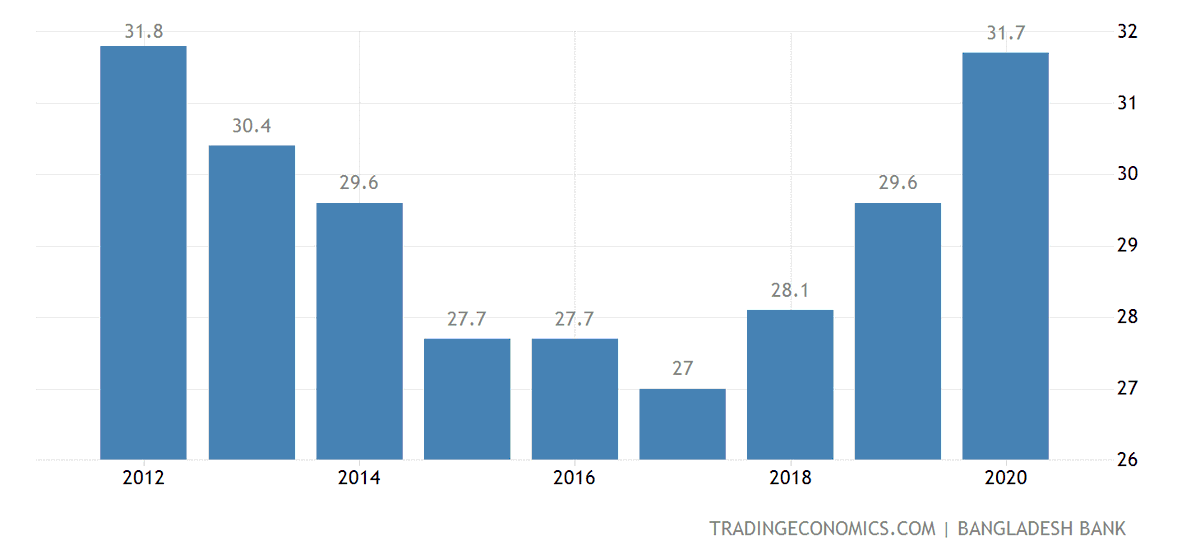
It also received $732 million from the IMF as a balance of payment support and $1.4 billion from the World Bank to implement the countrywide vaccination program. The Debt-GDP, which touched a 25-year low in 2017 at 27%, is back on the rise.
Unsustainable infrastructure spending
Since coming to power in 2009, the government has committed to several mega-projects like Padma Bridge, a nuclear power plant in Rooppur, Dhaka City Metro Rail, etc, which were funded by various countries & multilateral agencies.
Since coming to power in 2009, the government has committed to several mega-projects like Padma Bridge, a nuclear power plant in Rooppur, Dhaka City Metro Rail, etc, which were funded by various countries & multilateral agencies.
There has been a lot of cost overrun in these projects. Padma Bridge, one of the largest projects in the country, cost about $3.6 billion, estimated to be $1.16 billion in 2007.
Such overruns are very common and the main reason is overpricing of materials, corruption, and long delays.
China’s Belt and Road Initiative has been criticised heavily due to how unsustainable the costs are for the smaller countries.
China’s Belt and Road Initiative has been criticised heavily due to how unsustainable the costs are for the smaller countries.
In 2017, the World Bank noted that the cost of road construction in Bangladesh was the highest in the world. It costs $6.6 million to construct a 4 lane highway in Bangladesh.
For context, this costs
$1.1-1.3 million in India
$1.3-1.6 million in China
$3.5 million in Europe.
For context, this costs
$1.1-1.3 million in India
$1.3-1.6 million in China
$3.5 million in Europe.
The study is based on older data but highlights a critical issue.
Megaprojects are crucial for the long-term economic growth of a country, but time and cost overruns lead to a waste of taxpayers' money.
Megaprojects are crucial for the long-term economic growth of a country, but time and cost overruns lead to a waste of taxpayers' money.
Loan defaults and banking malpractice
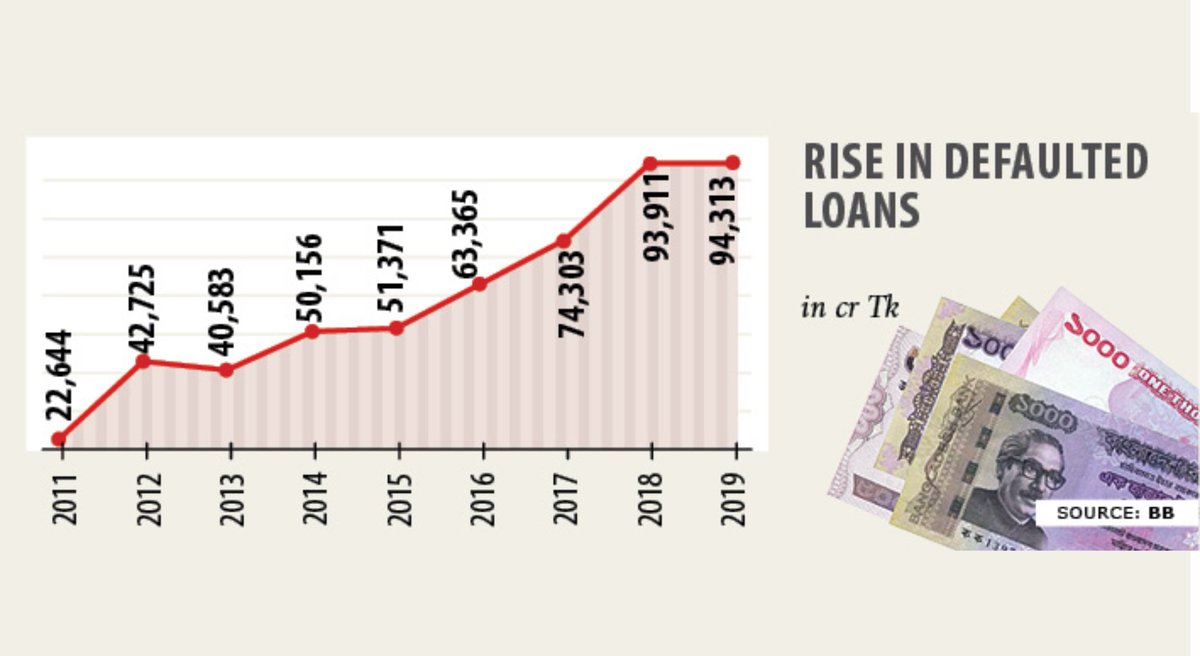
The banking sector of Bangladesh is crippled by large scams and non - performing loans.
Image source - Daily Star
The banking sector of Bangladesh is crippled by large scams and non - performing loans.
Image source - Daily Star
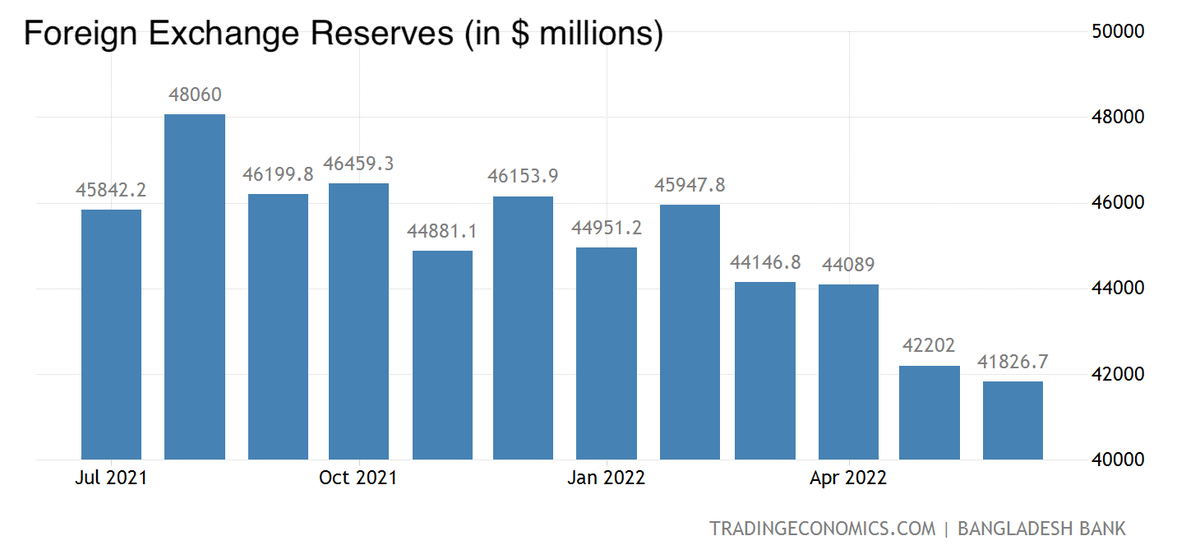
The Export Development Fund (EDF) was created in 1988 to encourage exports. As forex reserves swelled (up to $48 billion) during Covid, Bangladesh suddenly increased the size of the fund and widened the scope of the loan facility.
Commercial banks could borrow dollars from the EDF to give foreign currency loans. Borrowers would repay the loans in dollars from exports. But many of these loans ended up defaulting. Some politically influential business lobbies used this facility "to park assets abroad".
Such defaults have been happening for a long time. The government brushes these issues under the carpet by offering amnesty to the defaulting business groups. It regularises bad loans at a minimum cost, and they enjoy fresh borrowing facilities even after default.
This normalises non-creditworthy behaviour in the economy.
Another issue is misreporting of defaults. In 2019, the Central Bank claimed that total defaulted loans were $11.11 billion. However, the IMF disputed this, saying the actual amount is more than double.
Another issue is misreporting of defaults. In 2019, the Central Bank claimed that total defaulted loans were $11.11 billion. However, the IMF disputed this, saying the actual amount is more than double.
Why this discrepancy? Bad loans are being manipulated at a system level by simply changing the official definition of "bad loans".
Corruption in the power sector
In March 2022, the government celebrated its success in extending electricity coverage to the whole country. This, however, came at a huge cost.
In March 2022, the government celebrated its success in extending electricity coverage to the whole country. This, however, came at a huge cost.
The increase in electricity generation was mainly due to the establishment of Quick Rental Power Plants (QRPPs) in the private sector. These units installed in 2009 were meant to be temporary measures until a long-term solution was found, but they ended up sticking around.
In the past decade, the power sector received huge subsidies—between 2010 and 2021, the Power Development Board received $7.1 billion, while the Bangladesh Petroleum Corporation received $3 billion between 2010 and 2015.
Interestingly, these subsidies were paid to corporations even as the prices were being hiked for end consumers.
Furthermore, the capacity charge provisions included in the contracts force the government to pay these companies even if they don't provide any electricity. Twelve companies received $5.5 billion in the past decade as capacity charges.
Recently, the government has signed agreements with Adani electricity which would require Bangladesh to pay annually $423.29 million and $11.01 billion over twenty-five years as capacity for its energy supply.
Capital flight
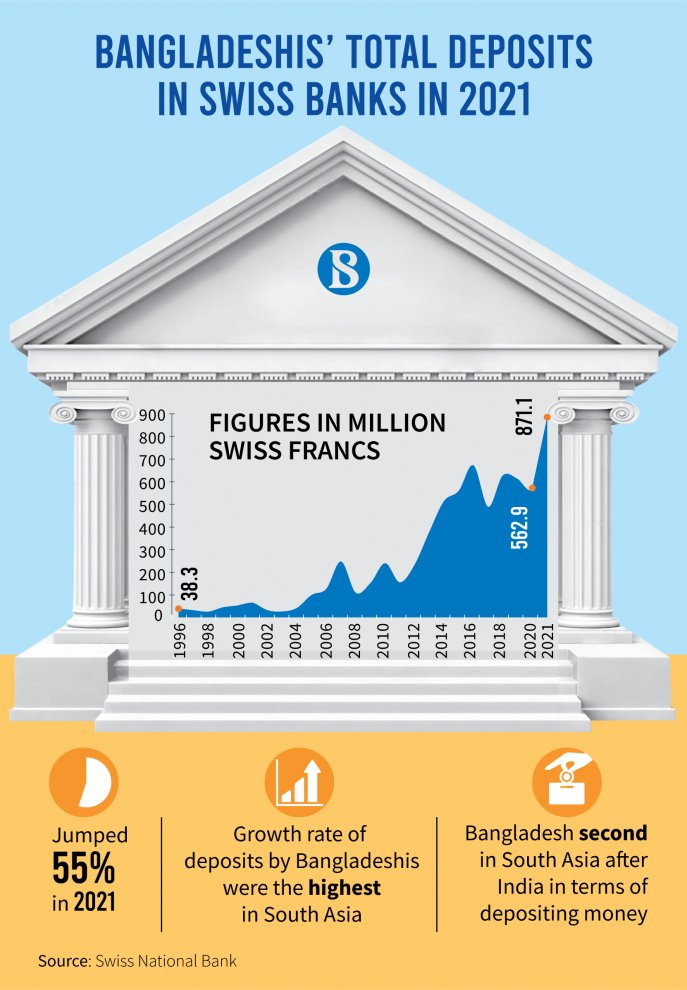
A small group of people amassed large sums of money due to corruption. Between 2009 and 2018, annually, $8.27 billion were siphoned by mis-invoicing the values of import-export goods.
A small group of people amassed large sums of money due to corruption. Between 2009 and 2018, annually, $8.27 billion were siphoned by mis-invoicing the values of import-export goods.
The growth of deposits by Bangladeshis in Swiss banks in the past decade also indicates capital flight. In 2021, it increased by 55.1%. (Image source - TBS News)
Final nail in the coffin
Garments contribute to 85% of the exports. Exports touched $52 billion in FY22 (July-June) due to huge post-Covid demand in the US and Europe.
But due to rampant inflation and the Russia-Ukraine War, demand for goods has dropped.
Garments contribute to 85% of the exports. Exports touched $52 billion in FY22 (July-June) due to huge post-Covid demand in the US and Europe.
But due to rampant inflation and the Russia-Ukraine War, demand for goods has dropped.
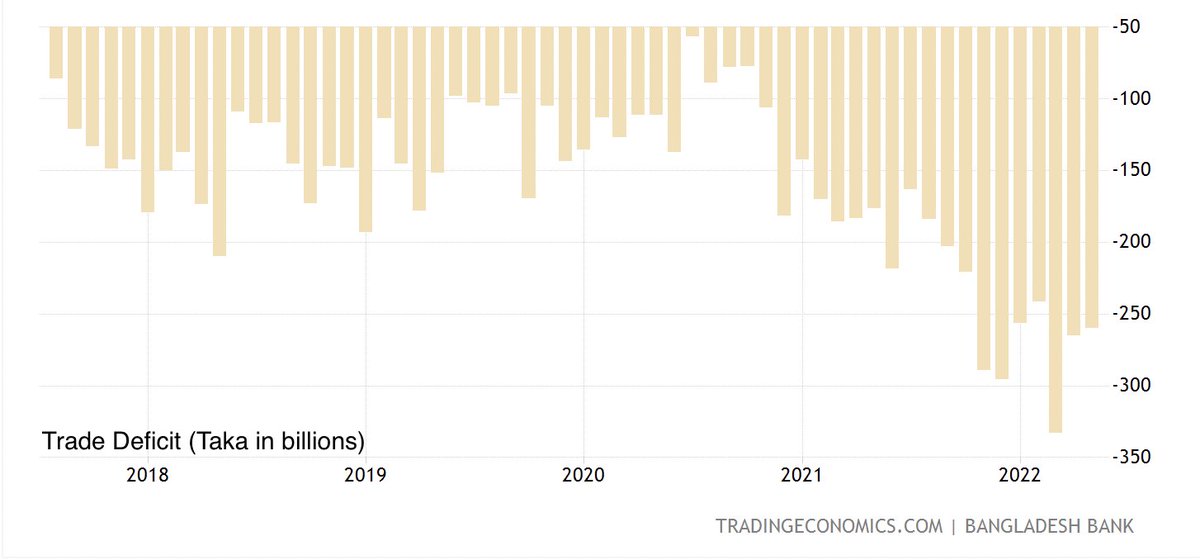
The PMI (purchasing managers index) for eurozone services fell to 53 in June, down from 56 in May. The UK is witnessing a decline in retail sales. Due to this, the trade deficit has widened.
And remittances, Bangladesh's second largest source of forex, declined by 15% in FY22.
And remittances, Bangladesh's second largest source of forex, declined by 15% in FY22.
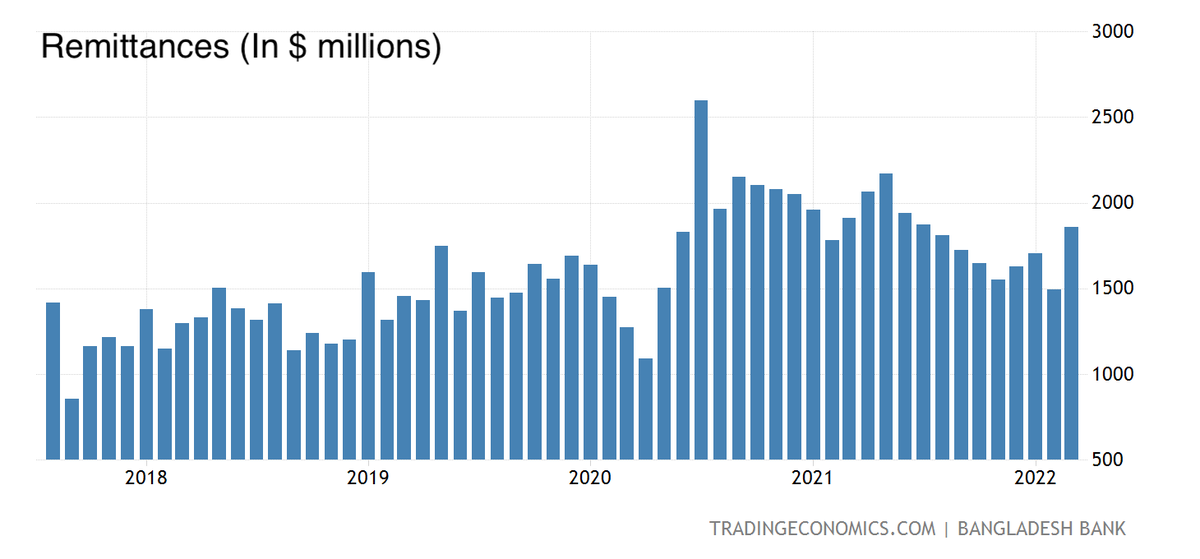
The Finance Minister has claimed that the nation has ~$40 billion forex reserves which is sufficient for 6-7 months of import. According to the IMF, the actual reserve is ~$31 billion, which can only support inflated import bills for a maximum of four months.
What is the situation now?
As per Prothom Alo (14 July 2022), the state-owned Bangladesh Petroleum Corporation has been facing hurdles in opening LCs (letters of credit) for import since April. Even if LCs were opened, payments to the foreign exporter were getting delayed.
As per Prothom Alo (14 July 2022), the state-owned Bangladesh Petroleum Corporation has been facing hurdles in opening LCs (letters of credit) for import since April. Even if LCs were opened, payments to the foreign exporter were getting delayed.
BPC has alerted the government at least thrice, beginning May 2022, about a looming energy crisis which the government finally admitted 2 weeks back.
The currency is also in a freefall which makes the position even more difficult. Despite adopting a floating exchange rate back in 2003, Bangladesh has fixed an official exchange rate to make the Bangladeshi Taka artificially strong against the dollar.
Unlike market intervention, where countries stabilise exchange rates by selling or buying dollars, here they have essentially created two exchange rates.
As of 21 July, the open market rate of a dollar (Taka 103) was 10 per cent more than the Bangladesh Bank (BB) declared rate of Taka 93.95). The kerb (street) rates are even higher at Taka 105.
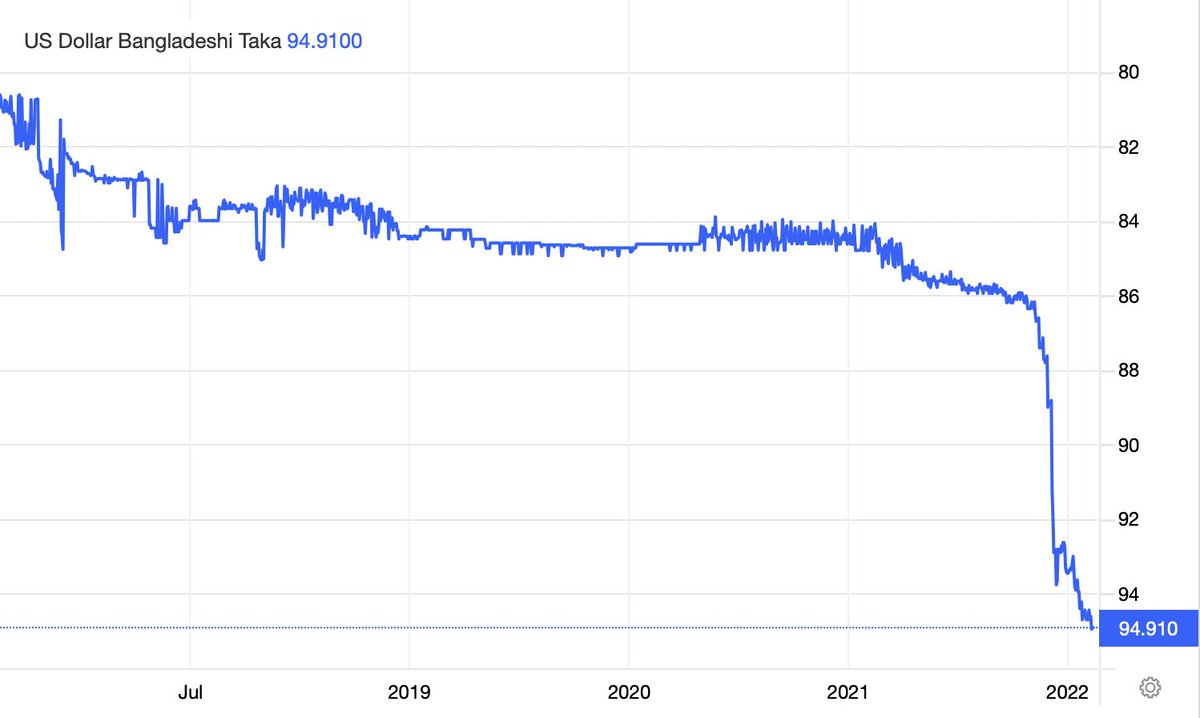
Such a policy distorts the open markets and hampers Bangladesh’s export and remittance earning potential since official transactions end up being less profitable for exporters
In fact, the Bangladesh Bank has asked six banks to remove their treasury heads under alleged dollar price manipulation. Banks generally buy dollars from exporters at a lower rate and sell those at a higher rate to importers to make profits.
Bangladesh bank said that the treasury chiefs preserved large amounts of dollars in order to raise the price of the bank note. The exchange rate of a dollar shot up to Tk 115 in the open market on 8 August amid a shortage of the currency while the interbank rate was at Tk 95.
What’s the solution to this
Measures like power cuts, restricted use of foreign currency, and fuel rationing are being adopted to keep the economy going.
Measures like power cuts, restricted use of foreign currency, and fuel rationing are being adopted to keep the economy going.
The IMF has shown willingness to support Bangladesh’s request for a $4.5 billion bailout package over the next 3 years. But this would just be a temporary relief measure.
Even as the per capita GDP has kept rising, a lot of it is dependent on unsustainable borrowings. Serious structural reform will be needed to bring the economy back on the right track.
Loading suggestions...