

If Central Banks only print bank reserves, why do they continue to engage in QE?
Because under certain conditions, QE sets up a virtuous cycle for capital flows towards risk assets.
A thread on the very important mechanics behind QE.
1/
Because under certain conditions, QE sets up a virtuous cycle for capital flows towards risk assets.
A thread on the very important mechanics behind QE.
1/
QE creates bank reserves, which is money only for commercial banks and not for us common people.
These bank reserves don’t have legal tender, and they can’t be used by the private sector to transact in the real economy.
So why do Central Banks perform QE at all?
2/
These bank reserves don’t have legal tender, and they can’t be used by the private sector to transact in the real economy.
So why do Central Banks perform QE at all?
2/
Mainly because QE coupled with regulation activates several virtuous cycle that help capital flow towards riskier assets that would otherwise be in trouble.
To understand this, let’s start from what QE does to the balance sheet of a commercial bank.
3/
To understand this, let’s start from what QE does to the balance sheet of a commercial bank.
3/
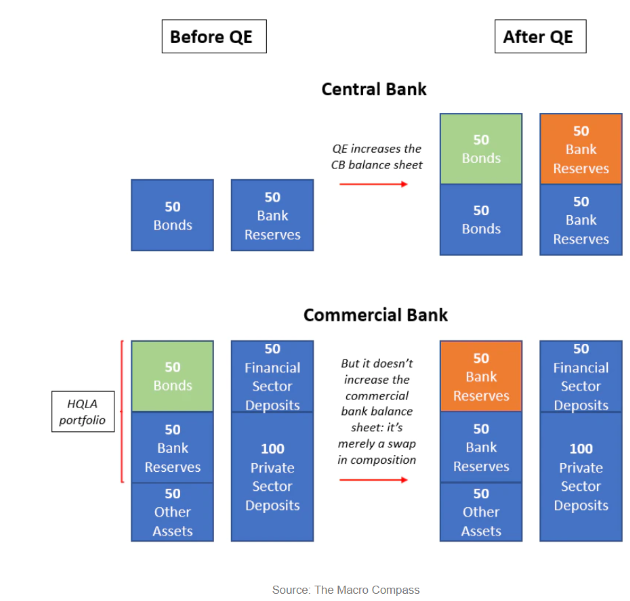
When a Central Bank performs QE and directly buys bonds from a commercial bank, they merely change the composition of the commercial bank asset side by reducing the amount of bonds they own and instead increasing the amount of reserves.
No new spendable money...
4/
No new spendable money...
4/
...for the private sector has been created in the process, as commercial banks don’t use reserves to make new loans.
But the portfolio composition of commercial banks has been changed, and this is very important.
5/
But the portfolio composition of commercial banks has been changed, and this is very important.
5/
Banks own a portfolio of bonds because:
A) Regulators incentivize them to do that;
B) Bonds are interest-bearing & liquid instruments which are also widely accepted as collateral;
C) They serve as a hedging tool for the interest rate risk of their liabilities.
6/
A) Regulators incentivize them to do that;
B) Bonds are interest-bearing & liquid instruments which are also widely accepted as collateral;
C) They serve as a hedging tool for the interest rate risk of their liabilities.
6/
Now, QE is taking away these bonds and flooding banks with reserves instead.
Let me show you why reserves are a sub-optimal asset to own for a bank, and hence why they’ll instead tend to rebalance their portfolio towards (riskier) bonds.
7/
Let me show you why reserves are a sub-optimal asset to own for a bank, and hence why they’ll instead tend to rebalance their portfolio towards (riskier) bonds.
7/
Regulators have made bonds (almost) as ‘‘regulatory-friendly’’ as reserves
After the GFC, regulators realized that banks weren’t owning enough liquid assets to survive a spike in deposit outflows and therefore implemented a new regulation: the Liquidity Coverage Ratio (LCR)
8/
After the GFC, regulators realized that banks weren’t owning enough liquid assets to survive a spike in deposit outflows and therefore implemented a new regulation: the Liquidity Coverage Ratio (LCR)
8/
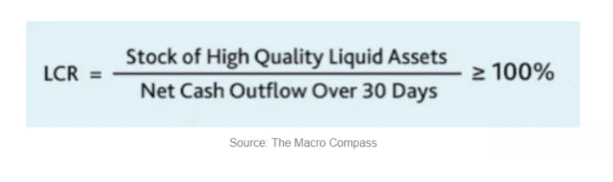
It basically forces banks to own enough High Quality Liquid Assets (HQLA) to be able to meet an avalanche of deposit outflows during a stressful period
European and US banks are now forced to own about $12 trillion (!!!) of cumulative HQLA assets at any point in time
Huge!
9/
European and US banks are now forced to own about $12 trillion (!!!) of cumulative HQLA assets at any point in time
Huge!
9/
Curious to know what’s eligible as HQLA?
The usual suspects: bank reserves and government bonds.
But subject to a maximum of 15% of the total HQLA portfolio, BBB corporate bonds, mortgage backed securities and even certain stocks (!) are HQLA eligible.
10/
The usual suspects: bank reserves and government bonds.
But subject to a maximum of 15% of the total HQLA portfolio, BBB corporate bonds, mortgage backed securities and even certain stocks (!) are HQLA eligible.
10/
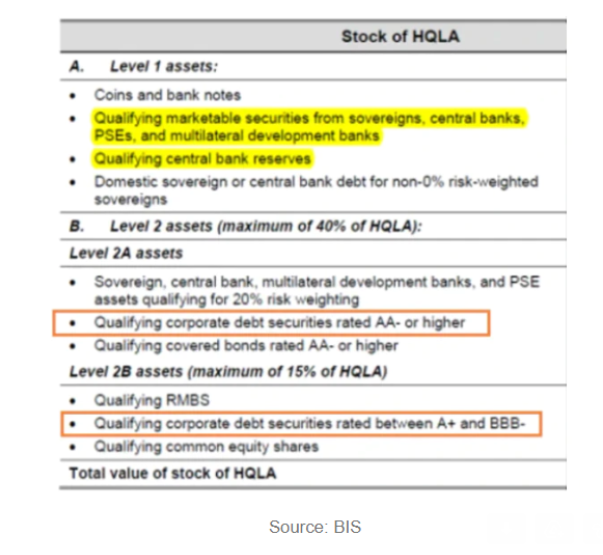
By making bank reserves and (riskier) bonds virtually inter-exchangeable, regulators have increased the marginal appetite banks have for ‘‘regulatory-friendly’’ HQLA bonds
If for regulators these bonds are as good as reserves and they offer a higher yield on top…why not?
11/
If for regulators these bonds are as good as reserves and they offer a higher yield on top…why not?
11/
HQLA-eligible bonds carry higher yields than bank reserves.
The chart above shows the 2 to 10 years yield curve for bank reserves at the Fed (orange) against two forms of regulatory-friendly bonds: US Treasuries (blue) and US BBB-rated corporate bonds (green).
12/
The chart above shows the 2 to 10 years yield curve for bank reserves at the Fed (orange) against two forms of regulatory-friendly bonds: US Treasuries (blue) and US BBB-rated corporate bonds (green).
12/
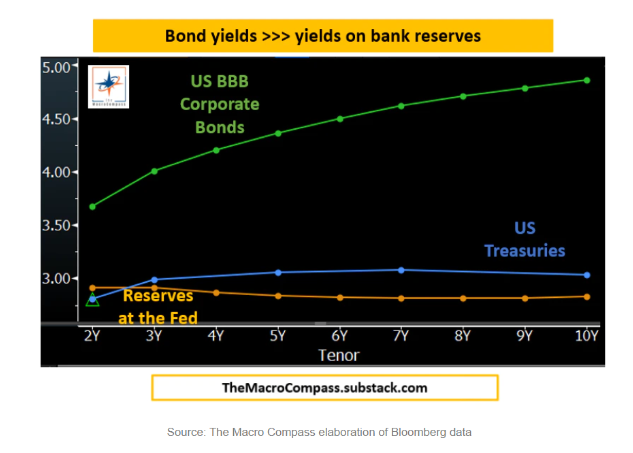
Treasuries already yield more than bank reserves & they have a very liquid secondary market, a deep repo market and they are the best collateral available out there - quite a no brainer!
BBB Corporate Bonds offer an even higher yield, but there are some trade-offs there.
13/
BBB Corporate Bonds offer an even higher yield, but there are some trade-offs there.
13/
The higher yield must be measured against the additional credit risk, some small regulatory haircut, a less liquid secondary market.
From a risk and liquidity-adjusted return perspective though, one can argue HQLA bonds are generally attractive vis-à-vis bank reserves.
14/
From a risk and liquidity-adjusted return perspective though, one can argue HQLA bonds are generally attractive vis-à-vis bank reserves.
14/
Also, and very important: bonds are not only for returns.
They can be used to hedge interest rate risk, while bank reserves can’t.
Let's quickly see how it works.
15/
They can be used to hedge interest rate risk, while bank reserves can’t.
Let's quickly see how it works.
15/
The liability side of commercial banks balance sheet is mostly composed by customer deposits, and generally these customers can decide to walk away with their money whenever they prefer.
Risk departments are tasked to calculate the average tenor of customer deposits...
16/
Risk departments are tasked to calculate the average tenor of customer deposits...
16/
...and other liabilities sitting on the bank’s balance sheet such that duration mismatches can be mitigated from the asset side - for instance, purchasing bonds with a certain offsetting duration
On the other hand, bank reserves are an overnight instrument with no duration
17/
On the other hand, bank reserves are an overnight instrument with no duration
17/
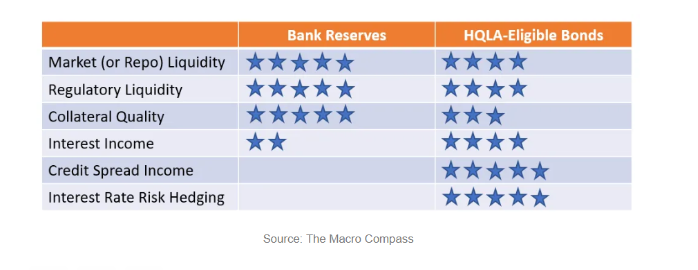
The bottom line is that while preserving many useful features, bank reserves are a zero-duration & low-yielding instrument which can be suboptimal to own in big sizes especially as regulation has become friendly towards certain bonds
Here is a useful table to compare them
18/
Here is a useful table to compare them
18/
Now that we have established how undesirable it is for commercial banks to own large amounts of inert bank reserves rather than regulatory-friendly HQLA bonds, let’s quickly revisit our QE example to understand how the Portfolio Rebalancing Effect really works.
19/
19/
In our stylized example, the commercial bank HQLA portfolio will consist of a bunch of inert bank reserves which don’t generate much returns and can’t be used to hedge interest rate risk: quite a suboptimal composition, wouldn’t you agree?
20/
20/
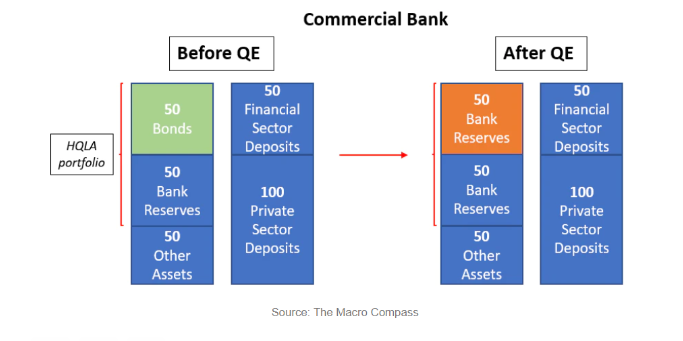
Hence, they will be looking to rebalance their portfolio towards a better composition of regulatory-friendly bonds and reserves: they will go and buy Treasuries, MBS, Corporate Bonds and so on and so forth.
But wait a second...
21/
But wait a second...
21/
...the Central Bank is already (!) buying these exact same bonds with QE, isn’t it? Yes, exactly.
Summarizing, here is the virtuous cycle behind the Portfolio Rebalancing Effect.
So, summarizing:
22/
Summarizing, here is the virtuous cycle behind the Portfolio Rebalancing Effect.
So, summarizing:
22/
- Central Banks expand their balance sheet and purchase (risky) bonds
- Commercial Banks' portfolio composition gets skewed towards more reserves, and less bonds
- But reserves are sub-optimal to own compared to regulatory-friendly bonds
23/
- Commercial Banks' portfolio composition gets skewed towards more reserves, and less bonds
- But reserves are sub-optimal to own compared to regulatory-friendly bonds
23/
- So banks start buying the very same bonds QE is buying, hence suppressing volatility and compressing credit spreads;
- Other players join the party, and given the reduced volatility pile on and rebalance their portfolio too
24/
- Other players join the party, and given the reduced volatility pile on and rebalance their portfolio too
24/
Now, if you read until here you deserve a medal :)
But also, it's very likely you'll find the educational and market coverage material I publish in my free newsletter TheMacroCompass.substack.com pretty interesting - there is much more over there!
It's free - have a look!
25/25
But also, it's very likely you'll find the educational and market coverage material I publish in my free newsletter TheMacroCompass.substack.com pretty interesting - there is much more over there!
It's free - have a look!
25/25

Loading suggestions...