

How to debate a Jew
🧵:
🧵:
Ibn al-Qayyim:
“We say to the one who had incurred wrath: ‘Have you seen Moses and witnessed his miracles?’
By necessity he will say: ‘No.’
“We say to the one who had incurred wrath: ‘Have you seen Moses and witnessed his miracles?’
By necessity he will say: ‘No.’
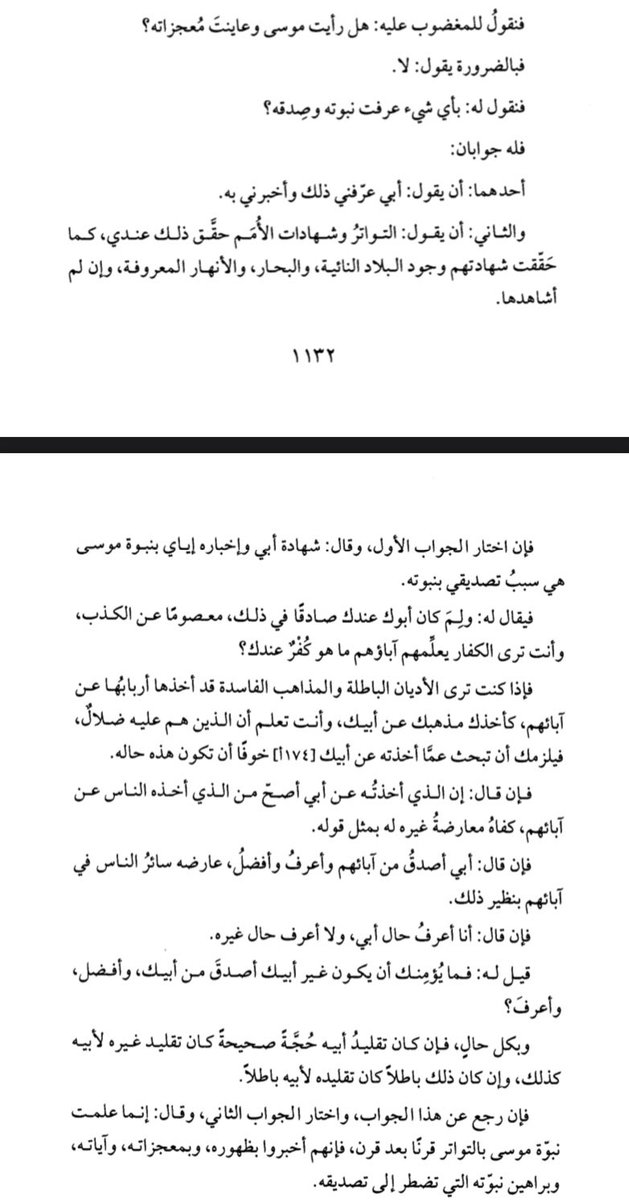
So we say to him: ‘by what standard have you figured out his prophethood and truthfulness?’
He has two (possible) answers:
One of them is to say: ‘my father informed me and told me about it.’
He has two (possible) answers:
One of them is to say: ‘my father informed me and told me about it.’
The second is to say: ‘the mass-transmission and testimony of the nations confirms it to me, just as their testimony has confirmed the existence of remote lands, seas, and well-known rivers, even though I have not seen them.’
If he chooses the first answer, and says: ‘My father’s testimony and his telling me of the prophethood of Moses is the reason for my belief in his prophethood.’
It will be said to him: ‘Why was your father truthful to you about that, infallible from lying, even though you see the infidels being taught by their fathers what is unbelief in your view?’
Given that you see false religions and corrupt sects which their forefathers have taken from their fathers, like you took your doctrine from your father, and you know that what they’re upon is misguidance, then you must look into what you took from your father
for fear that this happened to him (as well).
If he says: ‘What I took from my father is more correct than what people took from their fathers.’
If he says: ‘What I took from my father is more correct than what people took from their fathers.’
It suffices that others who oppose him tell him the same statement.
If he says: ‘My father is more truthful than their fathers, more knowledgeable and better,’
All other people oppose him in the same way using their own fathers.
All other people oppose him in the same way using their own fathers.
If he says: ‘I know the condition of my father, and I do not know the condition of anyone else.‘
It is said to him: ‘What makes you so sure that someone other than your father isn’t more honest, better, and more knowledgeable than your father?’
In any case, if imitating his father was a valid argument, then someone else imitating their father is likewise (valid), and if it’s invalid, then his imitation of his father is invalid.
If he turns back from this answer, and chooses the second answer, and says: ‘The prophethood of Moses is known by mass-transmission, century after century, for they told of his appearance, his miracles, his signs, and the proofs of his prophethood which compel belief in him.’
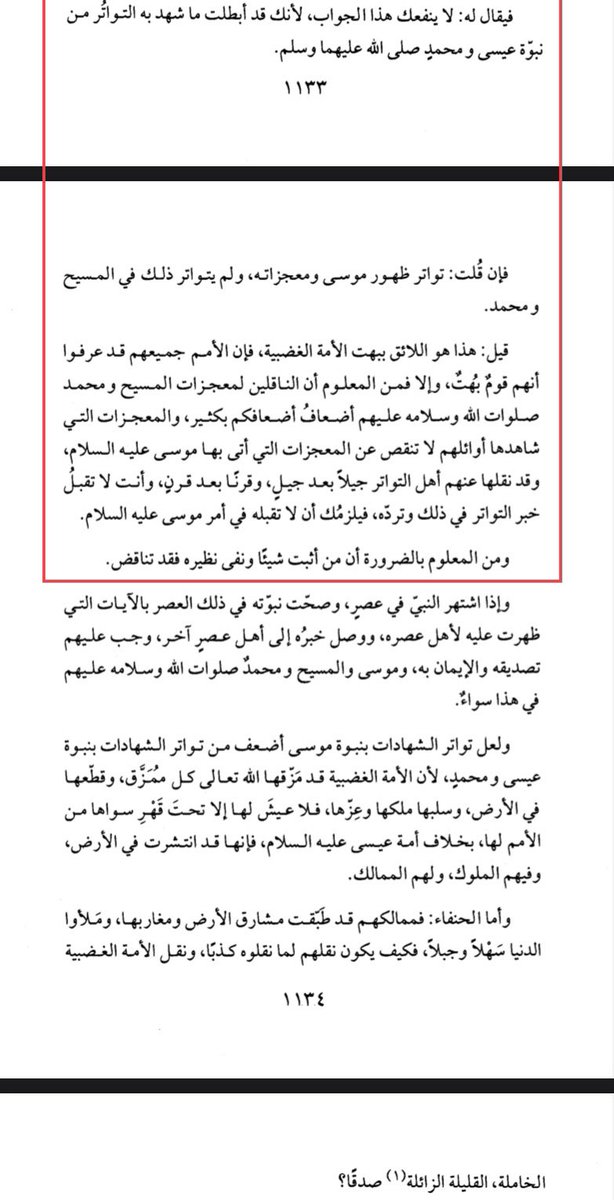
It is said to him: ‘This answer will not benefit you, because you have invalidated what mass-transmission testified of the prophethood of Jesus and Muhammad, May Allāh grant peace and blessing upon them.’
If you say: ‘The mass-transmission of Moses’ appearance and miracles, and this didn’t happen in the case of Christ and Muhammad.’
It is said: ‘This is slander befitting of the nation which incurred wrath, for all nations have known that they are a slanderous people.
Otherwise, it’s known that the transmitters of the miracles of Christ and Muhammad, May Allāh grant peace and blessing upon them, are many many times more than yours
and the miracles witnessed by their predecessors do not detract from the miracles that Moses, peace be upon him, brought.
It was transmitted from them by mass-transmission, generation after generation, and century after century, and you do not accept the report of mass-transmission in this (case) and you reject it, so you must not accept it in the case of Moses, peace be upon him.
It is known necessarily that whoever affirms something and denies its counterpart has contradicted.’”
Source: Ighāthat al-lahfān min-maṣāyid al-Shayṭān p. 1132-1134.
Source: Ighāthat al-lahfān min-maṣāyid al-Shayṭān p. 1132-1134.
Loading suggestions...