
entertainment
Film
Nature
Conservation
Film analysis
Bollywood
Cultural Commentary
Cultural Analysis

*Tiger Natural History Lessons from Zanjeer: A Thread*
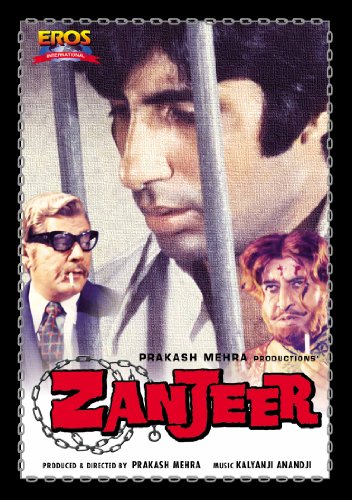
Zanjeer (1973) remains one of the most iconic Bollywood films of all time. I remember being quite obsessed with it as a kid when it used to be telecast often on Doordarshan. But when I recently rewatched the movie I was +
Zanjeer (1973) remains one of the most iconic Bollywood films of all time. I remember being quite obsessed with it as a kid when it used to be telecast often on Doordarshan. But when I recently rewatched the movie I was +

quite struck by some very interesting references to the natural history of tigers that were peppered across the movie. This was primarily due to Pran's character named 'Sher Khan', a benevolent Afghan Pathan don who is reformed as a result of his friendship with Inspector +

Vijay Khanna (Amitabh Bachchan). I won’t discuss the entire plot, but I must recount some bits relevant to the theme of this thread.
Directed by Prakash Mehra and with a screenplay by the legendary duo of Salim-Javed (@Javedakhtarjadu), Zanjeer became one of the biggest hits +
Directed by Prakash Mehra and with a screenplay by the legendary duo of Salim-Javed (@Javedakhtarjadu), Zanjeer became one of the biggest hits +
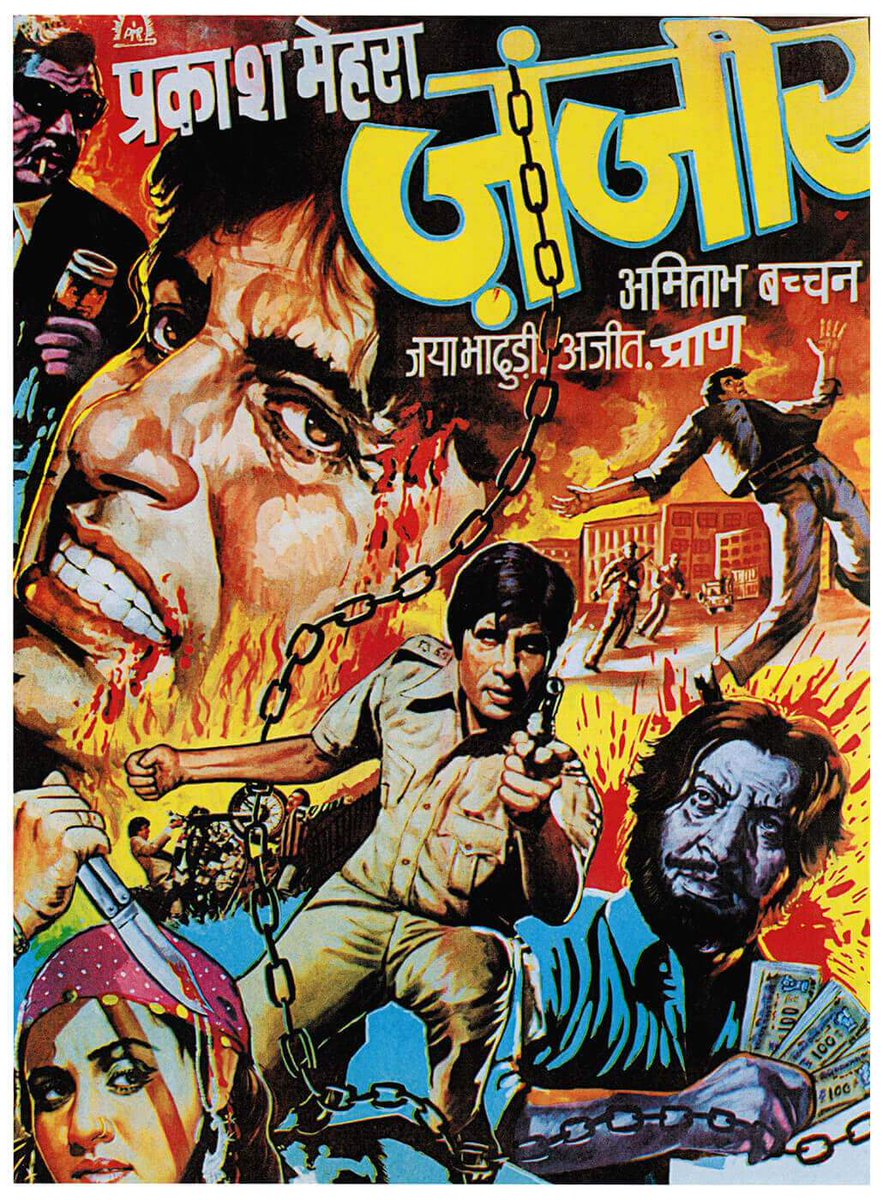
in the careers of everyone associated with the movie including the leads @SrBachchan (birthing his 'angry young man' persona), Pran, Jaya Bachchan, 'Ajit' Khan as well as the supporting cast that included Bindu (whose character 'Mona Darling' continues to be a pop culture +
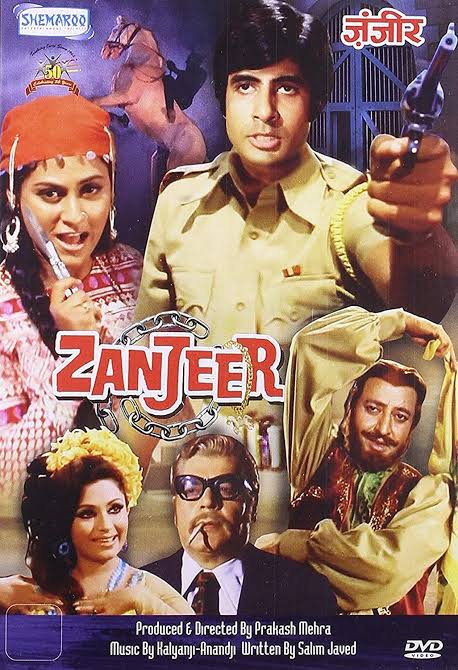
reference till date), Om Prakash, Iftekhar,etc.
Vijay first meets Sher Khan when he summons the latter to his police station delivering the iconic lines "Ye Police Station hai tumhare baap ka ghar nahin" (this is a police station, not your father's house), as he kicks away the+
Vijay first meets Sher Khan when he summons the latter to his police station delivering the iconic lines "Ye Police Station hai tumhare baap ka ghar nahin" (this is a police station, not your father's house), as he kicks away the+

chair when Khan tries to take a seat without his permission. An incensed Khan dares Vijay that his tough-guy attitude is a facade stemming from the power he wields courtesy his police uniform, and that the day he is stripped of it & his police chair he would see to him. Taking +
up Sher Khan on his challenge, that evening Vijay goes to the by-lanes of the city which are ruled by Sher Khan sans his uniform, and dares Khan to an all-out street fight! The two slug it out on the streets but neither win and the two ultimately collapse exhausted. Sher Khan, +
clearly impressed by Vijay's courage and toughness, gets up, and while extending his hand in friendship says "Aaj zindagi mein pehli baar Sher Khan ki Sher se takkar hui hai".
Interestingly, the official english subtitles of the movie translate this dialogue as "For the first +
Interestingly, the official english subtitles of the movie translate this dialogue as "For the first +

time in my life, I've met a lion-hearted man". The use of the word "lion-hearted" makes me briefly segway into the etymology of the word "sher", and why often people confuse over whether it means a tiger or a lion. The animal "sher" in Urdu refers to the tiger, while the word +
"shir/sher" means lion in Persian. On the other hand the word "babr/shir-e-babr" means tiger in Persian while "babbar/babbar sher/sher-i-babbar" means lion in Urdu. Thus, if one looks at the Persian meaning of the words, Pran's dialogue translates to "For the first time in my +
life, Lion Khan [since Shir/Sher = Lion in persion] has squared off against another lion". But if you look at the Urdu meaning of the words, his dialogue becomes "For the first time in my life, Tiger Khan has squared off against another tiger".
In India, since Urdu/Hindustani +
In India, since Urdu/Hindustani +
had trumped Persian, becoming the language of the masses from the 19th century onwards, so 'Sher' always means 'tiger'.
Incidentally, during the making of Zanjeer (and just a year before it's release), the tiger had trumped the lion for real as well in so far as the status of +
Incidentally, during the making of Zanjeer (and just a year before it's release), the tiger had trumped the lion for real as well in so far as the status of +
India's national animal was concerned. A lot of people are unaware of the fact that India's national animal right until 17th November 1972 was the Asiatic Lion. However, on 18th November 1972 at a meeting of the Indian Board of Wildlife (IBWL), the tiger displaced the lion to +
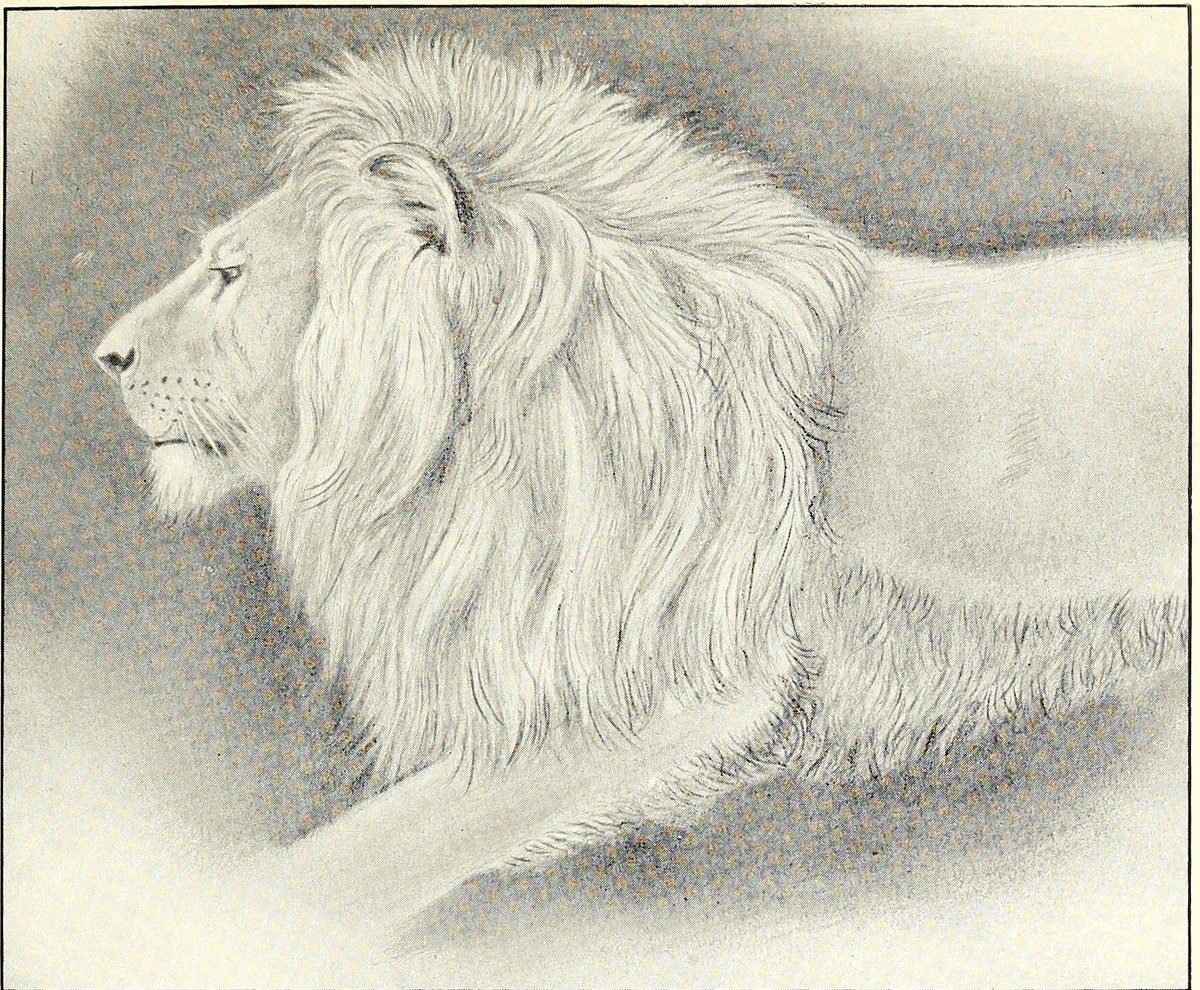
become India's national animal. Professor Mahesh Rangarajan, one of the world's foremost environmental historians, recounted how when he met Karan Singh (who was the chairman of IBWL) asking him the reason for choosing the tiger over the lion as India's national animal, he told +
him that "tigers were found in 11 of the [then] 16 states of India and spread across a variety of diverse habitats from mangroves of Sundarbans to dry open forests of Ranthambore, from grasslands of Terai in the north to the evergreen forests of western ghats in the south and +
north-east India, while at the same time the lion was just found in one state. So the tiger was a symbol of unity in diversity and thus chosen to replace the lion as our national animal".
Anyway, that was a long segway, and now back to Zanjeer. At one point in the movie, the +
Anyway, that was a long segway, and now back to Zanjeer. At one point in the movie, the +
henchmen of Seth Dharam Dayal Teja (Ajit), the movie's antagonist, approach a reformed Sher Khan (who now works as an auto mechanic at his garage) offering a 'supari' (assassination money) to kill Vijay (not knowing that Khan and Vijay are friends now). An enraged Khan throws +
the money back at the henchmen and then goes on to deliver what is the most interesting line of the movie for the conservationist and wildlife historian in me. He says: "Sher Khan sher ka shikar nahin karta. Waise bhi humaare mulk mein ab sher bahut kam reh gaya hai. Humne suna +

hai ke hukumat ne bhi sher maarne ki mumaaneat kar di hai". This translates to "A tiger doesn't hunt another tiger. Moreover, as it is there are very few 'tigers' left in our country. I have even heard that even the government has prohibited the hunting of tigers". This is a +
remarkable dialogue for many reasons because apart from "very few tigers being left in our country" alluding to "very few good/brave/tiger-hearted men being left in the country", the entire dialogue is also factually true. Tigers are rarely known to cannibalize in the wild, and +
there is nary an example of one tiger hunting another as prey. However, it's the other factually accurate half of the dialogue (alluding to the declining tiger numbers and their hunting ban) that is most interesting, especially given the year of the release of the movie. With +
this another brief tiger conservation history lesson is in order.
The depleting tiger numbers had become a major reason of concern among naturalists, conservationists, & wildlife scientists both in India & across the globe by the 1960s. In 1969, Kailash Sankhala, an IFS officer+
The depleting tiger numbers had become a major reason of concern among naturalists, conservationists, & wildlife scientists both in India & across the globe by the 1960s. In 1969, Kailash Sankhala, an IFS officer+
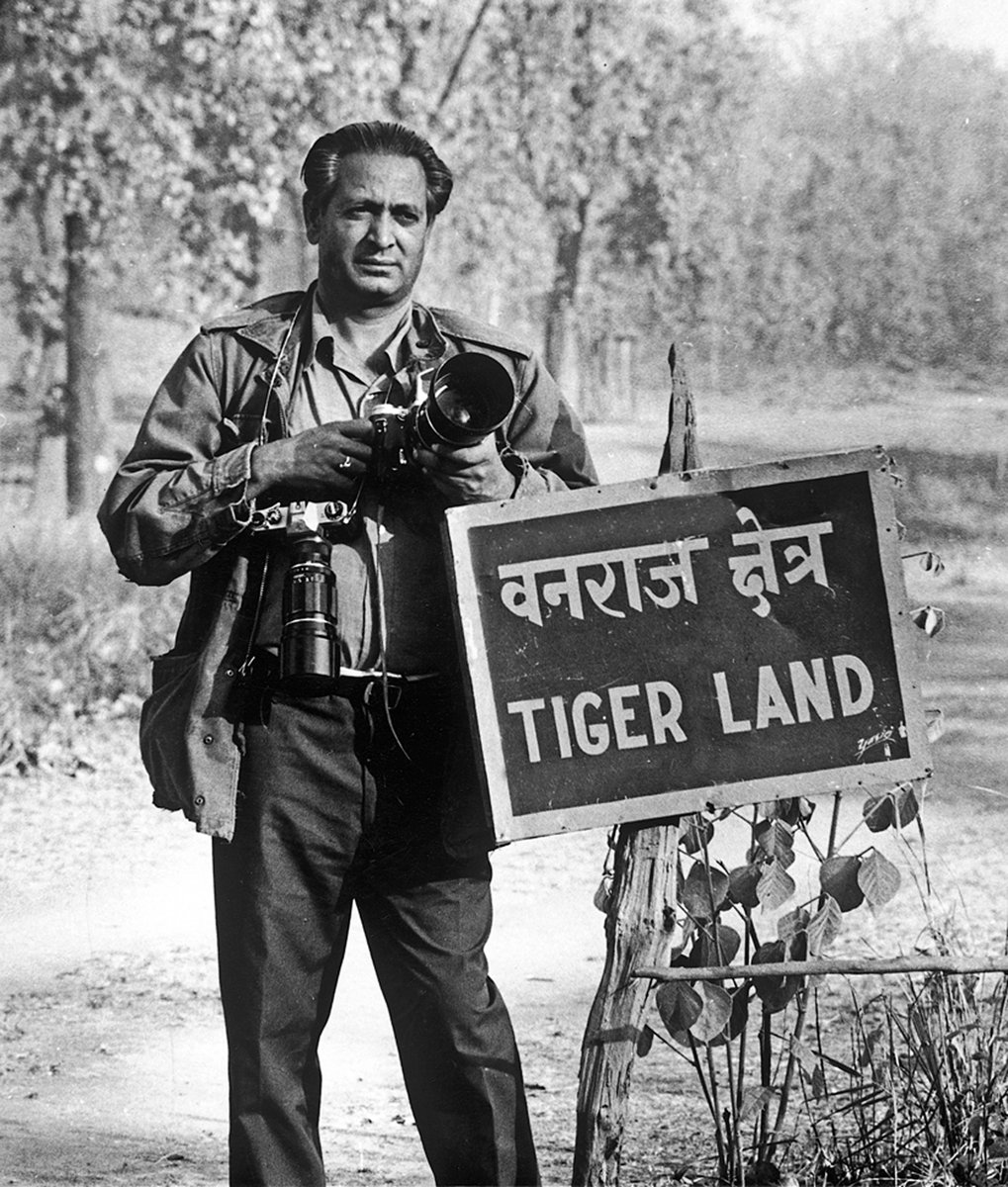
of the Rajasthan cadre studying the natural history and status of tigers under a Nehru Fellowship estimated the number of tiger skins in Delhi's fur shops alone to be not less than 500, and gave a mean all-India tiger estimate of about 2,500 (2724 to 3700) animals. The same year+
India became a member of IUCN and hosted the 10th General Assembly of IUCN at New Delhi, at the end of which the tiger was included in IUCN's "Red Data Book" earning it the tag of an endangered species for the first time. Moreover, a resolution calling for a ban on the killing +
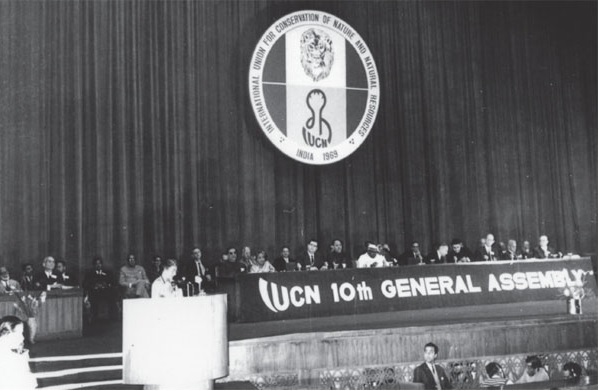
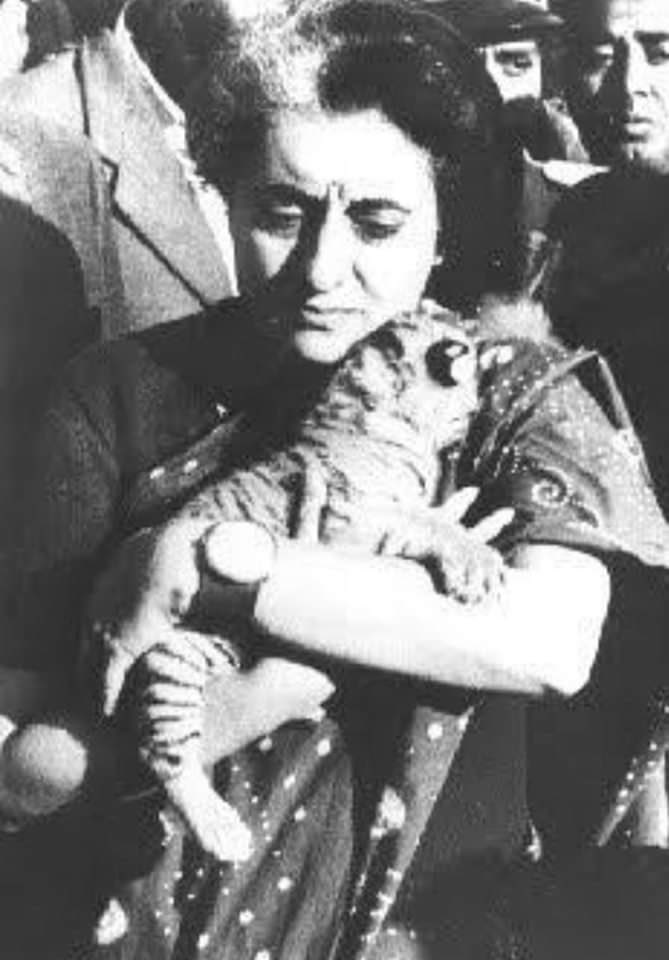
of tigers was adopted. IBWL met immediately in the General Assembly's aftermath and recommended a nationwide ban on all tiger shooting for a period of 5 years from 1st July 1970. Simultaneously, PM Indira Gandhi personally stepped to pursue the matter at a personal level with +
with the Chief Ministers of the States (since wildlife was a state subject at the time), and this culminated into a total ban on tiger hunting in India by July 1970. Simultaneously, the export of tiger and leopard skins and products made thereof was banned on September 8, 1970. +
Obviously, those whose business interests were hit – shikar companies and fur traders – went to Delhi HC challenging the hunting and export ban but the ban was upheld in February 1971. The next year, in 1972, India enacted the Wild Life (Protection) Act which outlawed hunting +
by law. With this, the era of tiger-hunting which had continued in India since antiquity and become especially prominent during the British rule, finally came to an end. I assume that when Salim Khan and @Javedakhtarjadu were writing the screenplay for Zanjeer, all these +
happenings regarding the precipitous decline in tiger numbers and the consequent ban on tiger hunting would have been playing out in the news, and the writer duo remarkably decided to incorporate these developments into Pran's dialogue where he talks about very few tigers being +
left in the country and the 'mumaaneat' (prohibition) on tiger-hunting by the 'hukumat' (State). I still marvel at the genius of such a deft weaving of a rather non-mainstream news subject (viz. tiger decline and hunting ban) into the dialogue of a fictional character (who they +
named after a tiger) at a very opportune moment in the movie with multiple contextual meanings. Another noteworthy bit is that Zanjeer was released on 11th May 1973 while Project Tiger with Kailash Sankhala as its first Director. was launched on 1st April, 1973 to create the +
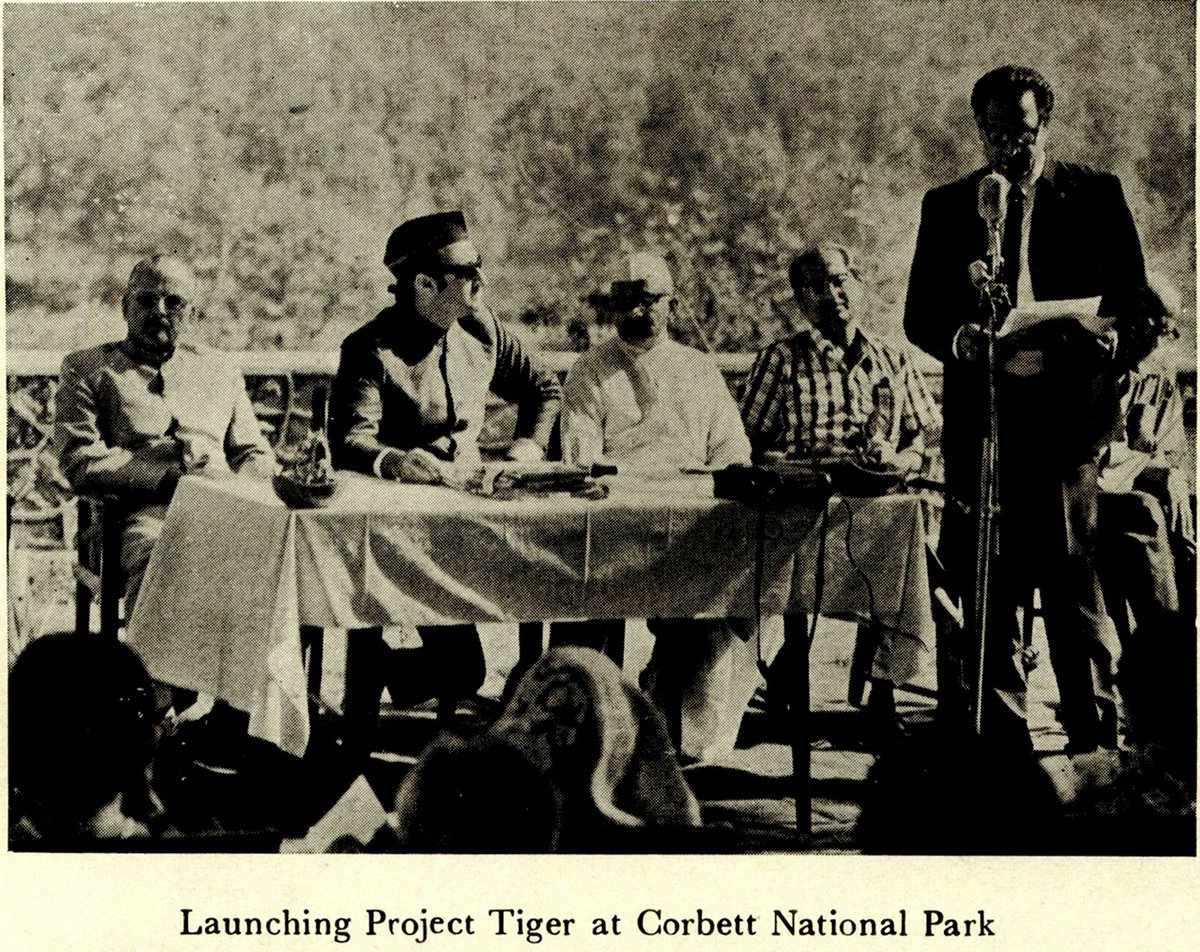
first 9 tiger reserves of India.
Now let's move on to another interesting bit on tiger ecology that @Javedakhtarjadu and Salim Khan incorporate into the movie. After the Teja's henchmen are kicked out by Sher Khan, he heads off to warn Vijay. When he meets him, he tells +
Now let's move on to another interesting bit on tiger ecology that @Javedakhtarjadu and Salim Khan incorporate into the movie. After the Teja's henchmen are kicked out by Sher Khan, he heads off to warn Vijay. When he meets him, he tells +
Vijay about the entire incident that happened at his garage. When Vijay brushes aside Khan's warning and says that the criminals won't be able to harm him, Sher Khan expresses his reservations against what to him is Vijay's overconfidence. He then says "Oye hum jaanta hai tum +
bahadur hai, diler hai. Lekin ye na bhulo ki 12 jungli kutte mil kar sher ko phaad daalte hain" (I know you are brave and fearless, but don't forget that a pack of 12 wild dogs can rip even a tiger apart). The tiger obviously alluded to Vijay and the wild dogs to the gang of

Teja and his henchmen. This entire dialogue was absolutely amazing to hear from a natural historian's perspective because it is a fact that Indian wild dogs, also known as Dholes or 'whistling hunters' (called so because the pack members utter a whistling sound while chasing +
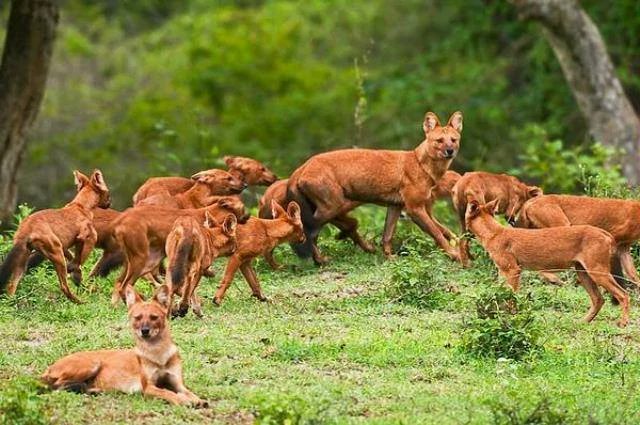
their prey) have been recorded in rare instances to kill a tiger. Of course, such rare battles where the tiger was killed also inflicted a heavy toll on the pack with the death of a majority of the dogs in the pack, but the tenacious hunters did manage to overcome the adversary.+
Attached herewith is an extract of a fascinating account from October 15, 1943 of a face-off between a tiger and a pack of wild dogs. Authored by W. Connell, it appeared in the Journal of Bombay Natural History Society. By the end of this epic clash, there were a bunch of dead +
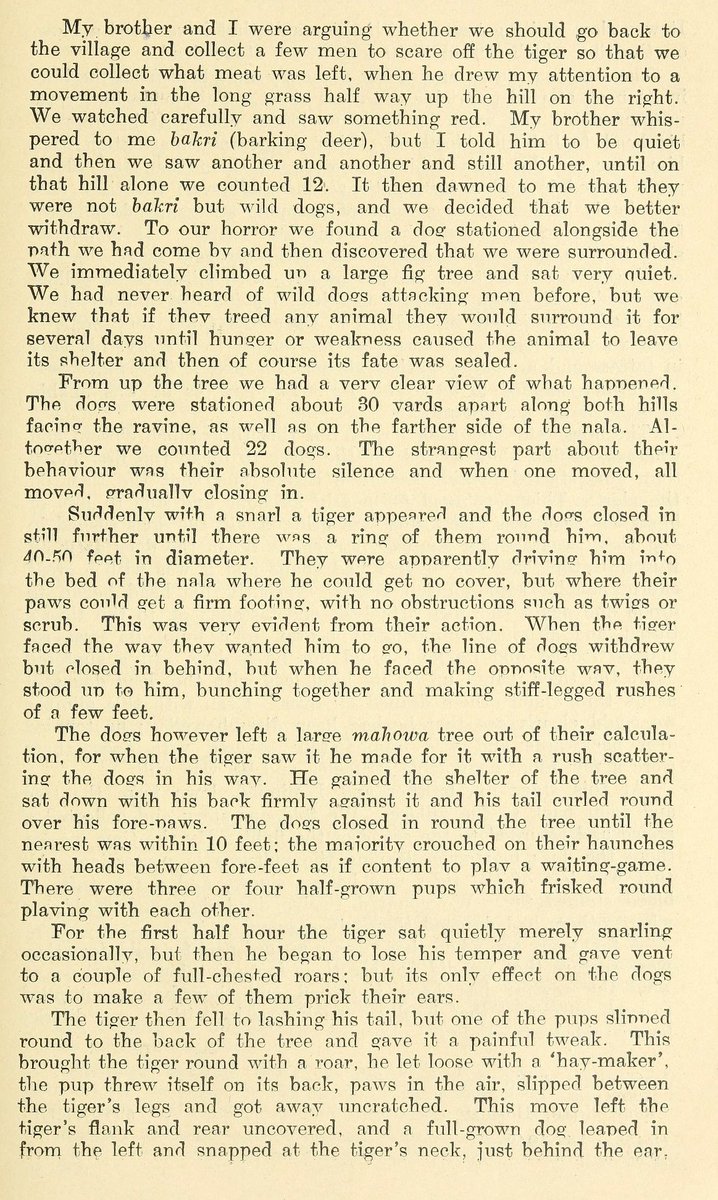
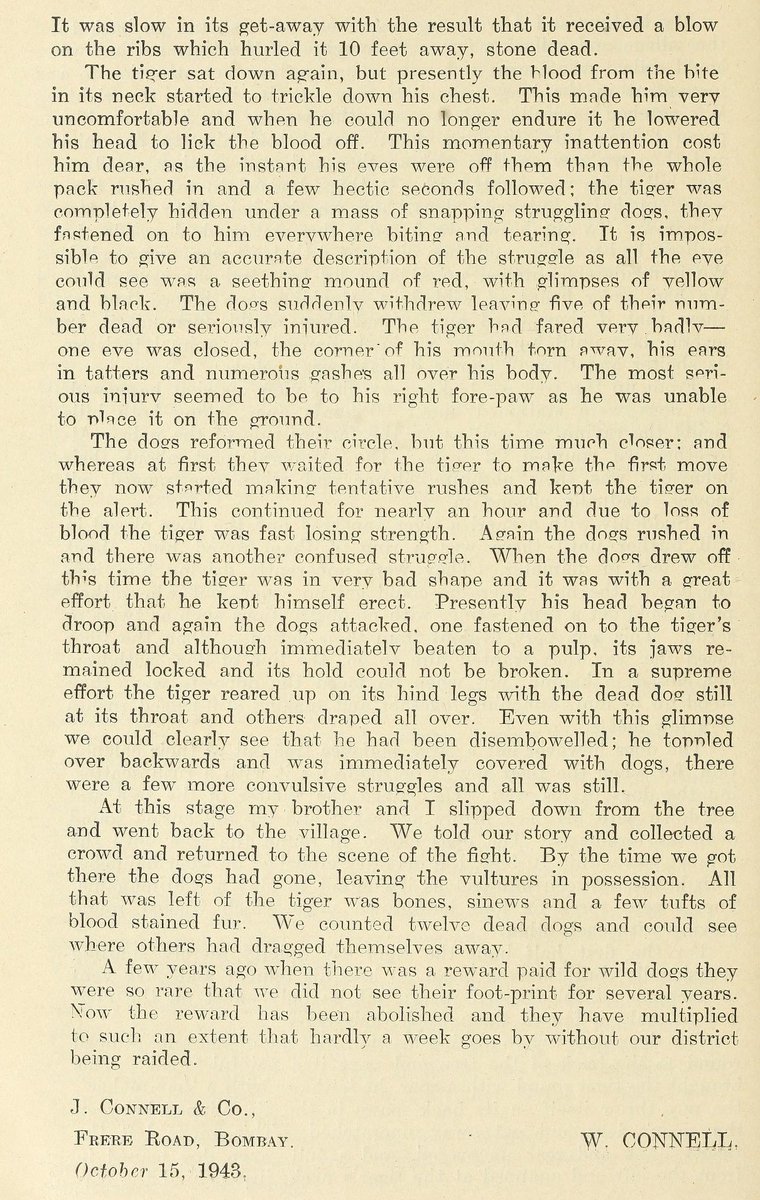
wild dogs and a dead tiger (who was then polished off by the surviving dogs). How many dead wild dogs you ask? Twelve!
Only Salim Khan and @Javedakhtarjadu can tell us if they had read this BNHS paper or a similar account somewhere before writing that dialogue for Pran or +
Only Salim Khan and @Javedakhtarjadu can tell us if they had read this BNHS paper or a similar account somewhere before writing that dialogue for Pran or +
had heard this tale from some naturalist or shikari acquaintance of theirs. Incidentally, perhaps the earliest visual representation of a face-off between wild dogs and a tiger was by painter Samuel Howitt who painted a scene titled "A tiger hunted by wild dogs" in 1805 for a +
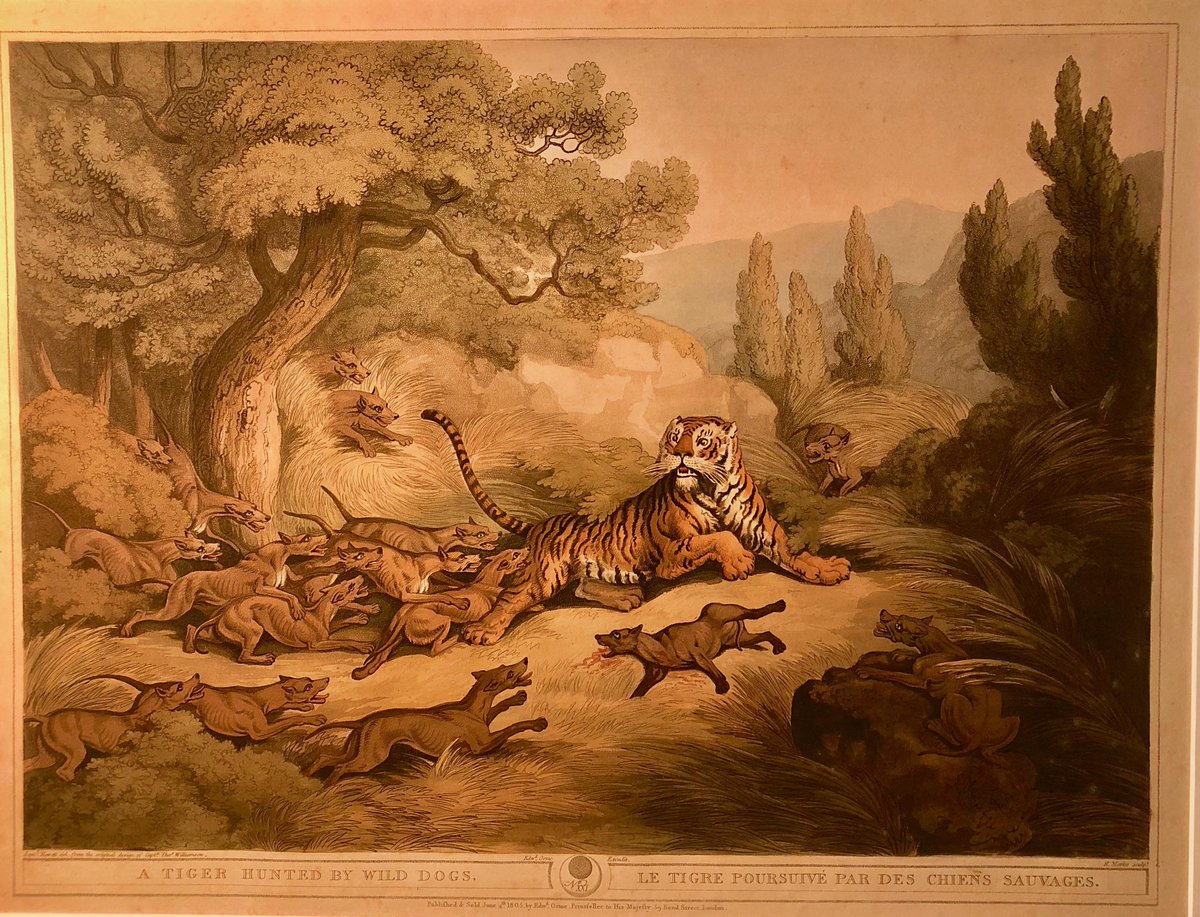
book called Oriental Field Sports by Captain Thomas Williamson published in 1807. The caption for the painting said "A tiger in a clearing, approaching from all sides by a pack of dogs, one of which lies dead in the centre."
It may be also worth mentioning here that the +
It may be also worth mentioning here that the +
parallel between wild dogs being used as an imagery for ravenous criminals in the aforementioned dialogue is very interesting to me because wild dogs for the longest period, both during British rule & even in post-independent India uptil 1972, were declared as "pest" & "vermin" +
and were thus ruthlessly killed (a major reason behind the shrinkage of their distribution range and numbers in India today). This belief that wild dogs were the "criminals" of the animal world in some ways worthy of description was believed in by naturalists, hunters, and +
forest officers alike in those days. Naturalist and hunter Lt. Col. E.G. Phythian-Adams' words published in an old article of BNHS summarise this unfortunate attitude that prevailed quite accurately. Calling the dhole a “perfect swine”, he wrote: “Except for his handsome +
appearance, the wild dog has not a single redeeming feature, and no effort, fair or foul, should be spared to destroy these pests of the jungle.”
Ok, so back to Zanjeer and onto our final observation related to the natural history of tigers in the movie. Due to the devious +
Ok, so back to Zanjeer and onto our final observation related to the natural history of tigers in the movie. Due to the devious +
machinations of Teja, Vijay gets convicted in a false bribery case and is jailed for 6 months along with imposition of a fine of Rs 5000. Since Vijay can't afford such a large sum, Mala goes to Sher Khan requesting him for help. Khan promises to arrange for the money but since +
he too has given up on his past criminal life so he is broke too! He thus approaches a Lala (a jewelry shop owner cum moneylender) to loan him Rs 5000. The Lala agrees to give him the money after a little thought but asks for something to be mortgaged in return. Sher Khan +
hesitatingly tells him that he owns nothing that he could mortgage before pausing for a bit. He then says "Haan ek cheez hai, agar tum uski qeemat pehchaano toh" (Yes I do have one thing to offer, but only if you realise the value of it). When the Lala enquires what it is, +
Khan proceeds to twirl his mustache and says "Sher Khan ki moonch ka baal" (a strand of hair from Sher Khan mustache) i.e. a tiger's whisker! The Lala immediately gets embarrassed at this and says he can recognize an honest man when he sees one, and immediately proceeds to give +

him Rs 5000 without any interest or mortgage. This dialogue here is supposed to represent the honour of Sher Khan as a man, since mustache hair is associated with honor among many Indian communities. However, this dialogue is remarkable in another sense as well because few know +
that many of India's forest-dwelling communities in the days of tiger hunting accorded great reverence to a tiger's whisker, albeit not as a marker of honour but as something that possessed magical powers (which could be both evil and to ward off evil). Most Adivasi shikaris +
used to fear the tiger's whisker as a poison and thus immediately get rid of them as soon as a tiger was killed, while others believed that burning off the whiskers stopped the spirit of the dead tiger from haunting the forest and bringing curse upon its killers. The positive +
belief systems included using them as amulets to ward off the evil eye, while some communities believed that the possession of the tiger's whiskers conferred the person with magical powers that made him capable of winning the heart of any woman he desired!
Phew! And with that, +
Phew! And with that, +
I guess it's time to conclude this thread. For those of you who read through till the end, I am really grateful and I hope it was worth your time. Zanjeer is a fantastic masala movie that one can watch many a times without getting bored. I have one bone to pick with the makers +
though – why oh why did you not name Ajit's character as "Loin" in Zanjeer (rather than naming him so in the movie Kalicharan) for then the face-off between Pran's Sher Khan and Ajit's 'Loin' (that is how he intonated his name in Kalicharan instead of just calling himself Lion)+
would have been a face-off between a Tiger and a Lion!
~fin~
~fin~
Loading suggestions...