

Sri Aurobindo inspired India to fight for her freedom and wrote books to make our ancient religion intelligible to the contemporary world.
Discover his insights on the definition of evil, the nature of God, and the impossible balancing act that is Sanātana Dharma.
A thread:
Discover his insights on the definition of evil, the nature of God, and the impossible balancing act that is Sanātana Dharma.
A thread:
1/ Sri Aurobindo's first rule:
"The first rule of life is that man must live the highest life of which he is capable, overcoming selfishness, overcoming fear, overcoming the temptation to palter with truth in order to earn earthly favors."
Know your soul's long-term interests.
"The first rule of life is that man must live the highest life of which he is capable, overcoming selfishness, overcoming fear, overcoming the temptation to palter with truth in order to earn earthly favors."
Know your soul's long-term interests.
2/ Sanātana Dharma is special because it "embraces all that the heart, the brain, the practical faculty of man can desire".
Now the task in front of us is to use this well-rounded religious foundation to tackle the "problems of modern politics".
Now the task in front of us is to use this well-rounded religious foundation to tackle the "problems of modern politics".
3/ Sanātana Dharma has to be applied “to the whole of life; its spirit has to enter into and mould our society, our politics, our literature, our science, our individual character, affections and aspirations.”
Sanātana Dharma is a universal truth that's also flexible.
Sanātana Dharma is a universal truth that's also flexible.
4/ Sri Aurobindo defines God as a “triple harmony” between “Satyam, Prema, Śakti - Truth, Love and Strength”.
He writes: “Our love must not make us weak, blind or unwise; our strength must not make us hard or furious; our principles must not make us fanatical or sentimental.”
He writes: “Our love must not make us weak, blind or unwise; our strength must not make us hard or furious; our principles must not make us fanatical or sentimental.”
5/ The world shapes the soul in the short term; the order flips in the long term:
“The soul has prepared by its own action this heredity. It has drawn around it these environmental forces by past karma. It has created in other lives the mental nature of which now it makes use.”
“The soul has prepared by its own action this heredity. It has drawn around it these environmental forces by past karma. It has created in other lives the mental nature of which now it makes use.”
6/ This is what happens when you accept the soul’s ultimate agency:
“Each moment becomes full of things infinite.”
A “past eternity” and a “future eternity” become relevant in the present moment
Every “thought, will, action” is a new opportunity for “self-determination.”
“Each moment becomes full of things infinite.”
A “past eternity” and a “future eternity” become relevant in the present moment
Every “thought, will, action” is a new opportunity for “self-determination.”
7/ Sanātana Dharma talks about karma but also differentiates between superficial and deeper karma
People get fixated on “this good or that bad action” and the resulting “externalities”
But real karma affects the “enlarging” or shrinking of the soul’s “range and action of power”
People get fixated on “this good or that bad action” and the resulting “externalities”
But real karma affects the “enlarging” or shrinking of the soul’s “range and action of power”
8/Sanātana Dharma balances a “delight of rest” with a “delight of action”
Sri Aurobindo: “When we gain the one, we need not lose its counterpart. To get to a foundation is not to destroy all capacity for superstructure”
Higher spirits combine “eternal calm” with “eternal power”
Sri Aurobindo: “When we gain the one, we need not lose its counterpart. To get to a foundation is not to destroy all capacity for superstructure”
Higher spirits combine “eternal calm” with “eternal power”
9/ Sanātana Dharma says “Karma and consequence” needn’t be a cycle of bondage
It can rather be the “joy of the creative spirit, the construction of the eternal mechanist, the word and drama of the eternal poet, the harmony of the eternal musician, the play of the eternal child.”
It can rather be the “joy of the creative spirit, the construction of the eternal mechanist, the word and drama of the eternal poet, the harmony of the eternal musician, the play of the eternal child.”
10/ Sri Aurobindo has a definition of evil:
“What we call sin or evil, is merely excess and defect, wrong placement, inharmonious action and reaction.”
The opposite of sin is not moral naivete but rather the wisdom to do the right thing at the right time, in the right way.
“What we call sin or evil, is merely excess and defect, wrong placement, inharmonious action and reaction.”
The opposite of sin is not moral naivete but rather the wisdom to do the right thing at the right time, in the right way.
11/ The seat of Sanātana Dharma: Vedas & Upaniṣads
But the “old knowledge” of the Vedas is like a “river wandering in dark caverns inaccessible” to most
Sri Aurobindo writes that with Upaniṣads, the river “first emerges into open country” and becomes “most accessible to us”
But the “old knowledge” of the Vedas is like a “river wandering in dark caverns inaccessible” to most
Sri Aurobindo writes that with Upaniṣads, the river “first emerges into open country” and becomes “most accessible to us”
12/ Sanātana Dharma is friendly to individualism:
“The stifling of the individual may well be the stifling of the God in man.”
Our desires may be “false or perverted” but they also hold “the seed” of growth
Society mustn’t become a “heavy, unenlightened, mechanical weight.”
“The stifling of the individual may well be the stifling of the God in man.”
Our desires may be “false or perverted” but they also hold “the seed” of growth
Society mustn’t become a “heavy, unenlightened, mechanical weight.”
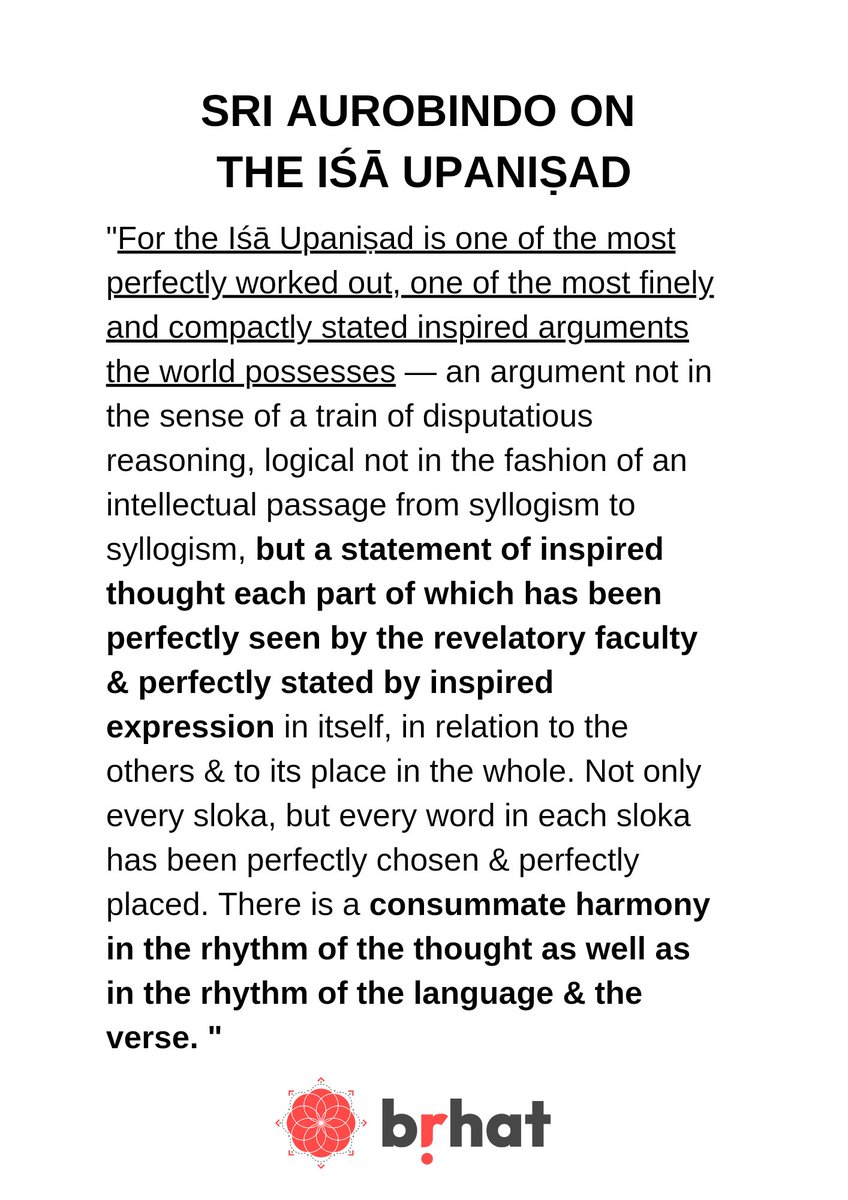
13/ Which text is a good getaway to Sanātana Dharma?
Sri Aurobindo has high praise for the Iśā Upaniṣad
Iśā Upaniṣad contains both the “inspiration of a poet possessed by divine truth”
And the “skill of a consummate architect of thought & language”
Sri Aurobindo writes:
Sri Aurobindo has high praise for the Iśā Upaniṣad
Iśā Upaniṣad contains both the “inspiration of a poet possessed by divine truth”
And the “skill of a consummate architect of thought & language”
Sri Aurobindo writes:
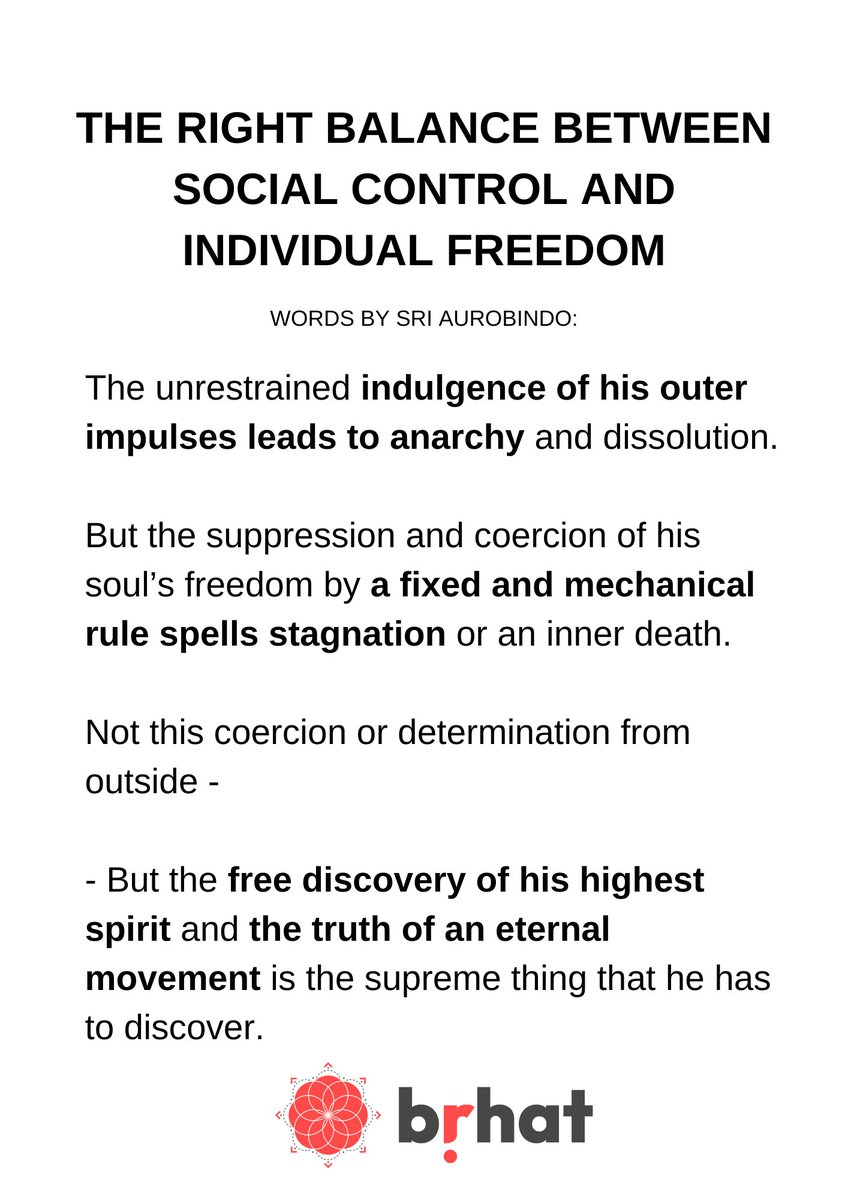
14/ On the right amount of social restraint
Zero social restraint leaves men exposed to the wild dogs of their desires
Too much restraint is an insult to our spiritual sovereignty
Therefore Sanātana Dharma aims at a balance
Sri Aurobindo articulates what this balance is:
Zero social restraint leaves men exposed to the wild dogs of their desires
Too much restraint is an insult to our spiritual sovereignty
Therefore Sanātana Dharma aims at a balance
Sri Aurobindo articulates what this balance is:
Sri Aurobindo had a gift for resolving the tension between opposing ideas
Should matter lead spirit, or vice versa?
Can philosophy & religion be more than frenemies?
What do India & the West have to teach each other?
@oldbooksguy explores:
brhat.in
Should matter lead spirit, or vice versa?
Can philosophy & religion be more than frenemies?
What do India & the West have to teach each other?
@oldbooksguy explores:
brhat.in
Loading suggestions...