
Politics
Economics
Energy
Environment
Renewable Energy
nuclear energy
Energy Economics
Nuclear Power
Energy Policy

A lot of people think that we need both renewables and nuclear, but we don't. If you have nuclear, there's no need for solar panels & wind turbines, particularly since they make electricity more expensive. The energy crisis has forced South Korea to recognize this reality.
I was the first journalist to point out what is now obvious: solar & wind make electricity more expensive. Why? Because they are unreliable & energy dilute. They depend on *reliable* power plants and are thus parasitical energy sinks, destroying wealth.
forbes.com
forbes.com
My 2018 analysis above was hotly denied by renewables advocates, but one year later economists at the Univ. of Chicago confirmed it & noted that earlier studies hadn't accounted for the unreliability of renewables & their ~300x higher land requirements.
forbes.com
forbes.com
Because solar and wind are unreliable, they lock-in natural gas power plants, I noted, which means they actually make addressing climate change harder, not easier.
forbes.com
forbes.com
The people who say "We need a mix!" of renewables and nuclear are making a political argument, not a technical or economic one.
France, Sweden, and Korea all prove that nations *don't* need a mix of renewables and nuclear to replace fossil fuels.
forbes.com
France, Sweden, and Korea all prove that nations *don't* need a mix of renewables and nuclear to replace fossil fuels.
forbes.com
Since then, some mainstream journalists have been forced to admit that over-investment in renewables and under-investment in nuclear and natural gas caused the energy crisis ravaging Europe.
michaelshellenberger.substack.com
michaelshellenberger.substack.com
It's now routine for energy analysts including Goldman Sachs to note that while the cost of solar panels & wind turbines has come down in price, they make electricity expensive because of the high cost of managing their unreliability.
michaelshellenberger.substack.com
michaelshellenberger.substack.com

At bottom, renewables make electricity expensive by returning so little energy relative to the energy invested.
Solar panels with storage deliver just 1.6x as much energy as is invested as compared to the 75x more energy delivered with nuclear.
festkoerper-kernphysik.de
Solar panels with storage deliver just 1.6x as much energy as is invested as compared to the 75x more energy delivered with nuclear.
festkoerper-kernphysik.de
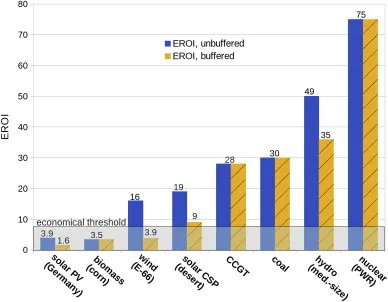
There is a perfect fit between the abstract physical theories, economic predictions, and real-world effects of renewables. It was predictable that energy-dilute renewable fuels like sunlight and wind would require far more land than either fossil fuels or nuclear, and they do.
It was predictable that renewables with such a low return-on-energy-invested would fail to produce enough energy to make recycling worthwhile, and they have. And it was predictable that such unreliable technologies would make energy so expensive, and they did.
Consider that while our high-energy economy can produce solar panels and wind turbines, a low-energy economy cannot. Imagine solar panels powering the mining, trucks, and factories needed to manufacture solar panels.
There would hardly be any energy left over for society’s other needs. In that sense, the renewables-powered economy is circular, but not in a way that produces abundant energy for infinite recycling.
Rather, renewables-powered economies are circular in the sense of spiraling downward, as in a drain, or like a snake eating its tail until there is nothing left.
And that's always been the explicit goal of greens: de-growth, de-industrialization, and de-civilization.
And that's always been the explicit goal of greens: de-growth, de-industrialization, and de-civilization.
We shouldn’t be surprised that renewables are making energy expensive. For as long as Greens have been advocating renewables they have viewed their high cost as a feature, not a bug.
Environmentalists have for decades argued that energy is too cheap and must be made more expensive in order to protect the environment. Greens viewed energy as the source of humankind’s destruction of nature and sought to restrict energy supplies.
But environmentalists got the relationship between energy and the environment backward. As people consume higher levels of energy the overall environmental impact is overwhelmingly positive, not negative.
As we consume greater amounts of energy we can live in cities, stop using wood as fuel, and afford to have fewer children. And as humans use more energy for agriculture in the form of tractors and fertilizers, we are able to grow more food on less land.
That allows marginal lands to return to grasslands, forests, and wildlife. Over time, rising electricity consumption, such as for high-speed trains in population-dense places like Europe and Asia, drives the transition from fossil fuels to zero-emissions nuclear.
The obvious alternative to Malthusian de-growth agenda is a pro-human environmental growth one. This starts with coming to grips with some fundamentals. Power density determines environmental impact.
As such, coal is good when it replaces wood and bad when it replaces natural gas or nuclear. Natural gas is good when it replaces coal and bad when it replaces uranium. Only nuclear can power our high-energy human civilization while reducing humankind’s environmental footprint.
Call it pro-human environmentalism. It will eventually triumph over apocalyptic environmentalism, I believe, because the vast majority of people in the world want both prosperity and nature, not nature without prosperity.
They are just confused about how to achieve both. For while some environmentalists claim their agenda will also deliver a greener prosperity, the evidence shows that an organic, low-energy, and renewable-powered world would be worse, not better, for people and the environment.
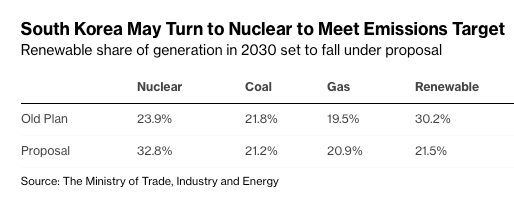
South Korea's policy U-turn is a major victory for people and the environment over climate nihilists and renewable energy zealots.
It is a long time coming. My colleagues and I have been fighting to save nuclear in South Korea for the last 6 years.
environmentalprogress.org
It is a long time coming. My colleagues and I have been fighting to save nuclear in South Korea for the last 6 years.
environmentalprogress.org
The new government was elected on a pro-nuclear platform. Public opinion shifted as Koreans saw that renewables are a bad joke, and that Korea needs nuclear to survive. It makes sense that the government is now cutting subsidies for parasitical renewables.
/END
/END
P.S. For a free overview of why renewables are so terrible for the environment and the economy, the piece I wrote for @Quillette remains the best summary out there.
quillette.com
quillette.com
Here's "Why Renewables Can't Save the Planet" as a TED talk. It now has nearly 5M views, which speaks to the lack of factual information out there about renewables, which have became a religious cult, something Europe's energy crisis will end soon enough.
youtube.com
youtube.com
Loading suggestions...