
1/ What is 'officer slavery', why do Russian army officers complain of it, and why is the Russian army like a Roach Motel – officers can check in, but they can't check out? Here's the first part of a 2-part 🧵 on why it can be hard to leave the Russian army if you're an officer.

2/ Even though the law allows Russian soldiers to resign from their contracts, many officers have complained that the army has prevented them doing so. Instead it's forced them to serve against their will – a situation some have called 'officer slavery'.
3/ Why do officers want to leave the army? (Note that this was before the war in Ukraine, which has given them many excellent new reasons, not least staying alive.)
The case of Dr. Andrei Ivanov, who joined the army as a lieutenant specialising in medicine, provides an example.
The case of Dr. Andrei Ivanov, who joined the army as a lieutenant specialising in medicine, provides an example.

4/ Ivanov studied for 5 years at the Military Medical Academy with the aim of being a doctor in the Airborne Forces. Instead, after qualifying he was sent to lead an infantry platoon in Crimea, rather than practicing medicine. His experience was not unique.
5/ Another officer, Pavel Zelenkov, had a similar experience to Ivanov. He also entered the academy for medical training but found himself working as an ordinary infantryman carrying out 'field trips' instead of medicine. His commanders made fake photo reports to their superiors.
6/ "All medicine was reduced to window dressing. Before a field trip you get dressed up like for a masquerade, you get photographed – a report is sent to command, everyone returns to their places."

7/ When Zelenkov took up his new post in Klintsy, he found that "in terms of medical equipment, there was practically nothing there. You only administer first aid and get sent on your way, so there was nothing in line with what the medical unit was initially designed for."
8/ Lieutenant Kirill Olenyev, a logistics officer, found himself in a similar situation. He was posted to a unit in Yoshkar-Ola but found himself being used for menial labour, prompting his decision to quit a year later.
9/ Olenyev's pay was low, he had no free time, and his duties were limited to shoveling earth, cleaning his unit's area and mowing the grass - things for which, he noted, he did not need to spend five years studying at a military university.

10/ "The situation is catastrophic," Andrei Ivanov wrote on Instagram, "not only young officers are fleeing the army, but also contract servicemen who understand the futility of their job and don't want to tolerate the bestial attitude, with a salary less than McDonald's."
11/ He highlighted the failure of the army to provide for its servicemen, including junior officers, commenting bitterly that "the social guarantees that are promised at the entrance are [left] there."
12/ "For example, housing is either not given or cannot be provided (there are exceptions); even if rent is paid, it is almost always not enough and servicemen often have to spend a large part of their small salary on a flat."
13/ Even if accommodation is provided, the living conditions can be appalling. Another lieutenant, Pavel Petrakov, filmed and described the slum-like conditions in the dormitory where he lived as a member of the elite Military Space Academy.

14/ "We tried to go with the commandant into the room that was allocated to me, but the door just [went] bang and fell down. There was natural [human] shit all around and the stench was so bad that I almost vomited."
15/ A journalist who visited Petrakov's dormitory wrote: "The door is back in place, boarded up. The tattered walls in the dormitory and the floors on the stairs are covered in dried blood stains, the glass in the corridors has been broken out and is lying around.

16/ "The only place where you can wash yourself is on the ground floor: two taps work in the men's shower room and three in the women's room. There are cockroaches in the pots left in the kitchen.

17/ "Children's things are scattered everywhere, as if the people who live here had been urgently evacuated and left everything in a moment, just like in the TV series 'Chernobyl'. But these are living quarters, officers and warrant officers with their families living like this."
18/ The food is just as bad. In 2019, 52 officer cadets of the Airborne Forces at the Ulyanovsk Suvorov School were infected with tapeworms, most likely after eating contaminated food. As one cadet said to his mother afterwards, "The army is hell, it's rotten."
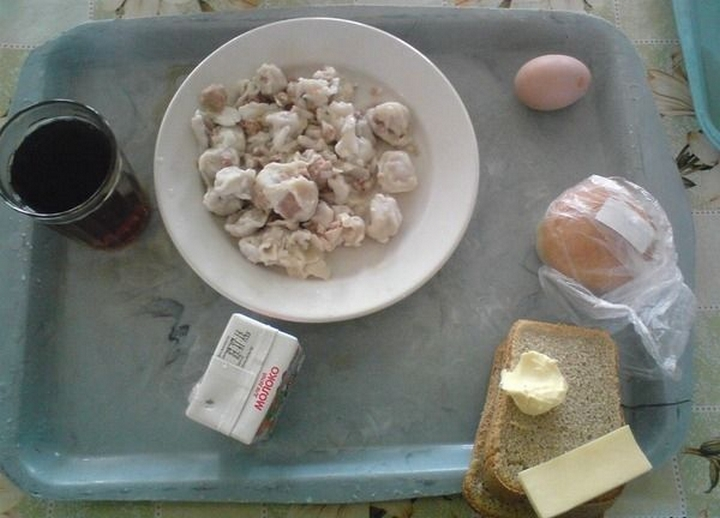
19/ A parent of one of the cadets told a Russian TV station: "The guys kept complaining about the food, saying there were worms in the food, hair, nails, the tables smelt of dirty rags, but to be honest, we just didn't believe it.
20/ "Yes, we saw the underwear they were given, it had holes in it. Or shoes that were falling apart on the move. And still we couldn't believe it, we thought they were making it up - this was an elite Guards school, it just couldn't be."

21/ One way to avoid the awful living conditions is for an officer to buy their own house or apartment. The military provides mortgages for officers, but at excessive rates, as Andrei Ivanov notes:
22/ "A military mortgage is pure slavery: if you become uncomfortable, you get fired and have to pay the entire sum yourself or live on the street. In fact, what is the point of taking one if the civilian rate is lower than that of the military one?"
23/ Commanders are also incentivised to hide the true state of health of their subordinates: "Injuries and pneumonia are concealed so as not to expose commanders to liability, and thus no serviceman receives any pay or sick leave."
24/ Another bone of contention is the so-called 'voluntary-compulsory requisition', which further drains officers' wages. Due to corruption and bureaucratic inefficiency, officers are forced to pay for their unit's upkeep from their own salaries.
25/ "Go buy paper, paint, printer, repair the barracks, equipment. You can say as much as you want that everything is given away, but in reality you buy everything with your own blood money."
26/ To make ends meet, Ivanov says, officers must earn extra money through side jobs carried out in whatever limited spare time they get, or through scams and corruption.
27/ "Someone works, most often as [a] taxi driver, someone steals (if his position and conscience allow him), someone earns using his official position (turns a blind eye to absenteeism, writes out additional bonuses for kickbacks)."
![27/ "Someone works, most often as [a] taxi driver, someone steals (if his position and conscience al...](https://pbs.twimg.com/media/FbhJJW4XoAUcqSZ.jpg)
28/ Junior officers are also badly overworked, according to Ivanov. "They [are] set impossible tasks at the end of the day and are too short of brains or balls to defend their right to rest."
29/ "Overwork, no one cares if you were on duty – go shit in the park! Night shooting [practice] and classes? Line-ups at 6 am the next day. Sunday, I'll finally get some sleep – shit, they'll put me in an outfit or physical training."
30/ He also deplored the abuse that officers meted out to conscripts, including forcing them to sign contracts against their wishes by beating them until they gave in. He qoutes one former officer telling him:
"Our officers 'reeled in' guys who were conscripted."
"Our officers 'reeled in' guys who were conscripted."
31/ "The officer says before lights out, we have to 'give birth to a contract soldier', and asks who wants to sign a contract – nobody wants to, and the guys start swinging until somebody gives up and signs it."

32/ The officers may have been motivated by a Russian Ministry of Defence scheme to release funds for refurbishment to barracks only if the unit concerned consisted entirely of contract soldiers, as part of the professionalisation of the Russian Army. This led to serious abuses.
33/ At one unit in Perm, dozens of soldiers were reportedly lined up in a row and left out for hours in the winter cold and summer sun. Those who agreed to sign contracts were allowed to go to the barracks.
34/ The more reluctant ones were beaten up by older soldiers, while "the most stubborn ones would be given their own fist in the commander's office." Another unit took a similar approach, lining up conscripts outside in the cold with no clothes above the waist until they signed.

35/ Other officers supplemented their salaries by simply robbing lower-ranking soldiers, who are paid in cash. In one unit, officers seized half of the salaries of the contract soldiers under their command, enabling even low-paid junior lieutenants to buy foreign cars.
36/ Such abuses have been publicised by parents' groups, but have also appalled many of the more responsible officers. Like Ivanov, Pavel Petrakov was also deeply disillusioned at the behaviour of many of his fellow officers.
37/ "When I went to military school, I thought the army was cool, officers are the elite of society, I never even imagined that you can drink and yell at children like that, they are pigs at home and in the workplace they drink."
38/ "The nastiest thing that makes many people leave the army is that you are treated like cattle: everyone who is even a step above you considers himself a god, it is impossible to talk [to them] in a human way."
39/ Not surprisingly, such mistreatment, neglect and the dreadful conditions often endured by junior officers has driven many of them to try to leave the army. But this is easier said than done.
40/ I'll continue this thread in a second part in which I'll cover how the Russian army has responded to officers trying to leave (hint: badly) – and what qualities appear to be required to be a successful officer. /end
Loading suggestions...