

Starting today, going to write threads on papers on non-genetic heritability & clonal heterogeneity (new + exciting areas) for a week.
Starting w/ @arjunrajlab ’s MemorySeq paper from 2020, which I think is crucial and quite a nice intro to the field:
cell.com
Starting w/ @arjunrajlab ’s MemorySeq paper from 2020, which I think is crucial and quite a nice intro to the field:
cell.com
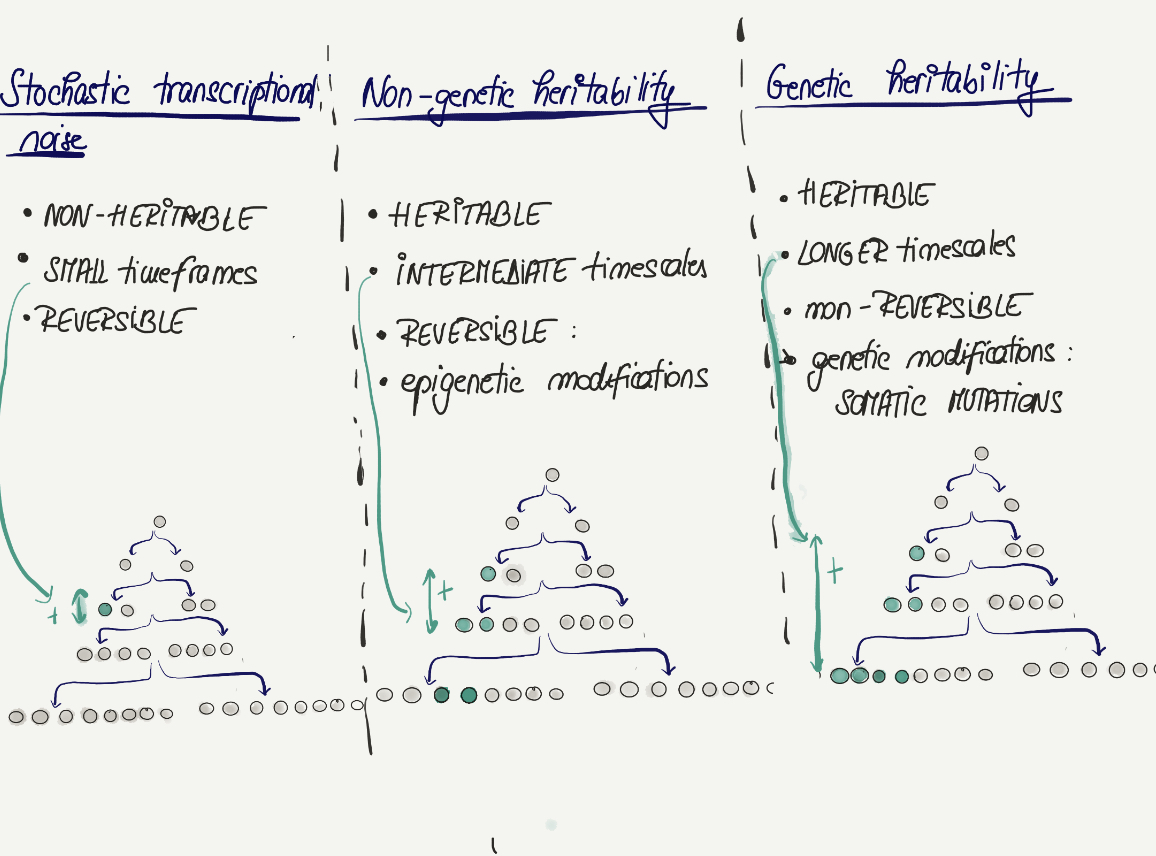
So what is non genetic heritability?
Cells can retain “memories” of gene expression according to the lineage they derive from & these memories are clonally transmitted.
One of the most obvious mechanisms of transmitting cellular memories is through permanent somatic mutations
Cells can retain “memories” of gene expression according to the lineage they derive from & these memories are clonally transmitted.
One of the most obvious mechanisms of transmitting cellular memories is through permanent somatic mutations
This has been widely studied, particularly in the context of cancer, where somatic mutations lead to clonal expansions and tumour progression.
Non generic heritability aims to quantify a different type of cellular “memory”: one that lies on an intermediate scale
Non generic heritability aims to quantify a different type of cellular “memory”: one that lies on an intermediate scale
Between the Permanent nature of somatic mutations and the rapid fluctuations of transcriptional noise.
The molecular basis of such memories could be epigenetic modifications bcs Epigenetic mods are:
1) heritable
2) more reversible than mutations.
The molecular basis of such memories could be epigenetic modifications bcs Epigenetic mods are:
1) heritable
2) more reversible than mutations.

How does MemorySeq aim to quantify such intermediate timescale cellular memory?
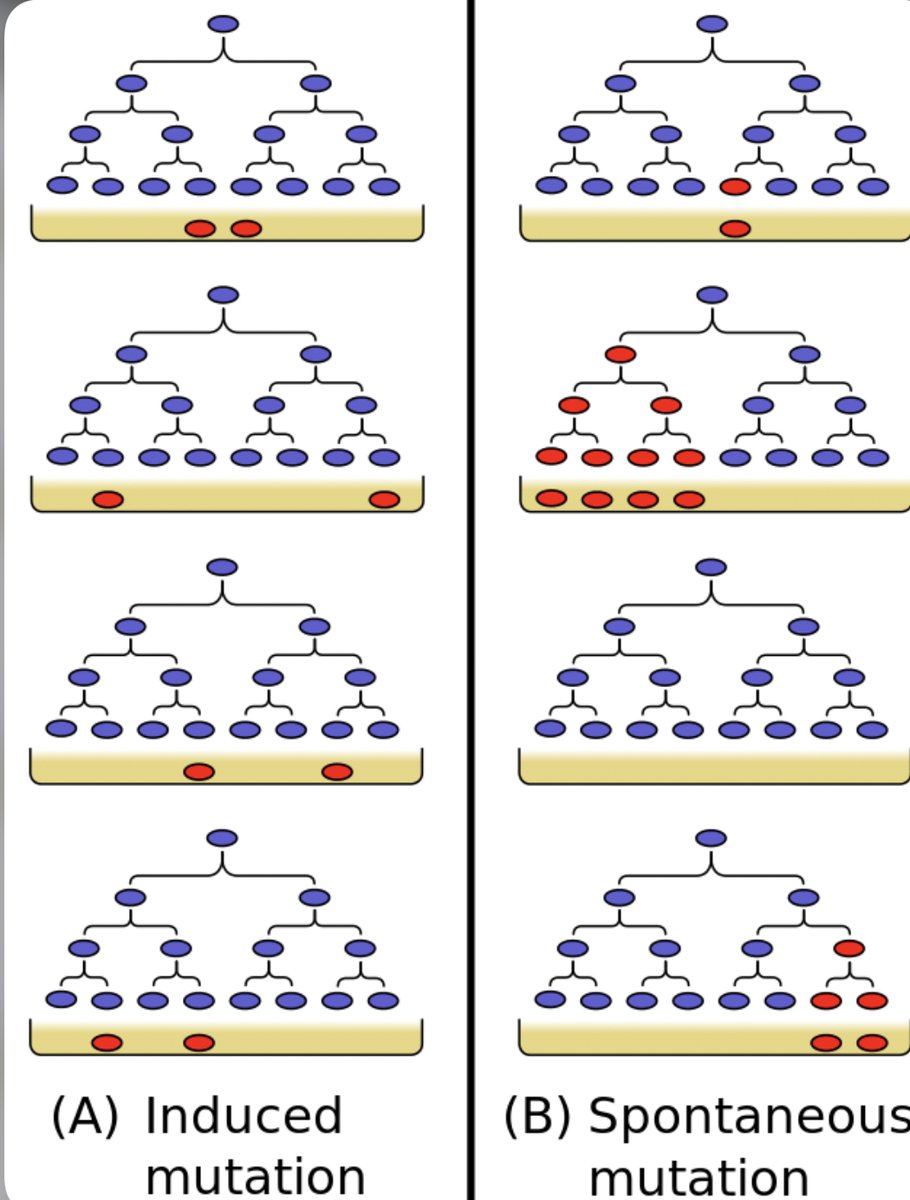
Single cells from a melanoma cell line (WM989-A6) were seeded into 48 separate wells and allowed to proliferate. The clones were then subjected to RNASeq.
Single cells from a melanoma cell line (WM989-A6) were seeded into 48 separate wells and allowed to proliferate. The clones were then subjected to RNASeq.
In the case of non- heritable gene expression, the levels of expression would not vary dramatically between MemorySeq clones, whereas in the heritable case, some clones would exhibit much higher levels of expression.
See pic 👇
See pic 👇

This is a neat and elegant modification of the famous Luria-Delbruck experiments used to demonstrate that in bacteria genetic mutations arise in the absence of selective pressure, rather than being a response to it.
As a science history nerd, I appreciate this.
As a science history nerd, I appreciate this.
Crucially, genes which had previously been associated with resistance to cancer in this specific melanoma type (EGFR, NGF) showed higher levels of variability. By contrast housekeeping genes showed low variability.
This hints at a possible biological role of this heterogeneity.
This hints at a possible biological role of this heterogeneity.
Then, the authors tried to directly confirm the key prediction of MemorySeq:
That a gene which shows high variability across MemorySeq clones would occasionally initiate high levels of expression that can persist across multiple cell divisions but don’t persist indefinitely.
That a gene which shows high variability across MemorySeq clones would occasionally initiate high levels of expression that can persist across multiple cell divisions but don’t persist indefinitely.
To test this they used experimental techniques including: genetic tagging + fluorescence microscopy & RNA-FISH experiments.
Key metrics used to measure heritability correlated well between MemorySeq and these experiments.
E.g spatial clustering (RNA-FISH)& skewness (MemorySeq)
Key metrics used to measure heritability correlated well between MemorySeq and these experiments.
E.g spatial clustering (RNA-FISH)& skewness (MemorySeq)

The final part of the paper addresses what might be the most interesting question posed by this paper: what might be the biological implications of such non- genetic heritability?
As hinted by the types of genes that are “affected” by this, a candidate could be drug resistance
As hinted by the types of genes that are “affected” by this, a candidate could be drug resistance
Populations of cells high in genes identified as heritable by MemorySeq (e.g EGFR, CA9) were sorted from 2 melanoma cell lines.
These populations were more resistant to common chemotherapy drugs than the cells low in these genes, as shown in pic below 👇
These populations were more resistant to common chemotherapy drugs than the cells low in these genes, as shown in pic below 👇

This strongly implicates Non genetic heritability as having a role in drug resistance.
Heritable expression of certain genes would lead to functionally distinct subpopulations that could account for drug resistance.
Thus, MemorySeq could serve as a tool of IDing these subpopulations that are not easy to identify via other methods.
Thus, MemorySeq could serve as a tool of IDing these subpopulations that are not easy to identify via other methods.
An interesting obs. :
Heritable gene expression changes could be more powerful biologically if instead of affecting only one gene at once, they would act on multiple genes.
The impacts of these co-variables genes would thus re-enforce each other to produce a greater effect.
Heritable gene expression changes could be more powerful biologically if instead of affecting only one gene at once, they would act on multiple genes.
The impacts of these co-variables genes would thus re-enforce each other to produce a greater effect.
So do such co-fluctuating gene modules (which make sense in theory) exist?
The authors do indeed go on to identify groups of genes that co-fluctuate within these transient subpopulations.
Based on these correlations, the authors propose the presence of multiple independent heritable gene expression programs.
👇 2 such programs in WM989-A6 cells:
Based on these correlations, the authors propose the presence of multiple independent heritable gene expression programs.
👇 2 such programs in WM989-A6 cells:
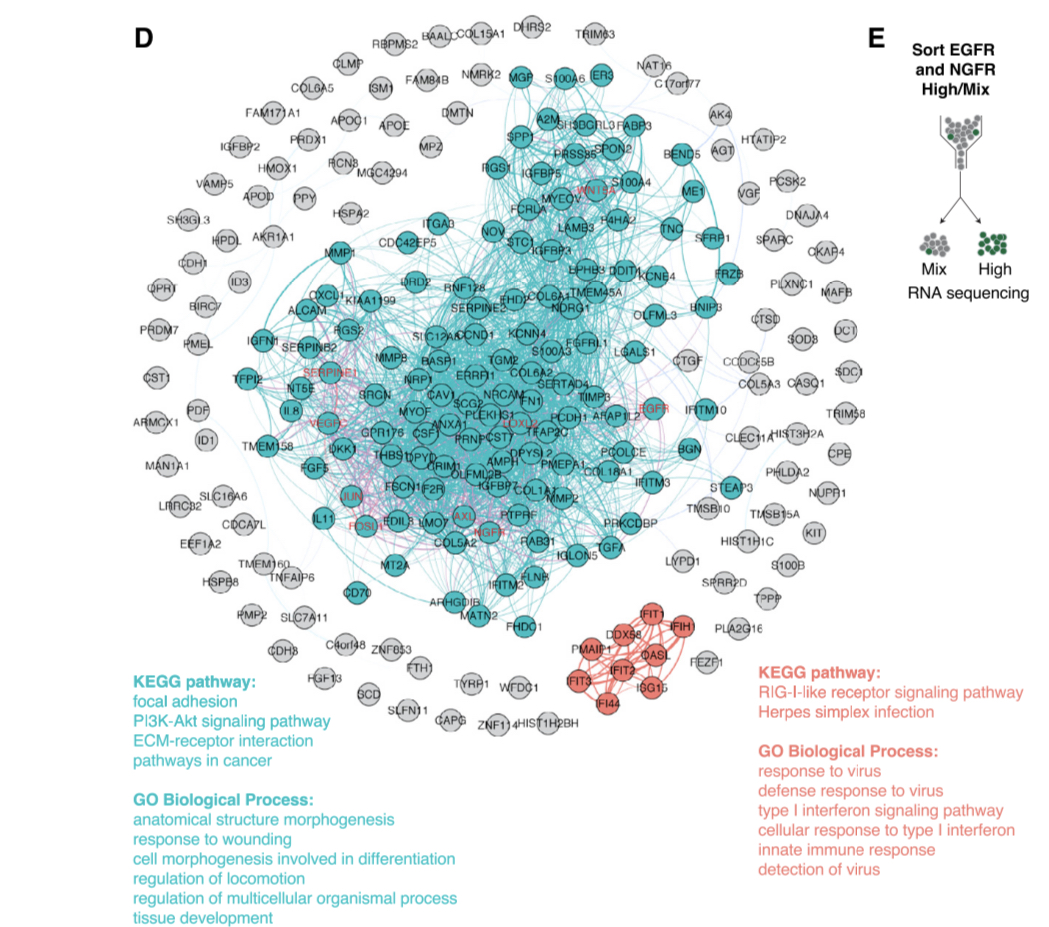
Notably, some of the genes within an individual “heritability module” are scattered across different chromosomes, raising an important question as to the mechanism that allows for such co-fluctuation.
Identifying the molecular mechanism is very briefly attempted in the paper, but it’s more of an afterthought (which is understandable given how complex the paper already is).
This is not to criticise the paper, but rather to highlight that identifying the mechanisms behind this non-genetic heritability is one of the major open questions posed by this paper.
The paper does briefly point towards some transcription factors and histone mods.
The paper does briefly point towards some transcription factors and histone mods.
Something I take issue is the phrasing in this part of the paper 👇
In particular this part seems to suggest that the genes would be expressed independently of each other and the only mechanism of co-occurrence is via the increased timescales which increase the prob.
In particular this part seems to suggest that the genes would be expressed independently of each other and the only mechanism of co-occurrence is via the increased timescales which increase the prob.

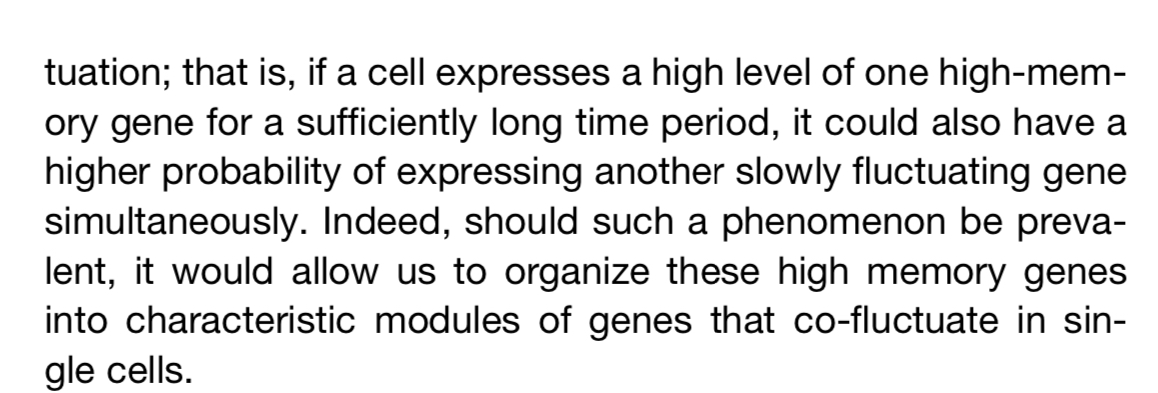
Of 2 Events co-occurring.
However, it’s suggested the expression of genes organised in “modules” is correlated (so not independent events) & that there are biological mechanisms that underpin their co-expression across chromosomes.
However, it’s suggested the expression of genes organised in “modules” is correlated (so not independent events) & that there are biological mechanisms that underpin their co-expression across chromosomes.
Overall I liked this paper a lot & I found the initial MemorySeq experiment to be particularly elegant.
I think it’s a nice intro to the very new field of non-generic heritability.
I think it’s a nice intro to the very new field of non-generic heritability.
I hope to explore other papers in the coming days and show how non-genetic heritability is relevant to a bunch of questions beyond drug resistance which include: cell type classification, differentiation, immune response + somatic evolution.
Loading suggestions...