

1) What if I told you the S&P 500 will reach new record highs in six months and continue rising for a few more years.
Is that something you’d be interested in? 🧵
Is that something you’d be interested in? 🧵
2) A lot of stock charts look like death right now. But zoom out and you notice something special.
A secular bull market is in progress.
A secular bull market is in progress.
3) A secular bull market is a period of prolonged above-average returns (15 to 20 years).
Valuations expand, risk-taking looks attractive, and neither pullbacks nor recessions disrupt the upward trend.
A secular bear market is the opposite.
Valuations expand, risk-taking looks attractive, and neither pullbacks nor recessions disrupt the upward trend.
A secular bear market is the opposite.
4) Since the Second World War there have been three secular bull markets. The first one lasted from 1950 to 1968.
It was brought about by the S&P 500 breaking out above the 20 level, which had served as a ceiling since 1937.
It was brought about by the S&P 500 breaking out above the 20 level, which had served as a ceiling since 1937.
5) The S&P 500 gained 445 percent despite three recessions, the Korean War, the Cuban Missile Crisis, the assassination of President Kennedy, and the race riots of the 1960s.
6) Bond yields rose the entire time.
The 10-year yield went from 2.2 percent to 5.6 percent.
The stock market was unaffected by this.
In fact, the 1950s was the best decade for stocks ever.
The 10-year yield went from 2.2 percent to 5.6 percent.
The stock market was unaffected by this.
In fact, the 1950s was the best decade for stocks ever.
7) The next secular bull market was 1980 to 2000. The S&P 500 increased by 1,400 percent.
This is despite two recessions, the crash of 1987, the Japanese bubble bursting, the Savings and Loan crisis, the first Gulf War, the Asian financial crisis, and the Russian debt crisis.
This is despite two recessions, the crash of 1987, the Japanese bubble bursting, the Savings and Loan crisis, the first Gulf War, the Asian financial crisis, and the Russian debt crisis.
8) Hitting 1,500 in the year 2000, the S&P 500 only managed to exceed this level thirteen years later in 2013.
That’s when the third secular bull market in the postwar era began.
That’s when the third secular bull market in the postwar era began.
9) Decisively breaking the confines of the post-2000 secular bear market, the S&P 500 has increased by 173 percent thus far.
This is despite fractured US politics, a global pandemic, unacceptably high inflation, the Russian-Ukraine war, and Europe’s energy crisis.
This is despite fractured US politics, a global pandemic, unacceptably high inflation, the Russian-Ukraine war, and Europe’s energy crisis.
10) There were three corrections of more than 20 percent between 1950 and 1968 but that did not disrupt the secular uptrend.
Three corrections of over 20 percent occurred in the 1980 to 2000 secular bull period as well.
In the current secular bull, we have had two so far.
Three corrections of over 20 percent occurred in the 1980 to 2000 secular bull period as well.
In the current secular bull, we have had two so far.
11) I looked at past cyclical bear markets (a decline of 20 percent or more) since 1950.
The S&P 500 declined 27 percent on average in secular bull periods but fell 43 percent during secular bear periods.
The S&P 500 declined 27 percent on average in secular bull periods but fell 43 percent during secular bear periods.
12) Whereas it took an average of 9 months to recover its previous highs during secular bull markets, the recovery took an average 48 months during secular bear markets.
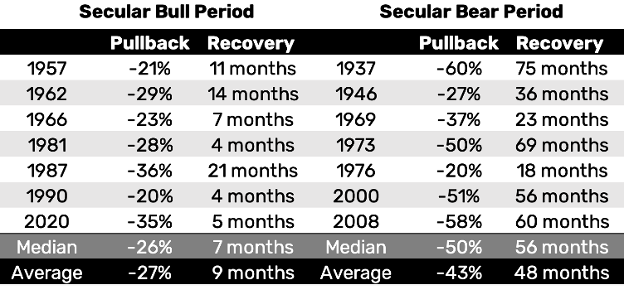
13) This gives me confidence that the correction has ended with the low in mid-June, and we are quickly returning to the highs.
What if the greatest trick the market ever pulled was convincing investors that we’re still in a bear market?
stray-reflections.com
What if the greatest trick the market ever pulled was convincing investors that we’re still in a bear market?
stray-reflections.com
14) Comparisons to the large bear market rallies in 2001 and 2008 are irrelevant because they occurred during a secular bear market.
This secular bull cycle is still just two-thirds of the way done.
This secular bull cycle is still just two-thirds of the way done.
15) But but but... stocks are still expensive. What about valuations?
In the secular bull market that lasted until 1968, the PE reached as high as 22 in 1961 and was still 17.8 at the 1968 top before declining to 7.4 during the secular bear market that lasted until 1980.
In the secular bull market that lasted until 1968, the PE reached as high as 22 in 1961 and was still 17.8 at the 1968 top before declining to 7.4 during the secular bear market that lasted until 1980.
16) Today the PE ratio sits at 20.8 after peaking at 24.8 in 2020.
Even if valuations may have reached their cycle top, it would be foolish to bet on a mean reversion during a secular bull market.
Valuations may stay high for the remainder of this cycle.
Even if valuations may have reached their cycle top, it would be foolish to bet on a mean reversion during a secular bull market.
Valuations may stay high for the remainder of this cycle.
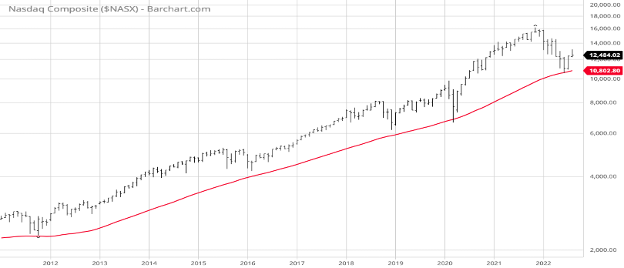
17) We get the same positive message looking at long-term charts.
The Nasdaq Composite has continued to trade above its 50-day moving average (on a monthly chart).
The index’s drawdown that took place this year ended precisely where you would expect it to.
The Nasdaq Composite has continued to trade above its 50-day moving average (on a monthly chart).
The index’s drawdown that took place this year ended precisely where you would expect it to.
18) Semis have the highest inventory build ever, memory chip prices are falling, and consumer demand for smartphones and personal computers is slowing, yet the Philadelphia Semiconductor Index remains in a secular uptrend.
The chip boom is not over.
The chip boom is not over.

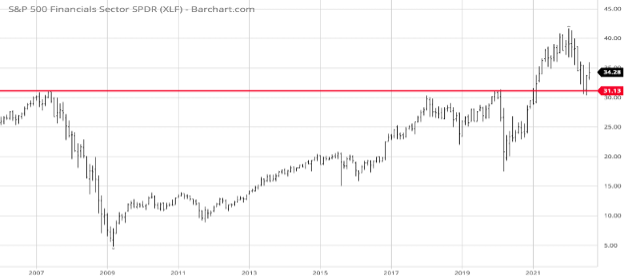
19) It took the financials sector fourteen years to finally break above the 2007 highs.
This year the breakout level was successfully retested, and the uptrend has since resumed.
The same is true for homebuilding stocks.
This year the breakout level was successfully retested, and the uptrend has since resumed.
The same is true for homebuilding stocks.
20) Zoom out. A secular bull market is in progress.
Are you bullish enough?
I get into the underlying fundamental forces driving this secular uptrend (members-only). 👇
stray-reflections.com
Are you bullish enough?
I get into the underlying fundamental forces driving this secular uptrend (members-only). 👇
stray-reflections.com
21) Follow me @jsmian to meaningfully inform your investing (and maybe even your inner life).
As Rumi says: “Be with those who help your being.”
As Rumi says: “Be with those who help your being.”
22) If you’re interested in joining the Stray Reflections community, you can learn a tiny bit more about us here: stray-reflections.com
Some of the world’s top investors rely on us for clarity, conviction, and a sense of calm.
🙏
Some of the world’s top investors rely on us for clarity, conviction, and a sense of calm.
🙏
Loading suggestions...