

10 Stoic concepts that will make your life way better:
1/ The dichotomy of control
The most important practice in Stoicism is identifying what we control & what we don’t.
We don't control what happens, but we do control how we respond to what happens.
“The chief task in life," Epictetus said, is focusing on what we can control.
The most important practice in Stoicism is identifying what we control & what we don’t.
We don't control what happens, but we do control how we respond to what happens.
“The chief task in life," Epictetus said, is focusing on what we can control.
2/ The two handles
“Every event has two handles,” Epictetus said.
In traffic? You can grip the frustration OR the chance to listen to more of that podcast.
Laid off? You can see it as unfortunate OR as an exciting challenge.
Life is always asking: Which handle will you grab?
“Every event has two handles,” Epictetus said.
In traffic? You can grip the frustration OR the chance to listen to more of that podcast.
Laid off? You can see it as unfortunate OR as an exciting challenge.
Life is always asking: Which handle will you grab?
3/ The obstacle is the way
The Stoics practiced turning obstacles upside down.
Marcus Aurelius said, “The impediment to action advances action. What stands in the way becomes the way."
That's the line that inspired @RyanHoliday's cult classic, The Obstacle is the Way…
The Stoics practiced turning obstacles upside down.
Marcus Aurelius said, “The impediment to action advances action. What stands in the way becomes the way."
That's the line that inspired @RyanHoliday's cult classic, The Obstacle is the Way…

4/ The power of perceptions
Epictetus famously said, "It's not things that upset us but our judgments about things."
There is no good or bad without us, there is only perception.
There is the event itself and the story we tell ourselves about what it means.
Epictetus famously said, "It's not things that upset us but our judgments about things."
There is no good or bad without us, there is only perception.
There is the event itself and the story we tell ourselves about what it means.
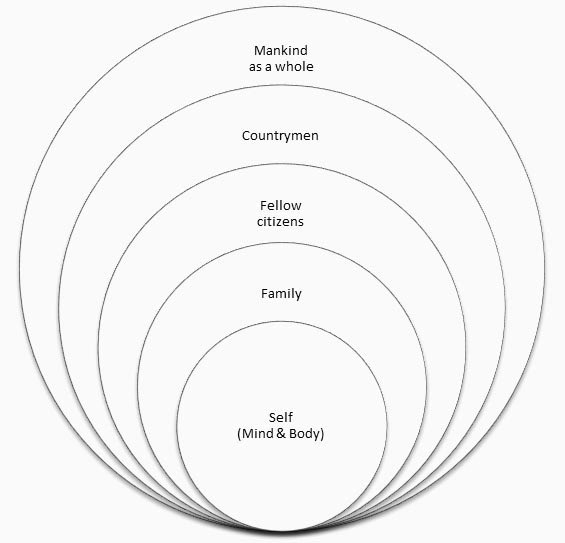
5/ The circles of concern
Our first concern, the Stoics said, is our self.
Then our family, our community, our country, our world.
The work of philosophy is to draw these concerns inward—to learn to care about as many people as possible, to do as much good as possible.
Our first concern, the Stoics said, is our self.
Then our family, our community, our country, our world.
The work of philosophy is to draw these concerns inward—to learn to care about as many people as possible, to do as much good as possible.
6/ Amor fati
The Stoic's recipe for greatness was amor fati (a love of fate).
You don't just accept what happens, you find a way to love everything that happens.
Marcus Aurelius' metaphor was: a blazing fire makes flame & brightness out of everything that is thrown into it.
The Stoic's recipe for greatness was amor fati (a love of fate).
You don't just accept what happens, you find a way to love everything that happens.
Marcus Aurelius' metaphor was: a blazing fire makes flame & brightness out of everything that is thrown into it.
7/ The habit bonfire
You are what you repeatedly do.
Epictetus said habits—good & bad—are like a bonfire. Every time we perform a habit, we reinforce it, we add fuel to the fire.
First decide who you want to be, Epictetus said, then do what you have to do.
You are what you repeatedly do.
Epictetus said habits—good & bad—are like a bonfire. Every time we perform a habit, we reinforce it, we add fuel to the fire.
First decide who you want to be, Epictetus said, then do what you have to do.
8/ Premeditatio malorum
The worst thing you can say, Seneca said, is 'I didn't think that could happen.'
This is why the Stoics practiced premeditatio malorum—the premeditation of evils.
You have to be prepared...always. You can't be surprised by the twists & turns of life.
The worst thing you can say, Seneca said, is 'I didn't think that could happen.'
This is why the Stoics practiced premeditatio malorum—the premeditation of evils.
You have to be prepared...always. You can't be surprised by the twists & turns of life.
9/ The 4 virtues
Marcus Aurelius called them the “touchstones of goodness.”
Courage.
Temperance.
Justice.
Wisdom.
“If,” Marcus wrote, “you should come across anything better than [the 4 virtues]…embrace it without reservations—it must be an extraordinary thing indeed.”
Marcus Aurelius called them the “touchstones of goodness.”
Courage.
Temperance.
Justice.
Wisdom.
“If,” Marcus wrote, “you should come across anything better than [the 4 virtues]…embrace it without reservations—it must be an extraordinary thing indeed.”
10/ Memento mori
Memento mori—mortality—puts everything in perspective.
It is not that life is short, Seneca said, it's that we waste a lot of it.
Which is why Marcus Aurelius reminded himself: you could leave life right now—let that determine what you do, say, & think.
Memento mori—mortality—puts everything in perspective.
It is not that life is short, Seneca said, it's that we waste a lot of it.
Which is why Marcus Aurelius reminded himself: you could leave life right now—let that determine what you do, say, & think.
That's 10 Stoic concepts that will make your life way better.
If you enjoyed this thread:
1. Follow @dailystoic for daily content that will make your life better.
2. RT the tweet below to share it with people who might also enjoy it:
If you enjoyed this thread:
1. Follow @dailystoic for daily content that will make your life better.
2. RT the tweet below to share it with people who might also enjoy it:
And if you want to receive content like this straight to your inbox...
Every morning, we send a short email inspired by the timeless wisdom of the Stoics & aimed at helping you cultivate strength, insight, & wisdom to live your best life.
Subscribe here: dailystoic.com
Every morning, we send a short email inspired by the timeless wisdom of the Stoics & aimed at helping you cultivate strength, insight, & wisdom to live your best life.
Subscribe here: dailystoic.com
Loading suggestions...