

1/ How do we design a permission system? The diagram below lists 5 common ways. 👇
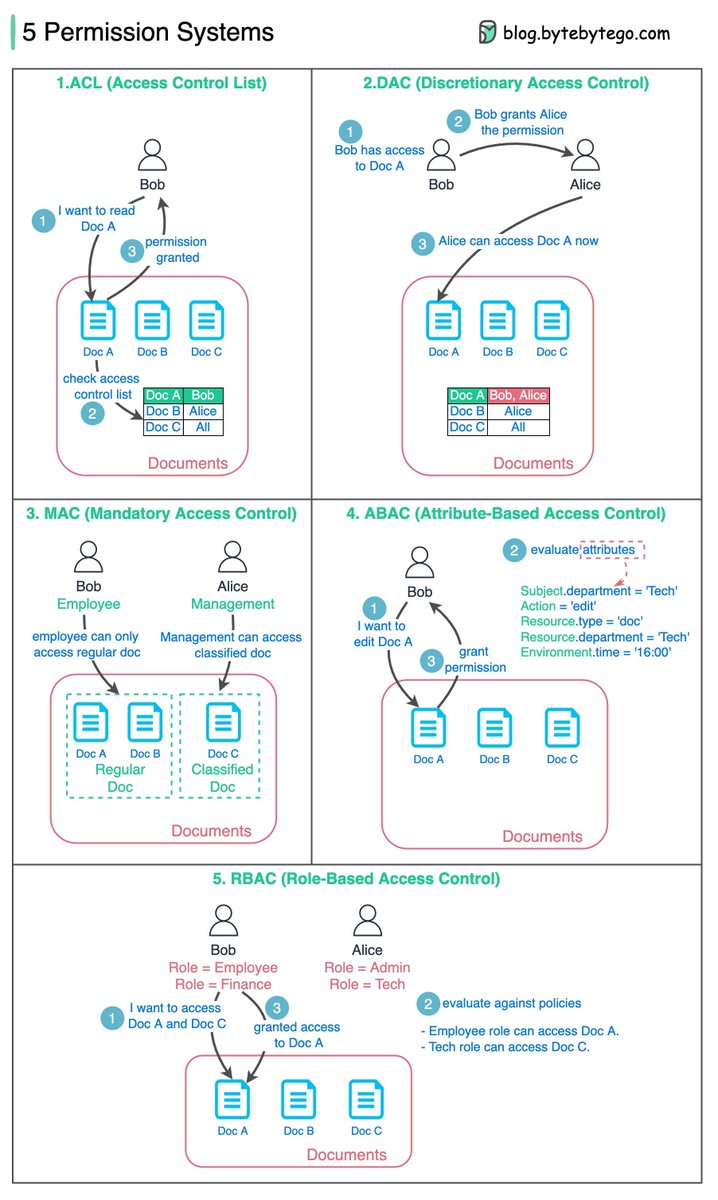
2/ 1. ACL (Access Control List)
ACL is a list of rules that specifies which users are granted or denied access to a particular resource.
Pros - Easy to understand.
Cons - error-prone, maintenance cost is high
ACL is a list of rules that specifies which users are granted or denied access to a particular resource.
Pros - Easy to understand.
Cons - error-prone, maintenance cost is high
3/ 2. DAC (Discretionary Access Control)
It grants or restricts object access via an access policy determined by an object's owner group.
Pros - Easy and flexible. Linux file system supports DAC.
Cons - Scattered permission control, too much power for the object’s owner group
It grants or restricts object access via an access policy determined by an object's owner group.
Pros - Easy and flexible. Linux file system supports DAC.
Cons - Scattered permission control, too much power for the object’s owner group
4/ 3. MAC (Mandatory Access Control)
Both resource owners and resources have classification labels. Different labels are granted with different permissions.
Pros - strict and straightforward.
Cons - not flexible.
Both resource owners and resources have classification labels. Different labels are granted with different permissions.
Pros - strict and straightforward.
Cons - not flexible.
5/ 4. ABAC (Attribute-based access control)
Evaluate permissions based on attributes of the Resource owner, Action, Resource, and Environment.
Pros - flexible
Cons - the rules can be complicated, and the implementation is hard. It is not commonly used.
Evaluate permissions based on attributes of the Resource owner, Action, Resource, and Environment.
Pros - flexible
Cons - the rules can be complicated, and the implementation is hard. It is not commonly used.
6/ 5. RBAC (Role-based Access Control)
Evaluate permissions based on roles
Pros - flexible in assigning roles.
Evaluate permissions based on roles
Pros - flexible in assigning roles.
8/ I hope you've found this thread helpful.
Follow me @alexxubyte for more.
Like/Retweet the first tweet below if you can:
Follow me @alexxubyte for more.
Like/Retweet the first tweet below if you can:
Loading suggestions...