

Making Blockchains Suck Less
My most recent conference talk the form of a (long) thread 🧵
Featuring @arbitrum Nova, @cosmos, @ignite_com, @LensProtocol, @0xPolygon, @fuellabs_, @biconomy, @AptosLabs, @Mysten_Labs, @CelestiaOrg, and more.
1/n 👇
My most recent conference talk the form of a (long) thread 🧵
Featuring @arbitrum Nova, @cosmos, @ignite_com, @LensProtocol, @0xPolygon, @fuellabs_, @biconomy, @AptosLabs, @Mysten_Labs, @CelestiaOrg, and more.
1/n 👇
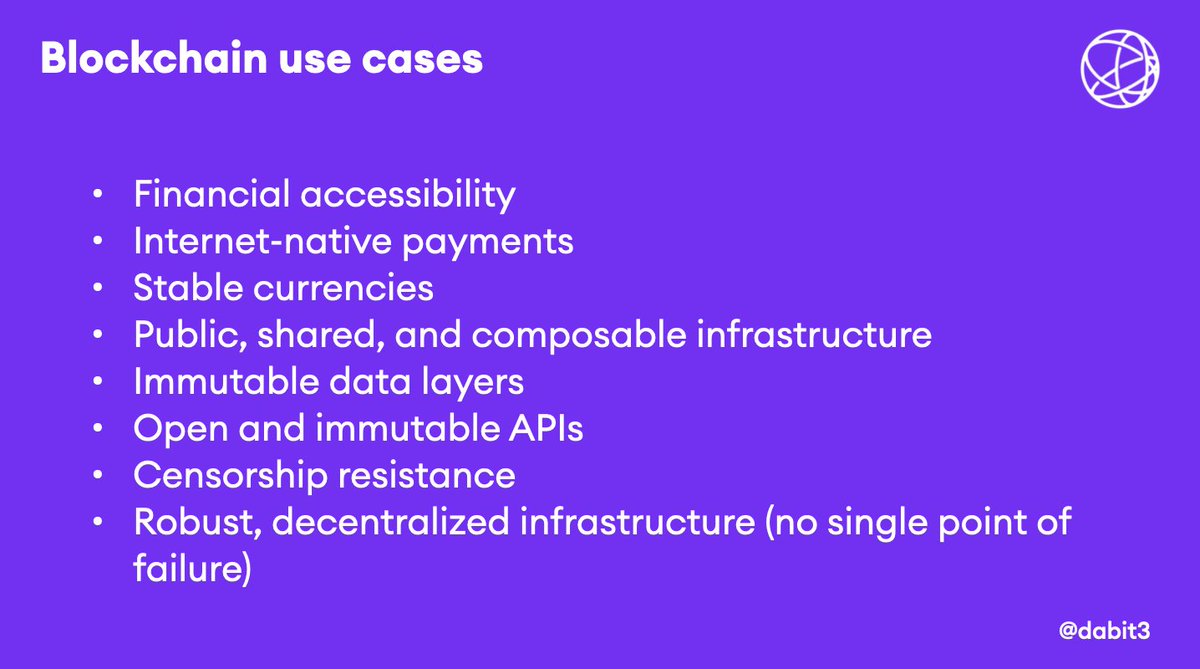
We'll begin with use cases.
I bucket them into two main categories - financial and non-financial.
Financial of course being crypto-related.
Non-financial being data and infrastructure-related (closer to how we might use a traditional database).
I bucket them into two main categories - financial and non-financial.
Financial of course being crypto-related.
Non-financial being data and infrastructure-related (closer to how we might use a traditional database).
Beyond financial use cases, what excites me the most has to do with composable, public data and infrastructure.
Developers are using decentralized networks as open APIs that are not controlled or owned by anyone.
Developers are using decentralized networks as open APIs that are not controlled or owned by anyone.
Like Open Source Software (OSS,) we now have Open Source Infrastructure (OSI).
Open source software was revolutionary because it allowed developers to easily share, fork, and reuse each others code.
Open Source Infrastructure does the same, but with data, backends, and APIs.
Open source software was revolutionary because it allowed developers to easily share, fork, and reuse each others code.
Open Source Infrastructure does the same, but with data, backends, and APIs.
⚫️ Challenges for blockchain adoption
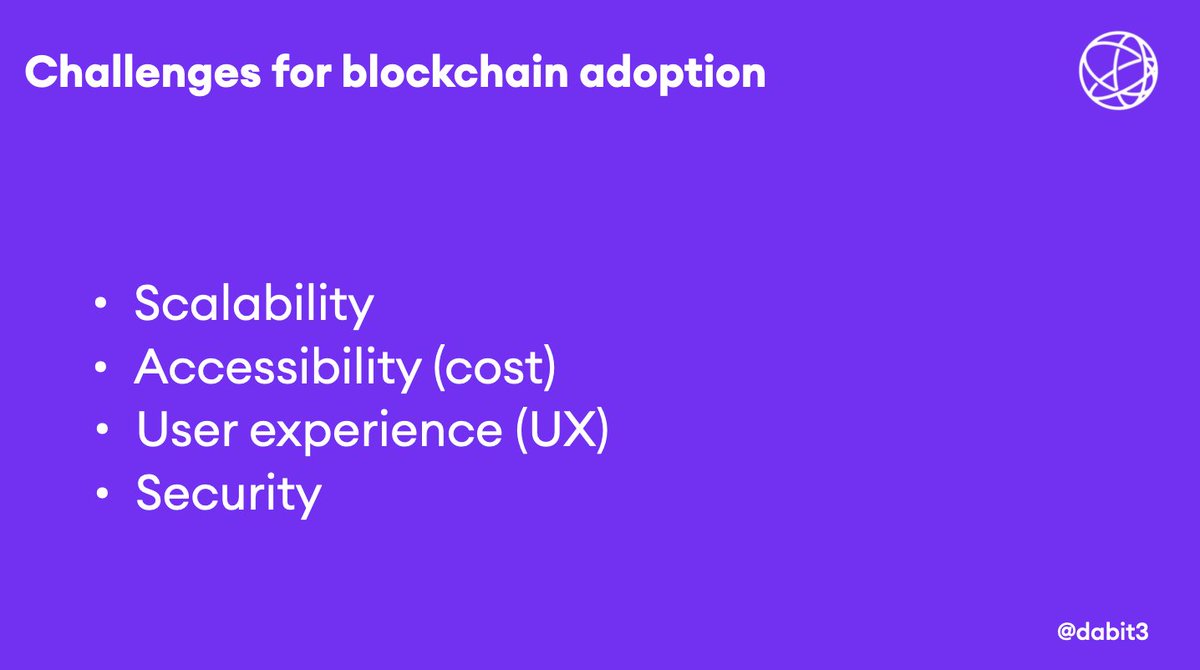
The main challenges for blockchain adoption are
1. Scalability
2. Accessibility (cost)
3. User Experience
4. Security
Some of these are not exclusive. i.e. user experience, security, and accessibility often overlap.
The main challenges for blockchain adoption are
1. Scalability
2. Accessibility (cost)
3. User Experience
4. Security
Some of these are not exclusive. i.e. user experience, security, and accessibility often overlap.
⚪️ Scalability
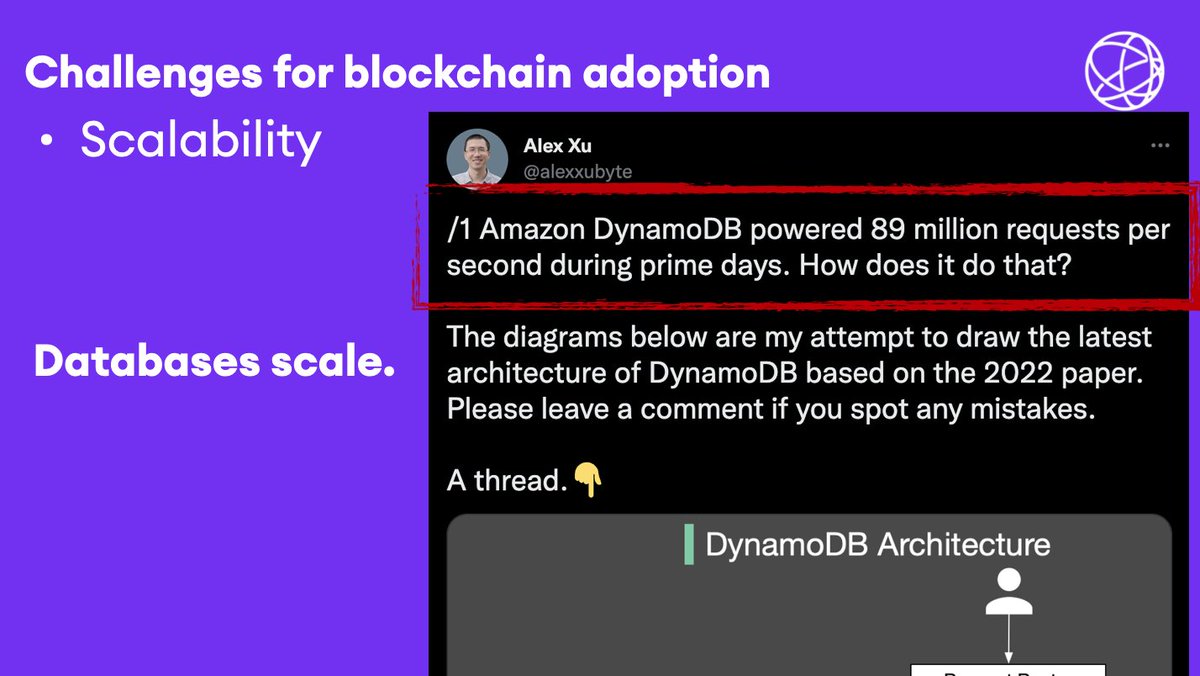
is a solved problem in the centralized tech stack.
At AWS where I worked for over 3 years, it was trivial for anyone to spin up a database like DynamoDB that can scale up to tens of millions or, yes, a hundred million operations per second in a well-built system.
is a solved problem in the centralized tech stack.
At AWS where I worked for over 3 years, it was trivial for anyone to spin up a database like DynamoDB that can scale up to tens of millions or, yes, a hundred million operations per second in a well-built system.
Blockchains are an order of magnitude less scalable today.
Blockchains are also not 1 to 1 comparisons to a database, the use cases are usually different. That being said, we need to at least get closer.
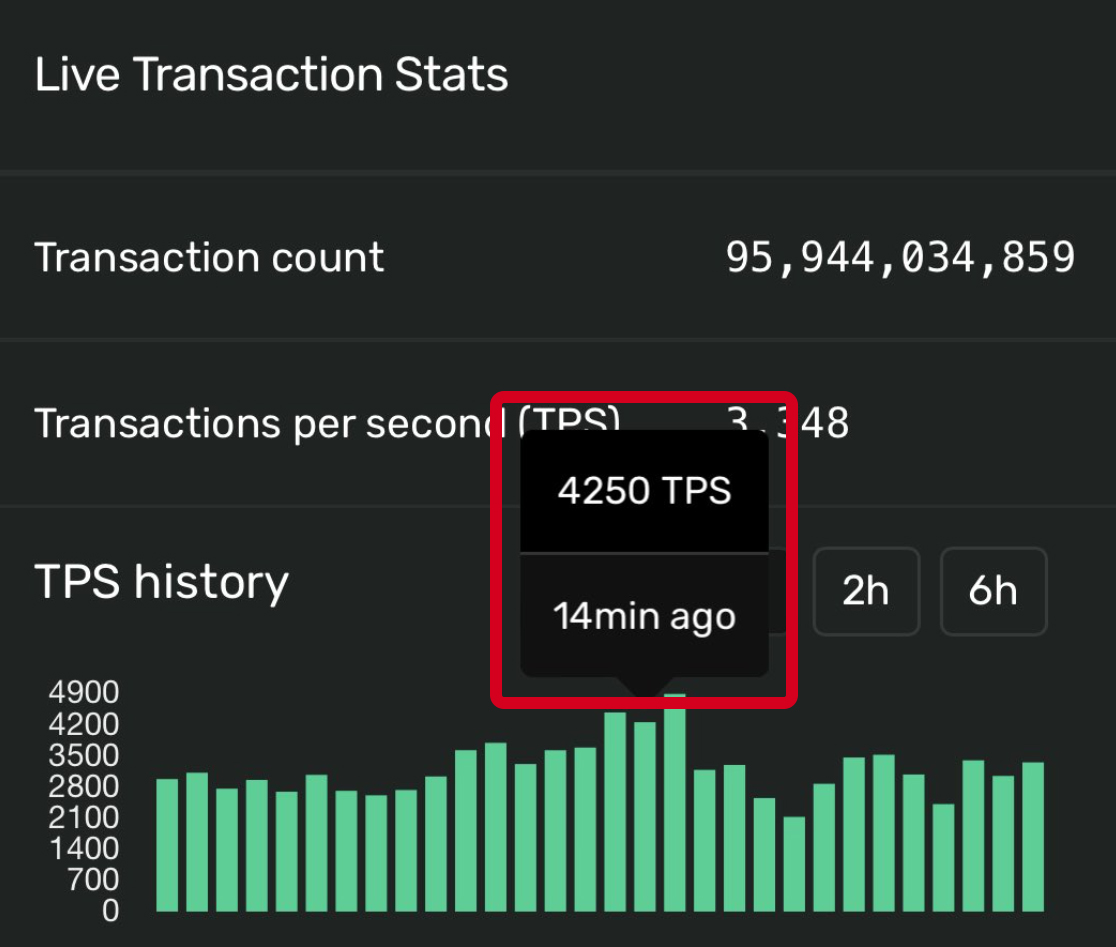
Did you know that even the most performant decentralized blockchains being
Blockchains are also not 1 to 1 comparisons to a database, the use cases are usually different. That being said, we need to at least get closer.
Did you know that even the most performant decentralized blockchains being
used in production today can only handle up to a few thousand transactions per second?
If you're reading this you probably did know that! But it's worth pointing out.
This is not a knock against the industry, it's just worth acknowledging where exactly we are today.
If you're reading this you probably did know that! But it's worth pointing out.
This is not a knock against the industry, it's just worth acknowledging where exactly we are today.
⚪️ Accessibility
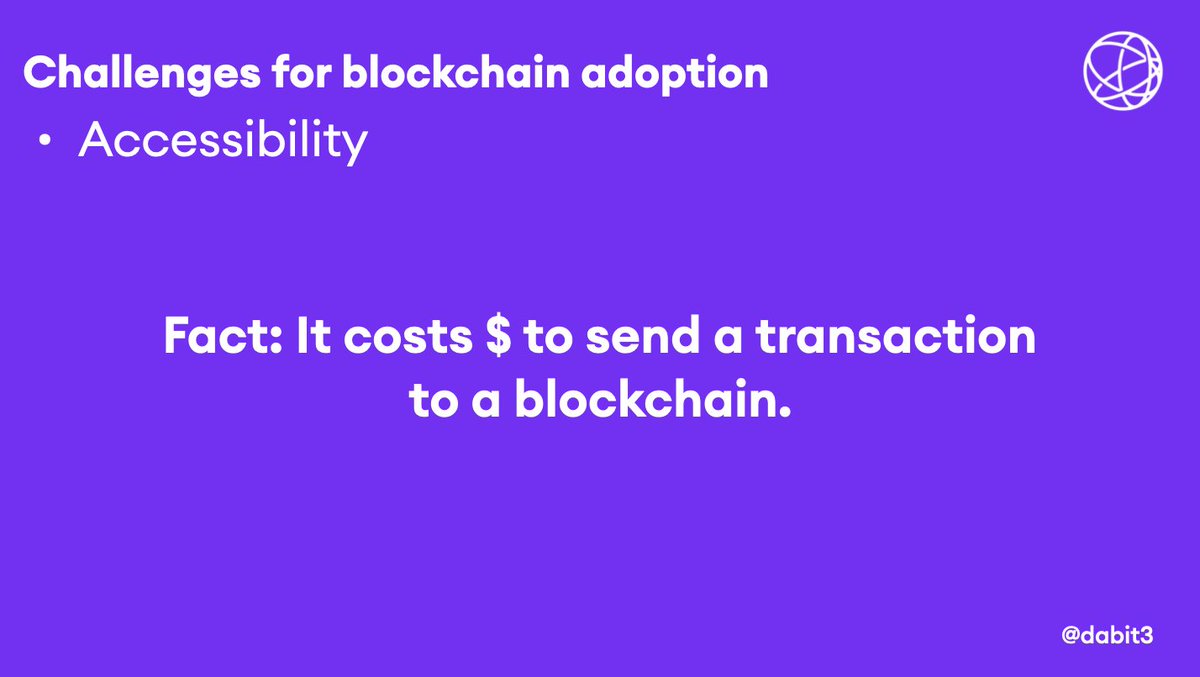
Fact: It costs money to send a transaction to a blockchain.
Yes, reading data is free, but writing data is not.
Imagine telling someone they would have to pay every time they liked a TikTok or posted a photo to Instagram.
Fact: It costs money to send a transaction to a blockchain.
Yes, reading data is free, but writing data is not.
Imagine telling someone they would have to pay every time they liked a TikTok or posted a photo to Instagram.
In addition to that, getting tokens is a huge process and challenge in and of itself *for most people in the world*.
The smartest people in the room have already realized that this does not make sense for most use cases outside of finance.
The smartest people in the room have already realized that this does not make sense for most use cases outside of finance.
⚪️ User experience and security
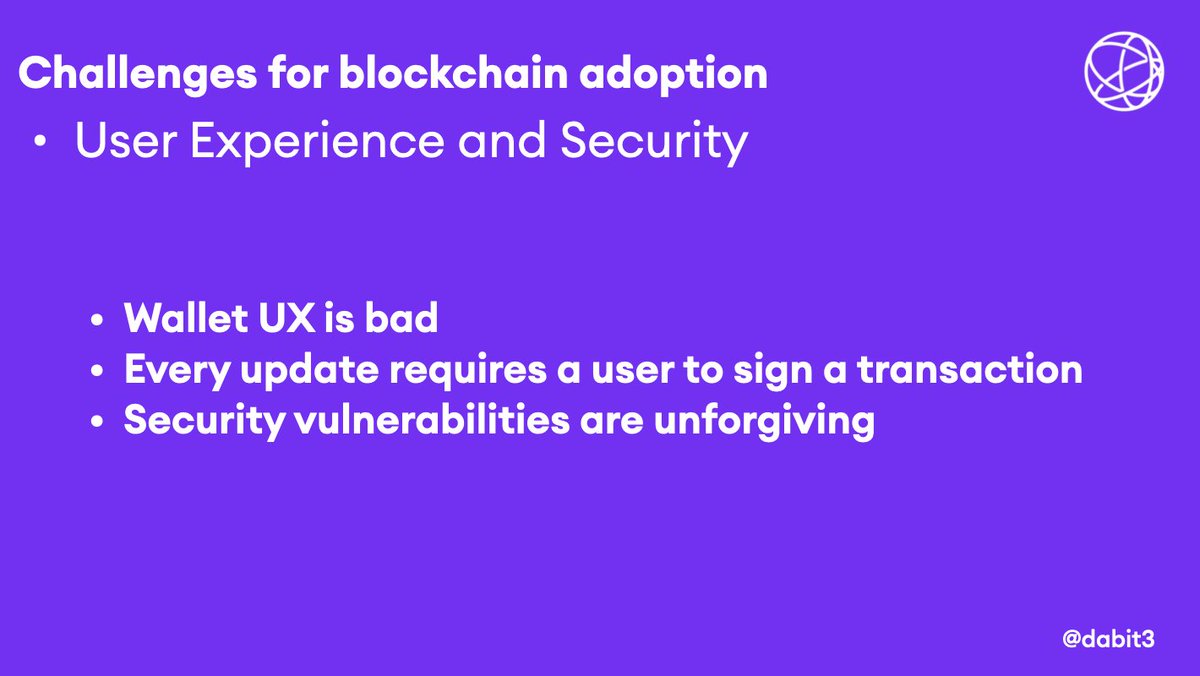
Wallet UX is unforgiving and rough.
Users have to sign a transaction every time they need to take an action.
There are huge improvements that we're already seeing though.
Wallet UX is unforgiving and rough.
Users have to sign a transaction every time they need to take an action.
There are huge improvements that we're already seeing though.
As I'll touch on later, relayers and dispatchers allow users to have seamless interactions as they would with any normal "web2" application.
When I used @phantom for the first time I was blown away at how good it was, better than anything I'd used inside or outside of crypto.
When I used @phantom for the first time I was blown away at how good it was, better than anything I'd used inside or outside of crypto.
⚪️ What are the solutions to these challenges?
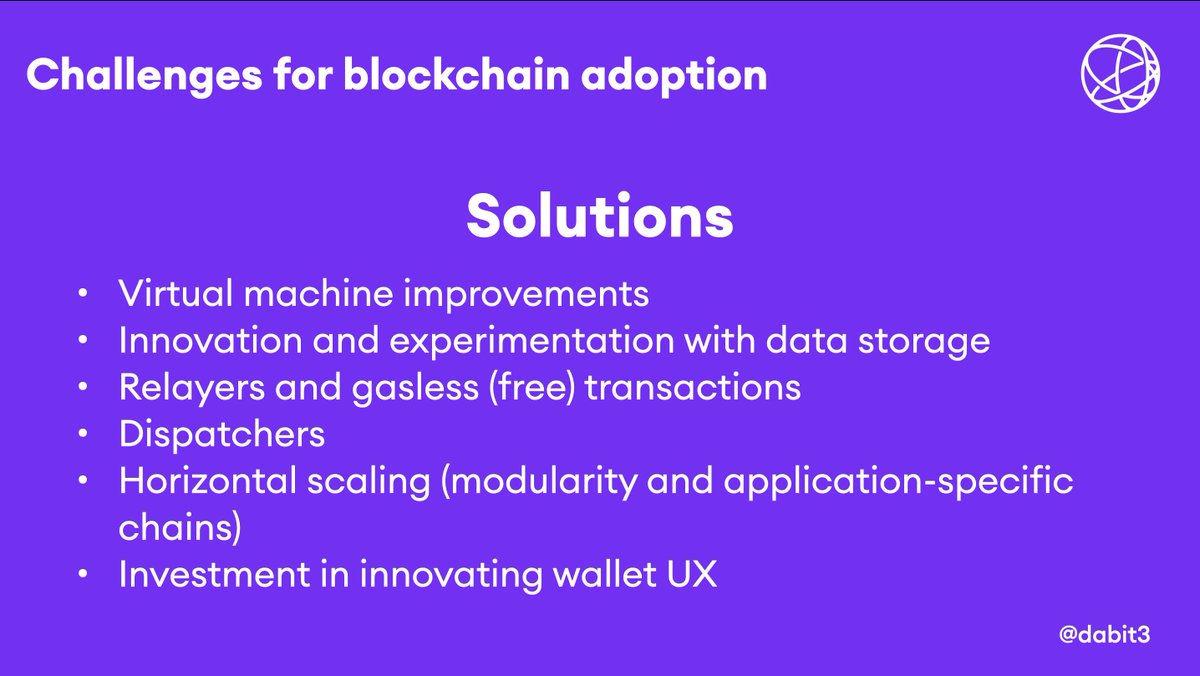
The ones I care the most about have to do with scalability and accessibility, so those will be what I focus on the most.
To scale we need innovations around infrastructure design, and to enable faster and easier experimentation.
The ones I care the most about have to do with scalability and accessibility, so those will be what I focus on the most.
To scale we need innovations around infrastructure design, and to enable faster and easier experimentation.
⚪️ Execution environments and VMs
Parallel processing improves performance at the VM level. @fuellabs_, @Mysten_Labs, @AptosLabs, @solana, & @linera_io are working to alleviate one of the largest bottlenecks to the throughput of a network - sequential execution of transactions.
Parallel processing improves performance at the VM level. @fuellabs_, @Mysten_Labs, @AptosLabs, @solana, & @linera_io are working to alleviate one of the largest bottlenecks to the throughput of a network - sequential execution of transactions.
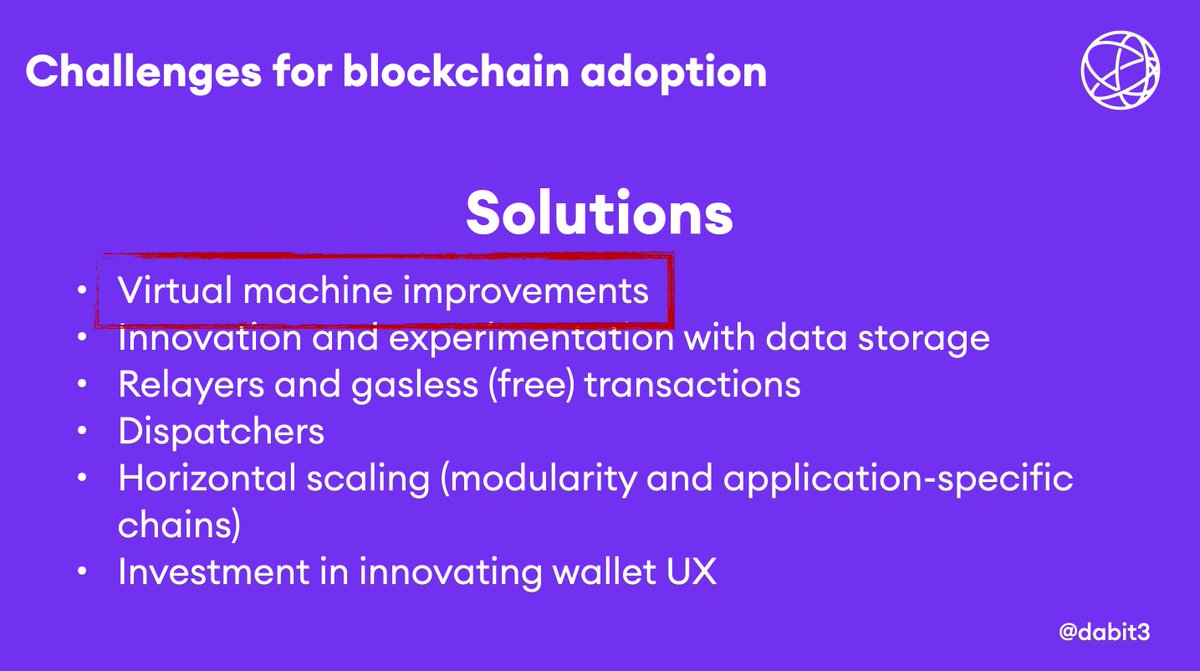
In addition to parallel processing, VM improvements will be unlocked as blockchains move towards a modular architecture and are not bound to a single implementation, but instead can create, fork, and experiment with variations of different virtual machines.
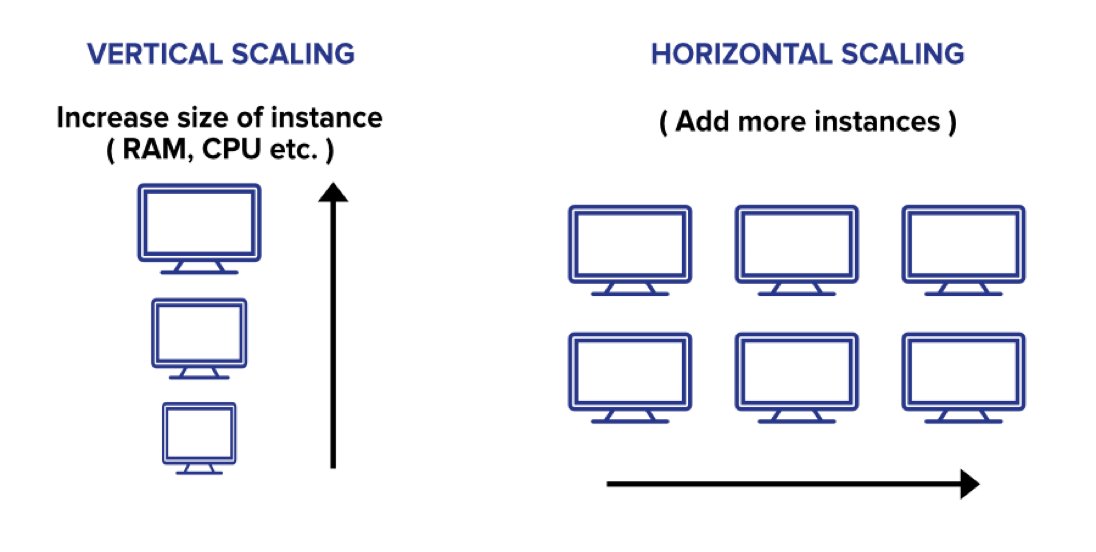
These improvements could be seen as scaling vertically in that the focus is on the performance & processing power of the environment itself.
⚪️ Innovation and experimentation with data storage
Nova is a new network launched by @arbitrum with a focus on cheap and fast transactions.
nova.arbitrum.io
Rollup calldata is large and expensive. Instead of posting calldata to Ethereum like most rollups, Nova uses
Nova is a new network launched by @arbitrum with a focus on cheap and fast transactions.
nova.arbitrum.io
Rollup calldata is large and expensive. Instead of posting calldata to Ethereum like most rollups, Nova uses
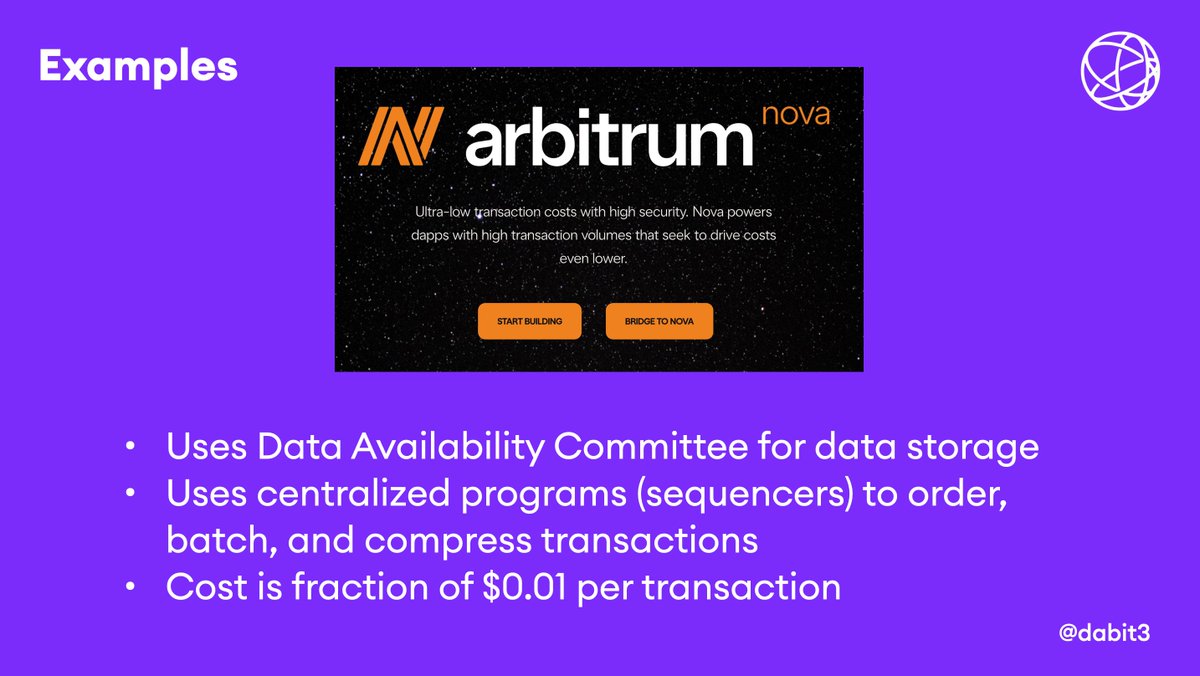
a data availability committee.
The committee signs data availability certificates for batches of transactions and only these certificates are posted to Ethereum.
To keep data available, the committee runs data availability servers which expose an API that allows data to be
The committee signs data availability certificates for batches of transactions and only these certificates are posted to Ethereum.
To keep data available, the committee runs data availability servers which expose an API that allows data to be
fetched by hash.
This enables Nova to maintain a much lower cost than other similar optimistic rollups, coming in at a fraction of a penny per transaction as of this writing.
This is of course a compromise
This enables Nova to maintain a much lower cost than other similar optimistic rollups, coming in at a fraction of a penny per transaction as of this writing.
This is of course a compromise
in decentralization, but for many use cases like social networks and games, it actually makes a lot of sense.
Reddit recently chose Nova for its Community Points program, allowing developers to build gaming, social, and other applications that make use of Reddit’s token.
Reddit recently chose Nova for its Community Points program, allowing developers to build gaming, social, and other applications that make use of Reddit’s token.
Modular Blockchains that offload the data availability and consensus to a completely separate layer also accomplish similar results without a compromise in decentralization, and are something I'll cover more later.
⚪️ Relayers and gasless transactions
If we want the other 99% of the world to use our applications, we can't expect all of them to go through the process of onboarding via exchanges and banks just to get started.
If we want the other 99% of the world to use our applications, we can't expect all of them to go through the process of onboarding via exchanges and banks just to get started.
Tools like @biconomy allow developers to build applications that are free for their users to use, with meta / gasless transactions enabled via a relayer.
A great example of this is @lensprotocol, which in addition to enabling gasless transactions, also added a dispatcher
A great example of this is @lensprotocol, which in addition to enabling gasless transactions, also added a dispatcher
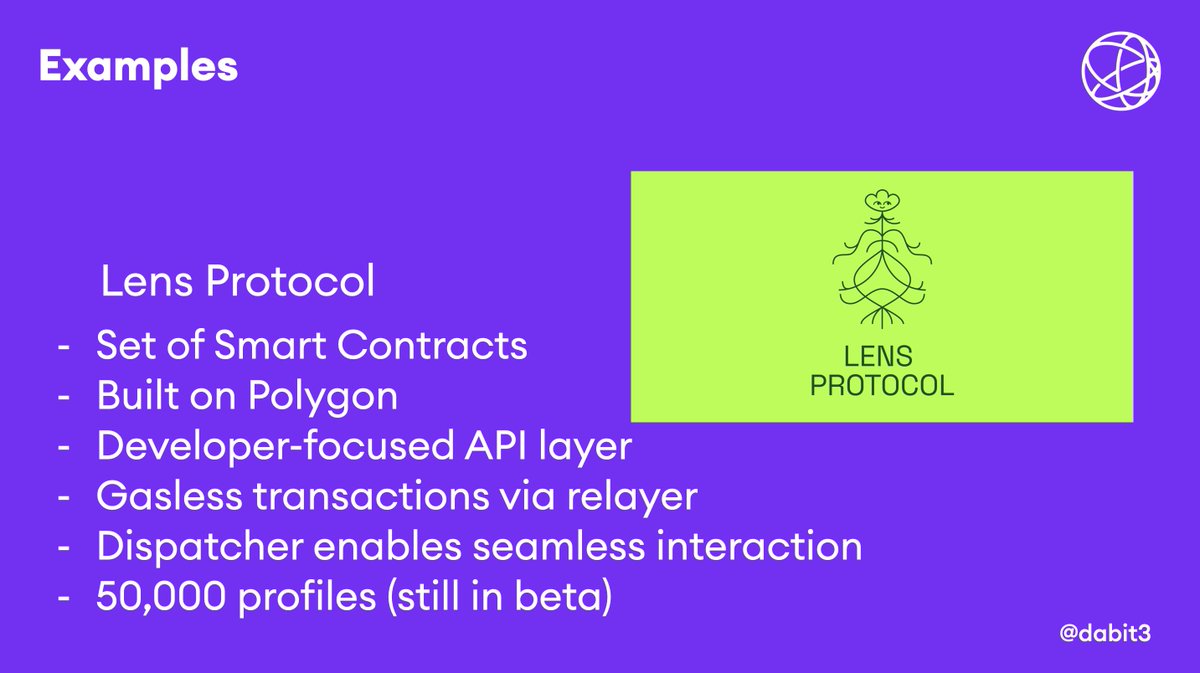
that allows users to seamlessly interact with the network without having to sign for every minor update.
A great quote from @StaniKulechov the founder of Lens:
"We believe the mainstream will come by interacting with the blockchain with non-financial transactions,
A great quote from @StaniKulechov the founder of Lens:
"We believe the mainstream will come by interacting with the blockchain with non-financial transactions,
and some later users will become active or passive DeFi users."
"Blockchain technology is not only for finance, there's actually a lot of doors that it's opening and magnificent use-cases that are empowering our communities."
"Blockchain technology is not only for finance, there's actually a lot of doors that it's opening and magnificent use-cases that are empowering our communities."
⚪️ Modular Blockchains
Most blockchains today are monolithic, usually with a shared execution environment.
Monolithic blockchains are blockchains that are responsible for all core functions - execution, settlement, consensus, and data availability.
Most blockchains today are monolithic, usually with a shared execution environment.
Monolithic blockchains are blockchains that are responsible for all core functions - execution, settlement, consensus, and data availability.
Modular blockchains are blockchains that outsource at least one of the core functions of a blockchain.
In the case of @celestiaorg, Celestia only is responsible for data availability and consensus.
A modular chain has shared security, enables launching a new chain
In the case of @celestiaorg, Celestia only is responsible for data availability and consensus.
A modular chain has shared security, enables launching a new chain
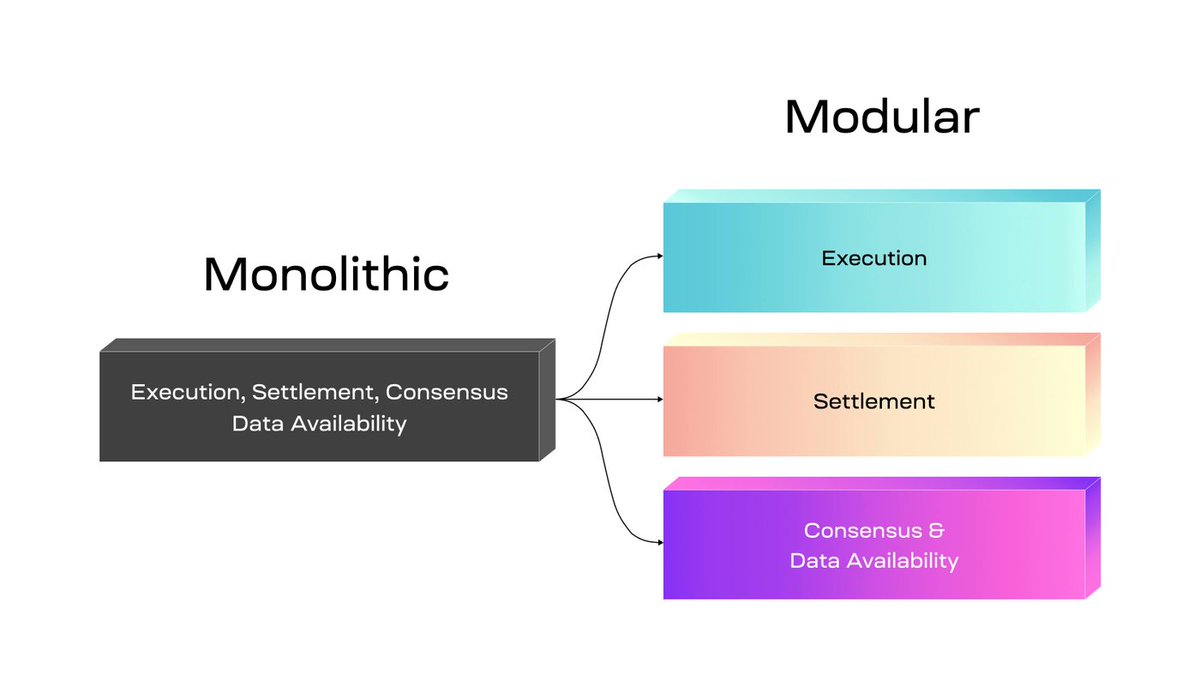
without bootstrapping a new consensus network, and scales without increasing node requirements.
Modular Blockchains unlock a variety of additional powerful scalability improvements that are too deep for me to go into in this thread.
Modular Blockchains unlock a variety of additional powerful scalability improvements that are too deep for me to go into in this thread.
I've written about here if you'd like to learn more:
Mental Modal of modular blockchains
Or this thread from @nickwh8te:
Mental Modal of modular blockchains
Or this thread from @nickwh8te:
There are also execution layers like @fuellabs_ innovating with vertical scalability improvements like parallel execution, while also building specifically for the modular future.
fuel-labs.ghost.io
fuel-labs.ghost.io
⚪️ Application specific chains
We're also starting to see more teams and applications going the route of building their own application-specific blockchain.
Like I mentioned earlier, most blockchains are monolithic and share an execution environment
We're also starting to see more teams and applications going the route of building their own application-specific blockchain.
Like I mentioned earlier, most blockchains are monolithic and share an execution environment
with all of the other applications running on that network.
This means that not only do all applications share the same execution environment & resources, all of the users of every application *also* share the same execution environment & resources!
This means that not only do all applications share the same execution environment & resources, all of the users of every application *also* share the same execution environment & resources!
This would be like building a new application on AWS, and instead of using my own server, Serverless execution environment, or virtual machine, I decide to share a single server with hundreds or thousands of other applications.
Of course this wouldn't make sense because I could just as easily spin up my own virtual machine and even set up my own custom environment with everything I want to start building my application.
What if we could just as easily do this the next time we wanted to build a new blockchain application? What if it was just as easy to deploy an application-specific blockchain as it was to deploy a smart contract?
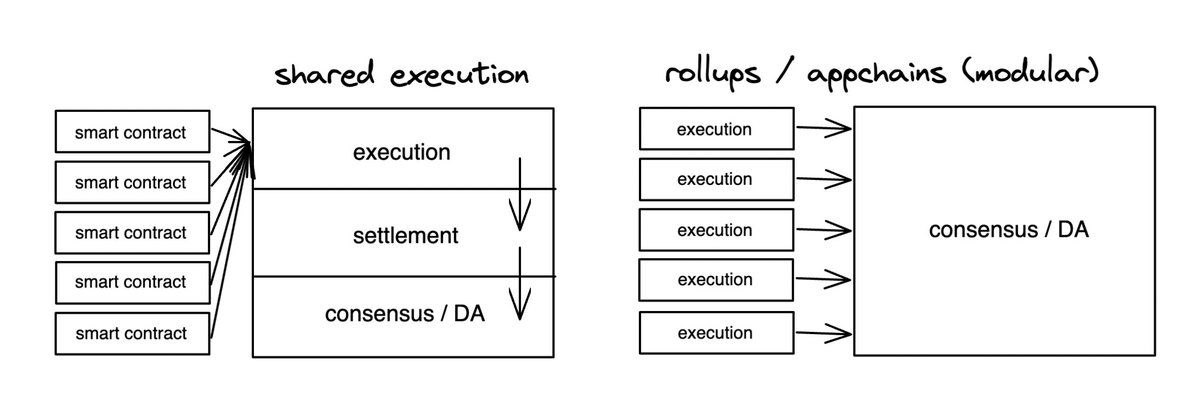
This would give us the scalability properties of horizontal scaling while still inheriting the vertical scalability improvements happening in different VMs.
With the success of *so many* different blockchains, it's become apparent to that we're headed to a multi-chain future.
With the success of *so many* different blockchains, it's become apparent to that we're headed to a multi-chain future.
Developers can already easily spin up their own application specific blockchain using the @cosmos SDK and @ignite_com,
docs.ignite.com
or build and test out application-specific rollups on Celestia with Cosmos and Optimint.
docs.celestia.org
docs.ignite.com
or build and test out application-specific rollups on Celestia with Cosmos and Optimint.
docs.celestia.org
As we saw with DYDX, this made sense for the for a variety of different reasons.
dydx.exchange
With modular blockchains, you'll be able to easily spin up and launch a chain with any execution environment and language you'd like to build with.
dydx.exchange
With modular blockchains, you'll be able to easily spin up and launch a chain with any execution environment and language you'd like to build with.
If you want to write your program in @SwayLang, Rust, Solidity, or JavaScript, you will not be bound to any specific implementation. Instead you’ll be able to compose the ideal software stack for you, your team, and your use case.
In addition to this flexibility, you’ll also be
In addition to this flexibility, you’ll also be
able to benefit from the vertical scalability improvements made available at the VM level.
Combine that with shared security and scalability enhancements made possibly by data availability sampling, and we’re now talking about a paradigm shift in blockchain performance.
Combine that with shared security and scalability enhancements made possibly by data availability sampling, and we’re now talking about a paradigm shift in blockchain performance.
/end
Thanks for reading!
If you liked this thread, please like, retweet, and subscribe to my newsletter here where you can also read this post:
nader.substack.com
Thanks for reading!
If you liked this thread, please like, retweet, and subscribe to my newsletter here where you can also read this post:
nader.substack.com
Loading suggestions...