

ok. as requested.
an option's theta (theoretical rate of decay over time) is not just "income" to an investor holding a short position.
it is compensation for the risk of loss that investor faces from negatively asymmetric exposure to moves in the underlying asset.
an option's theta (theoretical rate of decay over time) is not just "income" to an investor holding a short position.
it is compensation for the risk of loss that investor faces from negatively asymmetric exposure to moves in the underlying asset.
Theta Gang and option guru charlatans would have you believe that theta is a form of alpha, or free money for true believers.
but options are convex instruments with asymmetric payoffs - buyers can make a lot more than they are risking to lose, and vice versa.
but options are convex instruments with asymmetric payoffs - buyers can make a lot more than they are risking to lose, and vice versa.
when you hold a negatively asymmetric position, any large move causes a loss. if the underlying moves in a favorable direction, you benefit less and less from it; if it moves against you, you lose more and more, fast
we can write the value of an option as:
V(x, t, v)
where x is the price of the underlying, t is time, v is implied volatility, and V(.) is a standard option pricing method (eg Black-Scholes or a lattice/trinomial tree)
V(x, t, v)
where x is the price of the underlying, t is time, v is implied volatility, and V(.) is a standard option pricing method (eg Black-Scholes or a lattice/trinomial tree)
its change over one unit of time via a second order Taylor expansion as
dV(x, t, v) = dV/dt
+ dV/dx * dx
+ dV/dv * dv
+ 0.5 * d2V/dx^2 * dx^2
+ 0.5 * d2V/dv^2 * dv^2
+ dv2/dvdx * dvdx
dV(x, t, v) = dV/dt
+ dV/dx * dx
+ dV/dv * dv
+ 0.5 * d2V/dx^2 * dx^2
+ 0.5 * d2V/dv^2 * dv^2
+ dv2/dvdx * dvdx
= theta
+ delta * dx
+ vega * dv
+ 0.5 * gamma * dx^2
+ 0.5 * volga * dv^2
+ vanna * dx * dv
if you are short this option, you will earn the theta decay over time, but you are paying the piper on the other side: every time the stock moves materially you lose money on gamma
+ delta * dx
+ vega * dv
+ 0.5 * gamma * dx^2
+ 0.5 * volga * dv^2
+ vanna * dx * dv
if you are short this option, you will earn the theta decay over time, but you are paying the piper on the other side: every time the stock moves materially you lose money on gamma
if the option is away from the money, it will have meaningful volga (volatility gamma), and every time implied volatility moves significantly, you lose to that too
it may similarly have vanna (or skew) exposure; your short downside pit position may lose money as a result of spot falling and implied volatility rising, for example
either you are continually locking these losses in via dynamic hedging, or you are just ignoring them and accumulating delta and vega risk in an adverse direction, effectively betting double or nothing that the adverse moves will revert
just selling a naked call and letting it ride is an example of the latter; if the stock spikes, you get short delta; if it falls back again, you feel smart, but if it keeps running, you lose money faster and faster
the market prices these factors at every point in time: gamma is more valuable when volatility is high, because the amount of positive pnl that a long option position earns from gamma is proportional to dx^2
the net pnl stream from selling an option for theta will depend on the magnitude of these countervailing factors. if the market is charging too much for gamma, vanna and volga, then theta on a short position will steadily exceed the realized losses on those exposures
most of the time you should expect a slight risk premium, but only a tiny fraction of overall theta
that fraction may or may not be smaller than your transaction costs in options markets as an individual
also don't forget to consider vol rolldown / rollup... a short OTM put position will usually have theta that far exceeds its realized decay rate, even with no underlying moves, because implied vol goes higher and higher for very short dated crash puts of the same strike
obviously i am hinting at other uses of this taylor expansion here :)
* "pit" is obviously "put" above in "your short downside put position..."
if theta gang people cannot accept arguments, logic and data, perhaps they will accept credentials
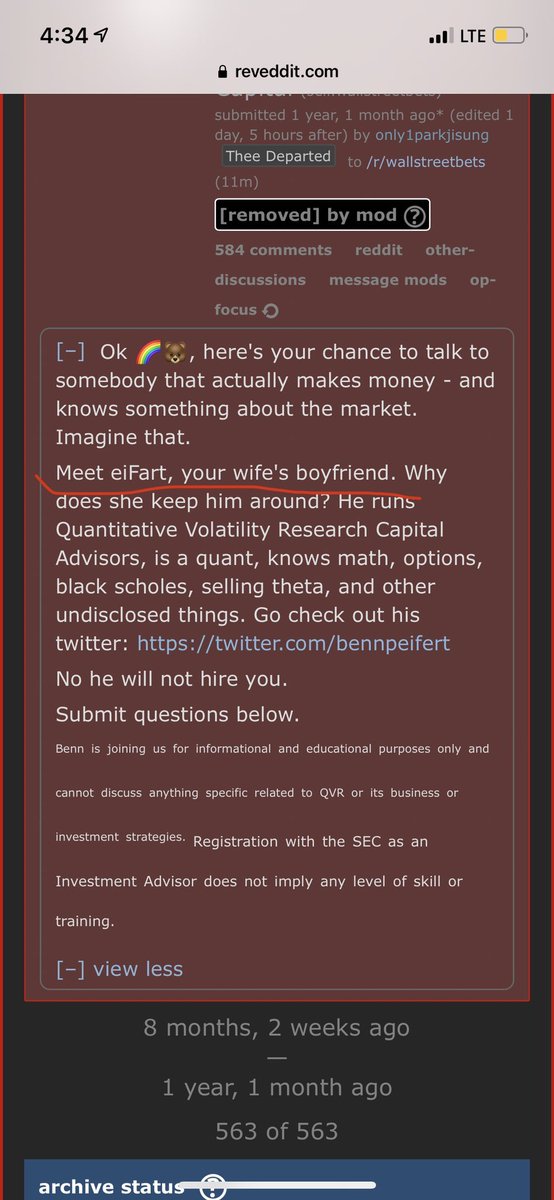
and "i'll just get assigned, i wanted to buy the stock there anyway" does not get you out of any of this. a naive hold to maturity analysis of a short option position can give rise to sloppy, illogical conclusions. please read Common VRP Discussions, here
qvradvisors.com
qvradvisors.com

Loading suggestions...