

1/ The commander of USAFE-AFAFRICA, Gen. James Hecker, recently told reporters that Ukraine has likely retained over 80% of its aircraft.
A brief thread on why Ukraine has likely been able to retain the majority of its aircraft.👇
A brief thread on why Ukraine has likely been able to retain the majority of its aircraft.👇
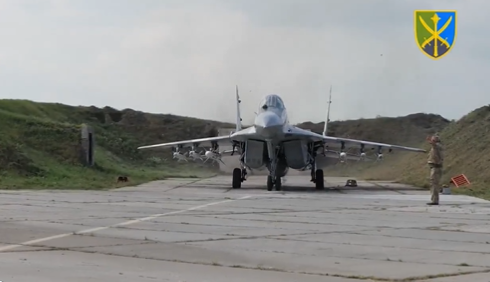
2/ Russian offensive counterair strikes in the beginning of the war were relatively limited in scope (for a military operation of this scale), and appear to have been focused primarily on Ukrainian SAM systems, C3 nodes and radar sites.
3/ The scope of strikes against Ukraine's relatively extensive airfield/base infrastructure (including aircraft on the ground) appears to have been particularly limited. Notably, very few attempts were made to target Ukrainian runways, & these were seemingly largely unsuccessful.
4/ As a result of these and other factors, including timely intelligence, Ukraine was able to disperse many of its aircraft (in addition to those already dispersed prior to the war) to alternative locations during the first hours of the Russian onslaught...
5/ making them more difficult to subsequently find and attack. Satellite imagery suggests that only a handful of Ukrainian aircraft were destroyed on the ground early on in the war, many of them non-operational (in open storage).
6/ For further reading on this topic, I recommend the following article:
key.aero
key.aero
7/ While the Russian military continued to occasionally target Ukrainian airfield/base infrastructure and, seemingly, also aircraft on the ground, its effort appears to have remained limited in both scope and effectiveness.
8/ What explains the continued lack of a more extensive and effective Russian effort to target Ukrainian aircraft on the ground?
9/ Since the beginning of the war, both Russian manned and unmanned aircraft activity over Ukraine has remained relatively limited and largely confined to certain parts of the country (initially, to the northern, northeastern, eastern, southeastern and southern oblasts...
10/ Subsequently - from around mid-April, - Russian aerial activity over Ukraine appears to have been further limited primarily to the Donbas region and to Kharkiv and Kherson Oblasts).
11/ The Russian military has seemingly largely refrained from sending its aircraft to find targets and/or conduct strikes with direct-attack weapons in other parts of Ukraine because such missions would have been highly risky given the limitations of the Russian Air Force...
12/ and the relatively formidable ground-based air defense capability that Ukraine continues to posses, especially further inland (indeed, Russia's effort to suppress & destroy Ukrainian ground-based air defenses has thus far been relatively limited in effectiveness...
13/ and largely confined to the above-mentioned oblasts).
14/ The decision to keep Russian aerial activity over Ukraine largely confined to the above-mentioned oblasts has meant the Russian military has been attacking targets in other parts of the country exclusively with ground-, air- and sea-launched stand-off weapons (missiles).
15/ Many Ukrainian airfields/bases are located in the western part of Ukraine. Several of these have hardened aircraft shelters (HASs), and some portion of Ukraine's operational aircraft fleet is likely hidden in HASs at any given point in time.
16/ While some Russian stand-off weapons are known to have a hardened target defeat capability, the Russian military has seemingly been reluctant to go after Ukrainian HASs (which are relatively numerous) given that it would require a very large number of missiles.
17/ Indeed, considering that many Russian missile types have reportedly had low or very low success rates (due to various reasons), more than one missile per HAS would likely be required to achieve a reasonable probability of kill.
Apart from the above, the decision to keep...
Apart from the above, the decision to keep...
18/ Russian aerial activity over Ukraine largely confined to the aforementioned oblasts has also greatly limited Russia's ability to find Ukrainian aircraft parked in the open (including in protective berms), to attack them in a timely manner...
19/ and to conduct post-strike battle damage assessment (BDA). Indeed, the Russian military has seemingly had very little to no success locating and destroying Ukrainian fixed-wing aircraft out in the open (yet alone helicopters, which can operate from more austere locations).
20/ Among other reasons, this is due to very limited airborne stand-off ISR & space-based ISR capabilities, lengthy sensor-to-shooter times, and other relevant limitations in the Russian military's C4ISR and targeting capabilities.
21/ As noted earlier, aside from the lack of a more extensive and effective effort to destroy Ukrainian HASs and aircraft on the ground, the Russian military has also seemingly carried out only limited - and, in some cases, unsuccessful strikes against...
22/ other Ukrainian airfield/base infrastructure (including runways). As a result, Ukraine has not only seemingly retained most of its aircraft, but has also been able to continue to operate some aircraft, including, it seems, from several major air bases.
23/ In this regard, it is important to note that the Russian military has also failed to interdict shipments of aircraft spare parts from the West, which have greatly aided Ukraine in keeping some of its aircraft operational.
24/What about the loss of Ukrainian aircraft in the air? Compared with the number of Ukrainian aircraft destroyed on the ground, the number of Ukrainian aircraft downed by Russian SAMs & air-to-air missiles (AAMs) is much greater. Indeed, Russian SAMs & AAMs have accounted for...
25/the vast majority of Ukrainian aircraft losses to date. That said, while the Russians have had far more success downing Ukrainian aircraft than destroying them on the ground, factors such as the clever use of tactics by Ukrainian pilots, the Russian military's reluctance to...
26/ conduct fighter sweeps further inland due to the threat posed by Ukrainian ground-based air defenses, and the Ukrainian military's effort to suppress and destroy Russian ground-based air defenses has made it more difficult for Russia to exact a heavier toll on Ukrainian...
27/ military aviation.
To date, Ukraine is known to have lost a total of 60 manned fixed- and rotary-wing combat, transport & utility aircraft. Thus, it appears to have indeed retained the majority of its manned military aviation.
oryxspioenkop.com
To date, Ukraine is known to have lost a total of 60 manned fixed- and rotary-wing combat, transport & utility aircraft. Thus, it appears to have indeed retained the majority of its manned military aviation.
oryxspioenkop.com
28/ As for the 80% figure, it is not entirely clear which specific aircraft types Gen. Hecker was referring to (does it include only manned aircraft or also UCAVs? Does it also include the ~35 helicopters & 18 Su-25s delivered to Ukraine following the beginning of the war? etc.)
29/ If, for example, one takes into account all manned fixed- & rotary-wing aircraft that were in service with the Ukrainian military at the beginning of the war, then this figure may indeed be plausible (especially if it includes the helicopters & Su-25s subsequently delivered).
30/ That said, many aircraft that Ukraine had before the war and still has in its possession are not serviceable. Indeed, at present, the number of serviceable aircraft available to the Ukrainian military is likely much smaller than it was just prior to the war.
31/31 I hope that this brief - and by no means exhaustive - thread was interesting and informative.
-END-
-END-
Loading suggestions...