
Commentary versus one's own text
Śrī Appayya Dīkṣita in his commentary on Śrīkaṇṭhācārya's commentary on Brahmasūtra 1.3.39, concludes that Śūdras don't have adhikāra in Brahmavidyā due to absence of upanayana.
But something else is seen in his own text Nyāyarakṣāmaṇi. +
Śrī Appayya Dīkṣita in his commentary on Śrīkaṇṭhācārya's commentary on Brahmasūtra 1.3.39, concludes that Śūdras don't have adhikāra in Brahmavidyā due to absence of upanayana.
But something else is seen in his own text Nyāyarakṣāmaṇi. +
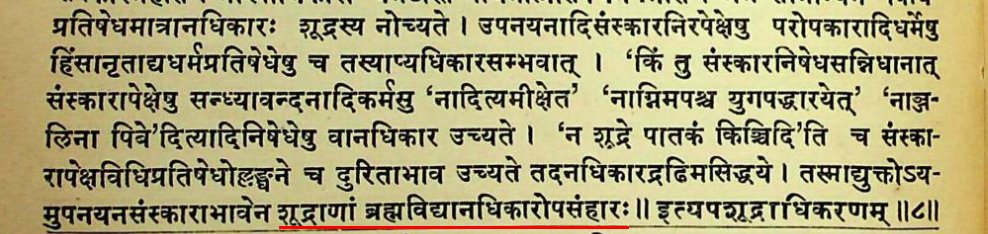
Here he says the very opposite. He says that there is no need of vidhi for Brahmavidyā. The need of vidhi is only regarding the sādhana of Brahmavidyā. Traivarṇikas have adhikāra of śravaṇa, etc. regarding Vedas, whereas Śūdras it have for Itihāsas & Purāṇas. +
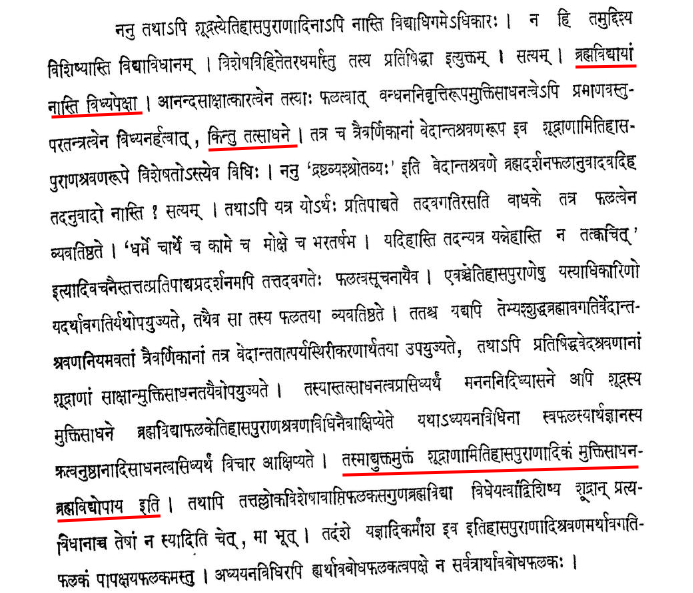
Hence, Śūdras have adhikāra for Brahmavidyā through śravaṇa, manana & nididhyāsana of knowledge gained through Itihāsas & Purāṇas.
Why such striking difference in his position in two texts; one being his commentarial work, and other being his own text? +
Why such striking difference in his position in two texts; one being his commentarial work, and other being his own text? +
The reason seems to be that in his commentarial work, he agreed with the anadhikāra of Śūdras in Brahmavidyā because Śrīkaṇṭhācārya (original author) had concluded in that manner.
In his own text, Śrī Appayya Dīkṣita is free to give his own take on the matter, which he does.+
In his own text, Śrī Appayya Dīkṣita is free to give his own take on the matter, which he does.+
In a commentarial work, an author is bound by the original text, and cannot take a position which is completely opposite to it.
P.S.: As per his 'Nyāyarakṣāmaṇi', Śūdras are not only eligible for hearing Itihāsas and Purāṇas, but also for reading/reciting them.
P.S.: As per his 'Nyāyarakṣāmaṇi', Śūdras are not only eligible for hearing Itihāsas and Purāṇas, but also for reading/reciting them.
Loading suggestions...