

These two charts from a fine book chapter by @ProfVarshney on the state of democracy in India help explain an apparent paradox: Most serious experts agree that Indian democracy is in trouble. But their arguments struggle to gain traction with the Indian public. 1/n


Some of this gap between political scientists and the public may be attributed to partisanship—BJP supporters can hardly be expected to agree that Modi has weakened Indian democracy—but there’s also an element of mutual incomprehension. They’re talking about different things. 2/n
When scholars decry the decline of Indian democracy they mean liberal democracy. Institutions meant to check government power and safeguard individual rights—like the media and the judiciary—no longer fulfill those roles. Judges are cowed. Journalists act like cheerleaders. 3/n
But as the charts show, India does reasonably well—particularly given its low per capita income—as an electoral democracy. People get to choose their leaders. Elections may not be perfect, but they’re generally free and fair. Power changes hands regularly. 4/n
Under these circumstances, it’s very hard to convince the average Indian that Indian democracy is in trouble. “How can you say that?” is the often outraged response. More than 600 million people voted in the 2019 general election. 5/n
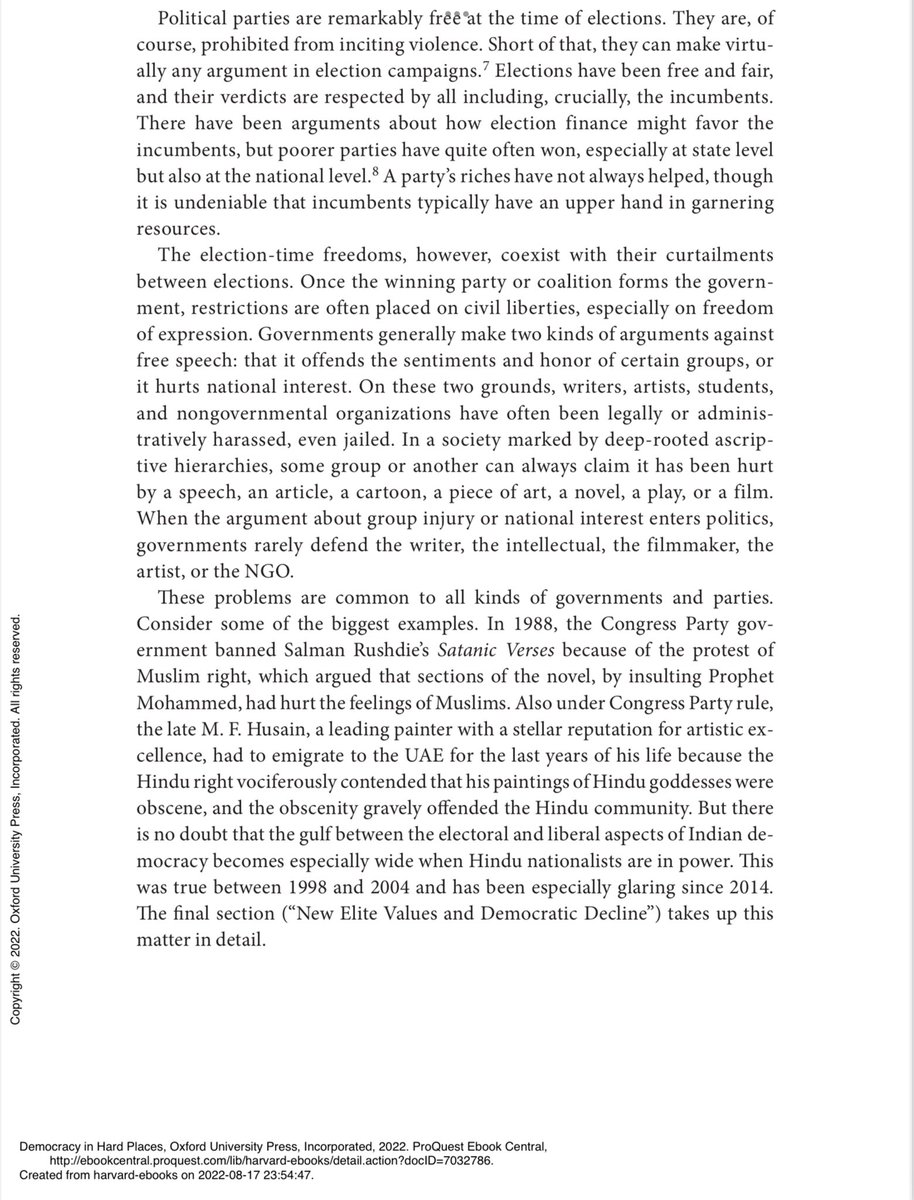
To complicate matters, India has always been a more robust electoral democracy than a liberal democracy. Here’s a summary from the chapter. In short, the Indian state has never really defended writers, artists and intellectuals who cause offense to powerful groups. 6/n
This does not mean that things have not gotten worse under the BJP. As @ProfVarshney points out, Hindu nationalists like Modi tend to privilege duties over rights. The decline of institutions like the Supreme Court, and misuse of others like the CBI, is well-documented. 7/n
In the end, as long as scholars use the word democracy to mean liberal democracy, and much of the public uses it to mean electoral democracy, the two will continue to talk past each other. The world will decry India’s democratic decline. But how many Indians will even notice? 8/8
For those asking: The book is “Democracy in Hard Places” edited by Scott Mainwaring and Tarek Masoud. @ProfVarshney’s chapter is titled “India’s Democratic Longevity and its Troubled Trajectory.” It’s a must read for anyone interested in the subject.
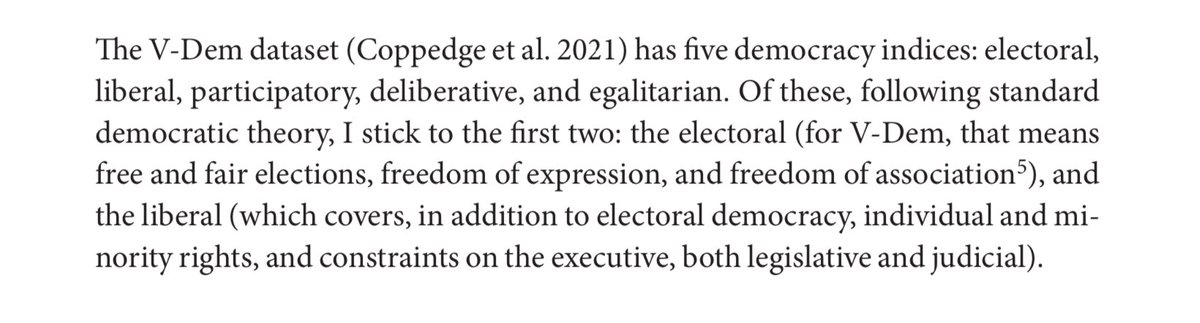
P.S.: Some folks point out that @vdeminstitute data used by @ProfVarshney shows India declining BOTH as a liberal democracy and as an electoral democracy. This may be because V-Dem Electoral Democracy Index includes freedom of speech and freedom of association as components. 1/2
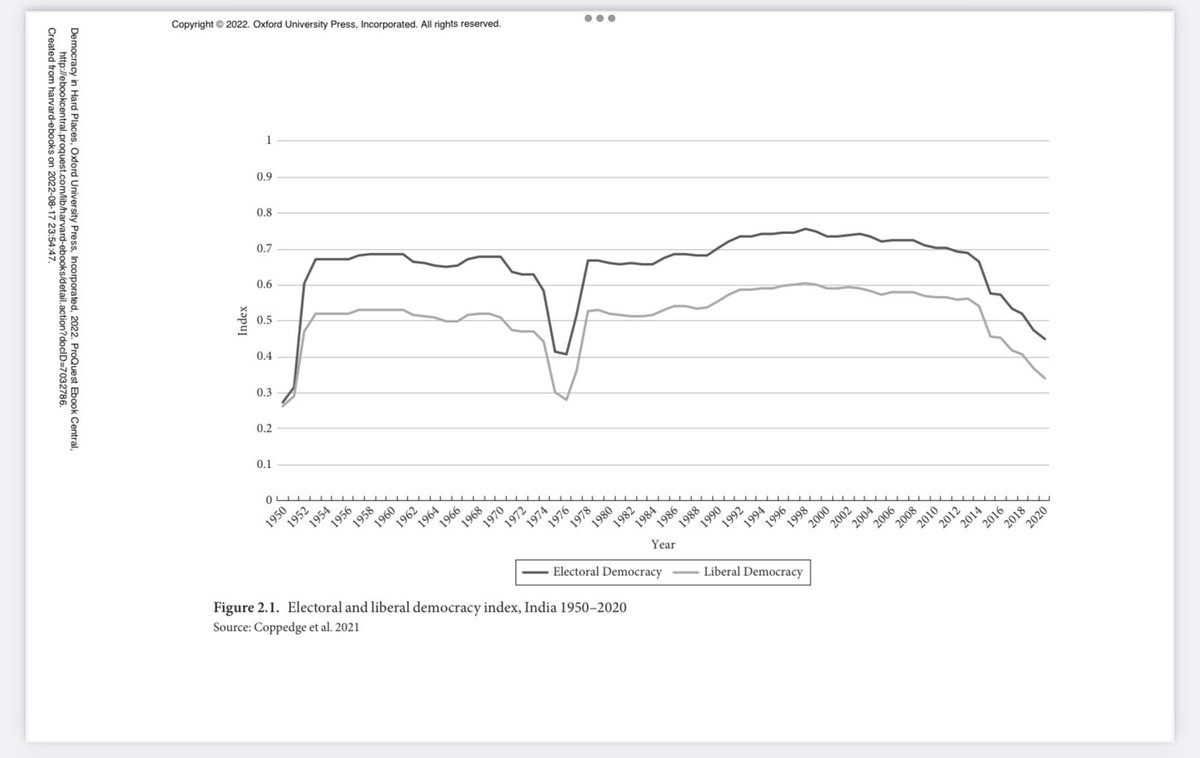
Here is @ProfVarshney’s explanation. FWIW personally I find @vdeminstitute’s methodology confusing. Easy to see that liberal democracy in India is in trouble. But hard to agree with their claim that—despite record turnouts—Indian electoral democracy has declined sharply too. 2/2
Loading suggestions...