

(Thread on Sheikh Yusuf al-Qardawi, who just died in Doha at the age of 96). Qardawi's standing is often attributed to his connection with Qatar and his use of new mass media that radically transformed the Arab public sphere in the 1990s i.e. satellite TV (Al Jazeera)
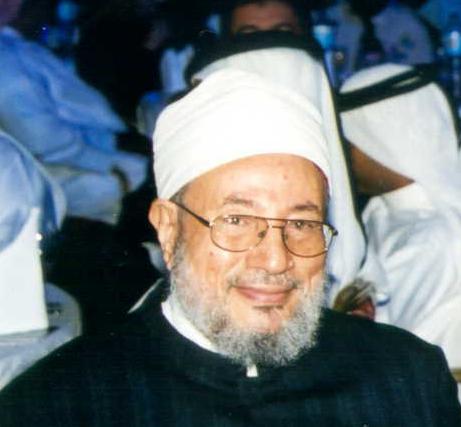
& Internet (the once paramount islamonline website he established in 1997). Yet his standing within the global Islamic religious field has deeper roots. He emerged as a successful writer in the 1970s owing to three key features:
1. Communicative skills (writing in an accessible style, which isn't necessarily standard in Islamic scholarship) 2. Solid scholarly credentials (PhD from al-Azhar) 3. Willingness & ability to engage in modern ideological debates (against socialism, liberalism, ...)
In other words, Qardawi was one of the few figures who felt at ease within two domains of knowledge that were usually dealt with separately i.e. 'ilm ("sacred knowledge", i.e. traditional Islamic doctrines) & fikr ("thought", i.e. modern intellectual debates).
In the Arab world, Qardawi only had two credible peer competitors: Egyptian Muhammad al-Ghazali (d. 1996) and Syrian Said Ramadan al-Buti (d. 2013) (the latter was Qardawi’s fiercest rival).
Qardawi/Ghazali/Buti won't have successors for the reason explained above: they acquired their status due to a very specific historical context during which ideological debates were central to the (Arab) public sphere. That's a long-gone era.
Qardawi's 2 best known books illustrate his twin expertises: “The Permissible and the Forbidden in Islam” (1960) is a compendium drawing on Islamic scholarship whereas "Imported Solutions and How They Ruined our Nation" (1971) defends Islam vs "alien" ideologies (socialism etc.)
"Imported Solutions" also marked a shift in Islamic discourse, which put greater emphasis on cultural authenticity (by the early 1970s, asala, i.e. "authenticity", became a buzzword among the Arab political spectrum at large, not just among Islamists).
Earlier Islamist ideologues were less concerned with cultural authenticity: in 1958 Mustafa al-Siba'i (head of Syrian Muslim Brotherhood) released "The Socialism of Islam", in which he explained that Islam was in accordance with a (mild) form of socialism.
This was a late Islamic modernist approach that still aimed to emulate Western models while reconciling them with Islamic principes.
As for Sayyid Qutb (d. 1966), he was less concerned with the culturally alien character of non-Islamic political ideologies than with the fact that, according to him, they subjugated people to new forms of slavery.
Coming back to Qardawi: pre-2011, his many facets (scholar, intellectual, TV preacher, 'webmaster', head of the International Union of Muslim Scholars he founded in 2004) enabled him to overcome the idea that he was just the "spiritual leader of the Muslim Brotherhood"
That's when Bettina Gräff & Jakob Skovgaard-Petersen nicknamed him "the Global Mufti" (book released in 2008). Back then, e.g., he was given warm welcome by the Syrian regime even though membership in the Syrian Muslim Brotherhood was (still is) punishable by death.
He was held in high esteem by many Syrian scholars, pro and anti-regime alike (but needless to say, not by al-Buti). Of course, this situation came to an end due to extreme political polarization across the region after 2011 and even more so after the 2013 coup in Egypt.
Loading suggestions...