
Politics
Economics
Elections
Social Issues
Population
Economic Growth
Demography
Public service provision
Environmental quality

Nigeria’s population, without exaggerating, will determine Nigeria’s viability and liveability as a country.
But chances are that we will go through this entire campaign season without mentioning it.
Why do we need to talk about population?
A THREAD
1/13
But chances are that we will go through this entire campaign season without mentioning it.
Why do we need to talk about population?
A THREAD
1/13

Population matters for reasons from economic growth, public service provision, winning or losing elections, and our environmental quality.
In Nigeria, the population is even more critical for several reasons. We will focus on three.
2/13
In Nigeria, the population is even more critical for several reasons. We will focus on three.
2/13
The first reason is that a large population increases the amount of work you need to do to shift people out of poverty, which is the default setting of any country.
3/13
3/13
None of Africa’s five richest countries—Equatorial Guinea, Seychelles, Gabon, Mauritius and Botswana—measured by GDP per capita, has a population greater than 2.5 million people.
4/13
4/13
If your population grows at 3% per year, you need economic growth to be higher than that just to keep your head above water. Before 2021, Nigeria’s economy spent six years growing at rates slower than that.
5/13
5/13
The second reason population is crucial is that there is no sign of what demographers call a ‘fertility transition’ in Nigeria yet—even though a number of the conditions that should indicate one is already in place.
6/13
6/13
Fertility transitions go through three phases, starting with having high fertility rates alongside high death rates (from disease and infant mortality). In this first phase, the population isn't actually growing, given that high deaths cancel out high births.
7/13
7/13
In the next phase, fertility remains high, but deaths reduce due to improved healthcare that eliminates a lot of infant mortality and stops various simple diseases from killing people. As you might expect, populations grow quickly in this phase.
8/13
8/13
The final phase is where fertility finally reduces due to various factors like urbanisation and empowerment of women to have more control over their own fertility. In this final phase, populations also remain stable.
9/13
9/13
Nigeria has been stuck in the middle phase of the fertility transition for a long time (since before independence), and there is no sign that it is moving out of it.
10/13
10/13
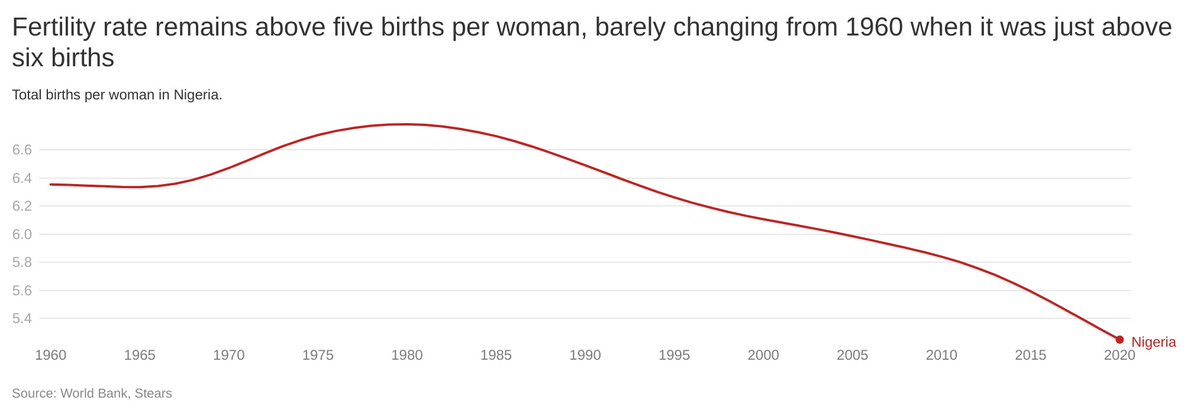
Urbanisation, which is supposed to be a good predictor of a drop in birth rates, has been rising in Nigeria for decades. The total fertility rate remains above five births per woman, barely changing from 1960 when it was just above six births.
11/13
11/13
The average Nigerian woman currently contributes more than five children to the future.
12/13
12/13
The final reason to talk about Nigeria’s population is a rather disturbing one that is best illustrated with a story.
Subscribe for the uninterrupted story.
➕Understand a critically ignored topic
➕Discern if your candidates have good answers.
13/13
stears.co
Subscribe for the uninterrupted story.
➕Understand a critically ignored topic
➕Discern if your candidates have good answers.
13/13
stears.co
Loading suggestions...