
Indus Valley / Sindhu Saraswati Civilization & fake Dravidian Claims: THREAD
Diane Elizabeth Hawkey, an important Scholar of Anthropology & Bioarchaeology of ASU, Tempe. Says:
A. "There is no biological support to the argument that IVC belongs exclusively to 'Dravidians.'"
1/5
Diane Elizabeth Hawkey, an important Scholar of Anthropology & Bioarchaeology of ASU, Tempe. Says:
A. "There is no biological support to the argument that IVC belongs exclusively to 'Dravidians.'"
1/5
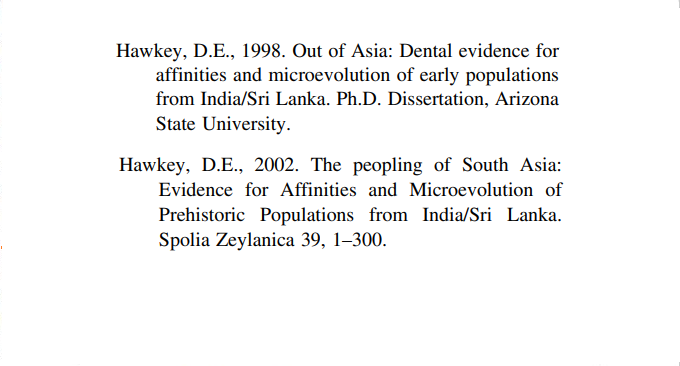
B. "Confusing of a linguistically-defined population (‘Dravidian’) with a biological population (Indus) has plagued Indian population affinity research for many years."
C. Hawkey studied 29 dental morphological features using a large sample size of 4,198 individuals in a...
2/5
C. Hawkey studied 29 dental morphological features using a large sample size of 4,198 individuals in a...
2/5
most comprehensive account in this line of research.
"The peoples of the Indus Civilization are dentally similar not only to modern 'Dravidian'-speakers (of South India, Sri Lankan Tamil), but also to the Indo-European (Afghanistan/Pakistan, Bengal, Sri Lankan Sinhalese)...
3/5
"The peoples of the Indus Civilization are dentally similar not only to modern 'Dravidian'-speakers (of South India, Sri Lankan Tamil), but also to the Indo-European (Afghanistan/Pakistan, Bengal, Sri Lankan Sinhalese)...
3/5
& AustroAsiatic (East India) groups as well.
The dental data supports the hypothesis that the Indus population was multilinguistic & probably ethnically diverse."
D. "There is no substantial amount of gene
flow between the Indus & the Deccan
farming/herding communities.
4/5
The dental data supports the hypothesis that the Indus population was multilinguistic & probably ethnically diverse."
D. "There is no substantial amount of gene
flow between the Indus & the Deccan
farming/herding communities.
4/5
In other words, the Deccan Neolithic-Chalcolithic
groups have evolved directly from the hunting-gathering Mesolithic communities."
Dravidian claims on IVC, like ALL of their claims, is a joke.
5/5
Source:
groups have evolved directly from the hunting-gathering Mesolithic communities."
Dravidian claims on IVC, like ALL of their claims, is a joke.
5/5
Source:

Loading suggestions...