

A new stablecoin has entered the arena: $DCHF - pegged to the Swiss Franc🇨🇭 & overcollateralized with ETH & wBTC.
@DeFi_Franc launched earlier this week and is a fork of @LiquityProtocol.
This 🧵 provides an overview of the protocol and how you can earn ~ 200% APR on DCHF 1/11
@DeFi_Franc launched earlier this week and is a fork of @LiquityProtocol.
This 🧵 provides an overview of the protocol and how you can earn ~ 200% APR on DCHF 1/11
2/ If you understand how @LiquityProtocol works you will also know the fundamentals behind @DeFi_Franc.
Unfamiliar with Liquity and their native stablecoin $LUSD?
I recommend checking out the thread here by the man @BarryFried1
Unfamiliar with Liquity and their native stablecoin $LUSD?
I recommend checking out the thread here by the man @BarryFried1
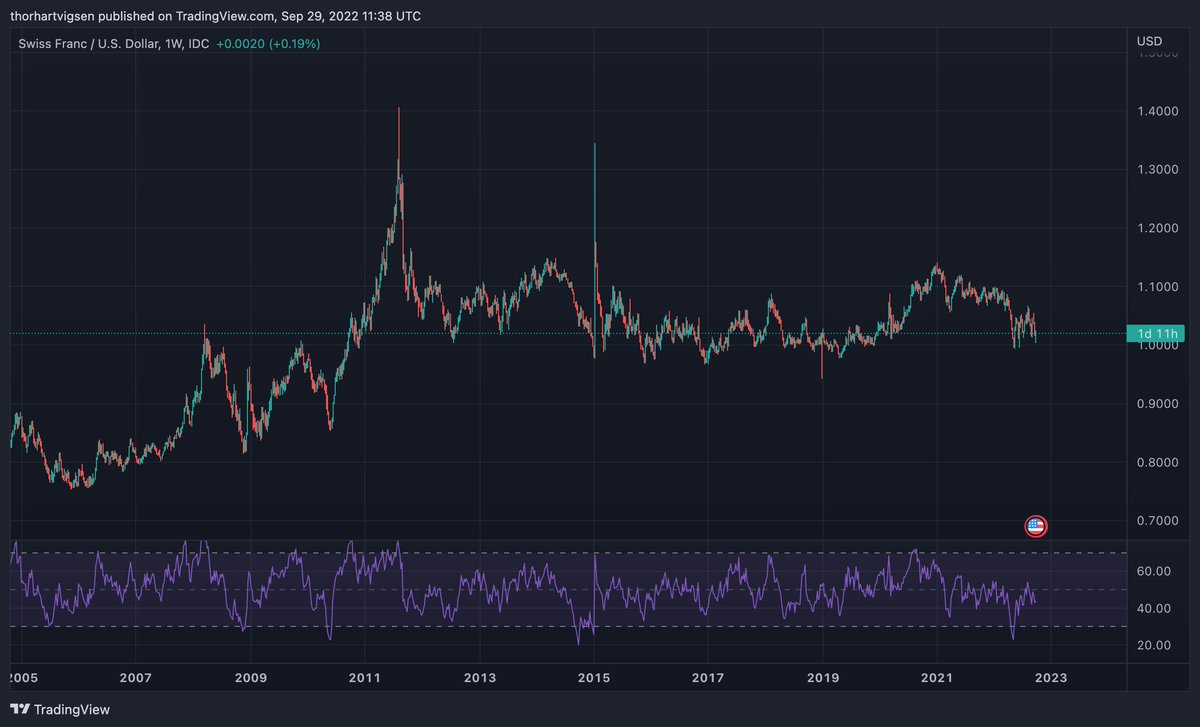
3/ The Swiss Franc has historically been one of the world's strongest currencies and has also been holding up quite well against the strong dollar.
As mentioned $DCHF is the native stablecoin on @DeFi_Franc and is pegged to the CHF (Franc).
As mentioned $DCHF is the native stablecoin on @DeFi_Franc and is pegged to the CHF (Franc).
4/ $DCHF is minted when opening a trove on @DeFi_Franc by depositing either ETH or wBTC as collateral. Like Liquity, Defi Franc operates on Eth mainnet.
The troves have a minimum collateral ratio of 110%. This allows for efficient use of liquidity and only 10% loss if liquidated
The troves have a minimum collateral ratio of 110%. This allows for efficient use of liquidity and only 10% loss if liquidated
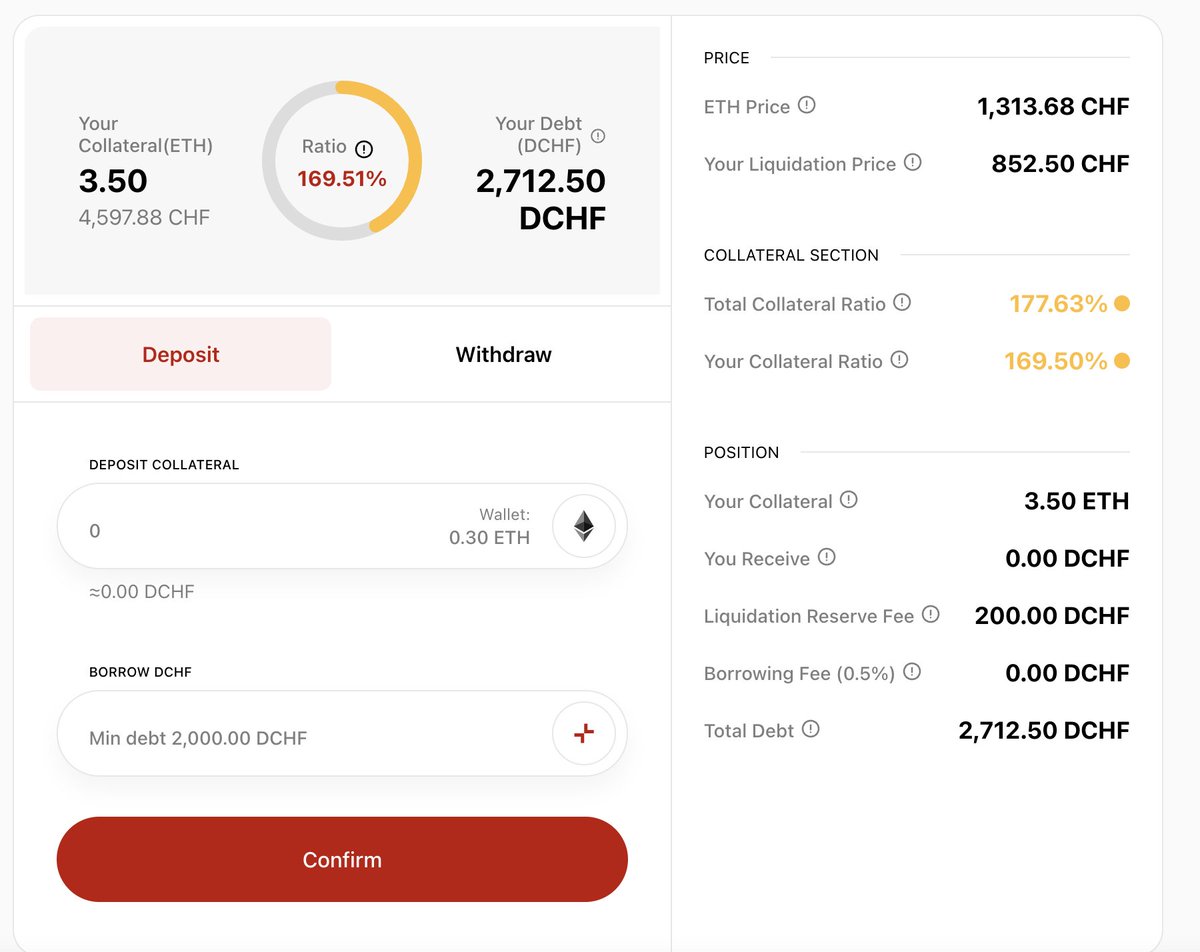
5/ The lower collateral ratio (the more DCHF borrowed against ETH or BTC), the higher the risk.
The total collateral ratio of $DCHF troves is 177%. This is a signal of how overcollateralized the stablecoin is and is aimed to be above 150%.
The total collateral ratio of $DCHF troves is 177%. This is a signal of how overcollateralized the stablecoin is and is aimed to be above 150%.
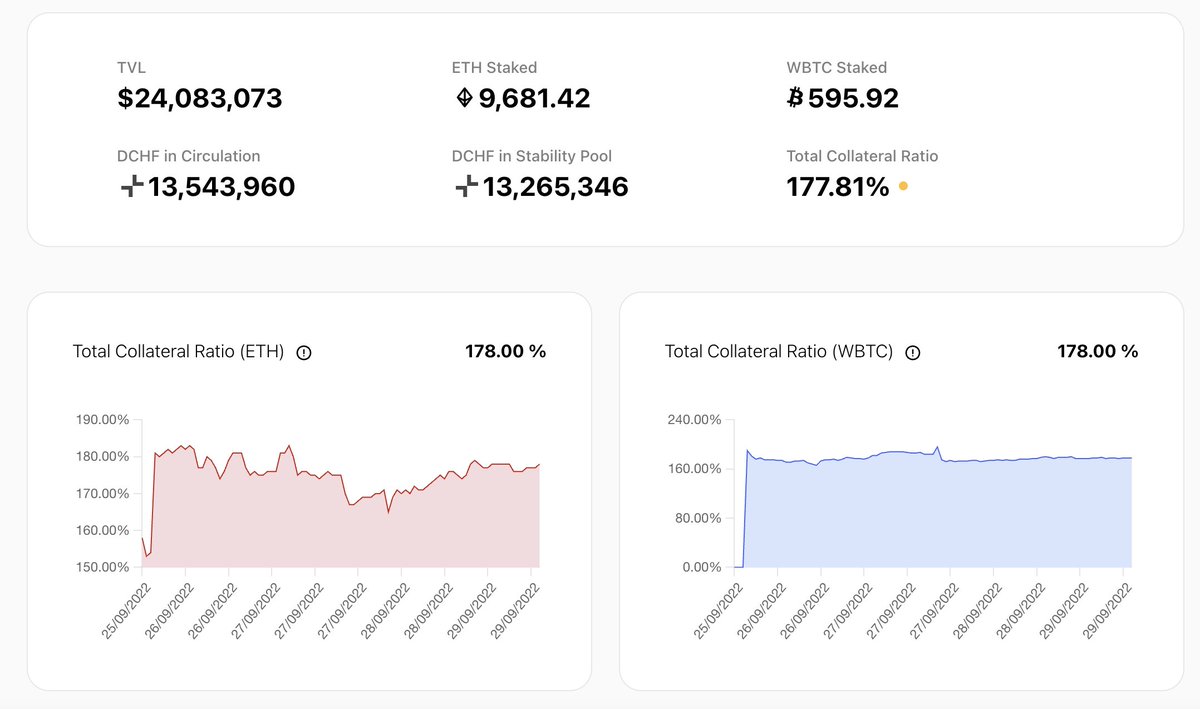
6/ If the total collateral ratio (CR) falls below 150% the protocol goes in "recovery mode" and liquidates positions with <150% collateral ratio until the overall ratio is more than 150% again.
Read more about this, price stability & more in the docs: docs.defifranc.com
Read more about this, price stability & more in the docs: docs.defifranc.com
7/ - Stability Pool -
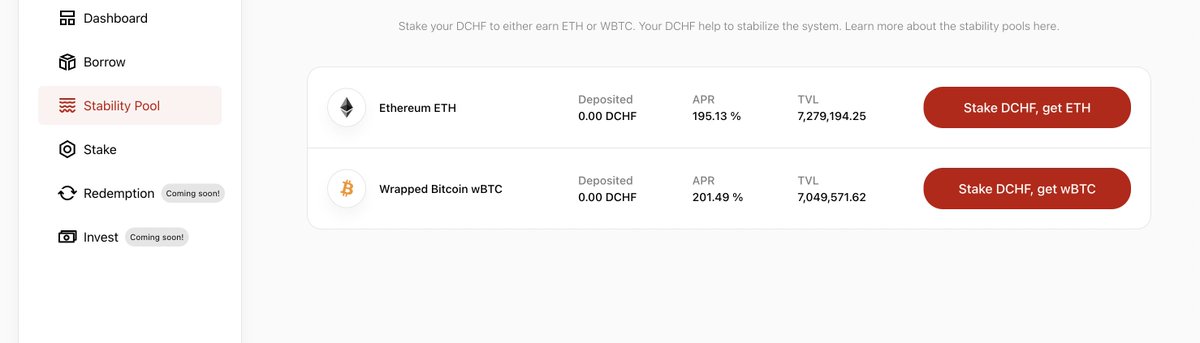
One of the main use cases when borrowing $DCHF is providing it in the stability pool to liquidate troves <110% CR and earn a yield in return.
Currently the yield is ~250% APR because of $MON incentives to bootstrap liquidity.
One of the main use cases when borrowing $DCHF is providing it in the stability pool to liquidate troves <110% CR and earn a yield in return.
Currently the yield is ~250% APR because of $MON incentives to bootstrap liquidity.
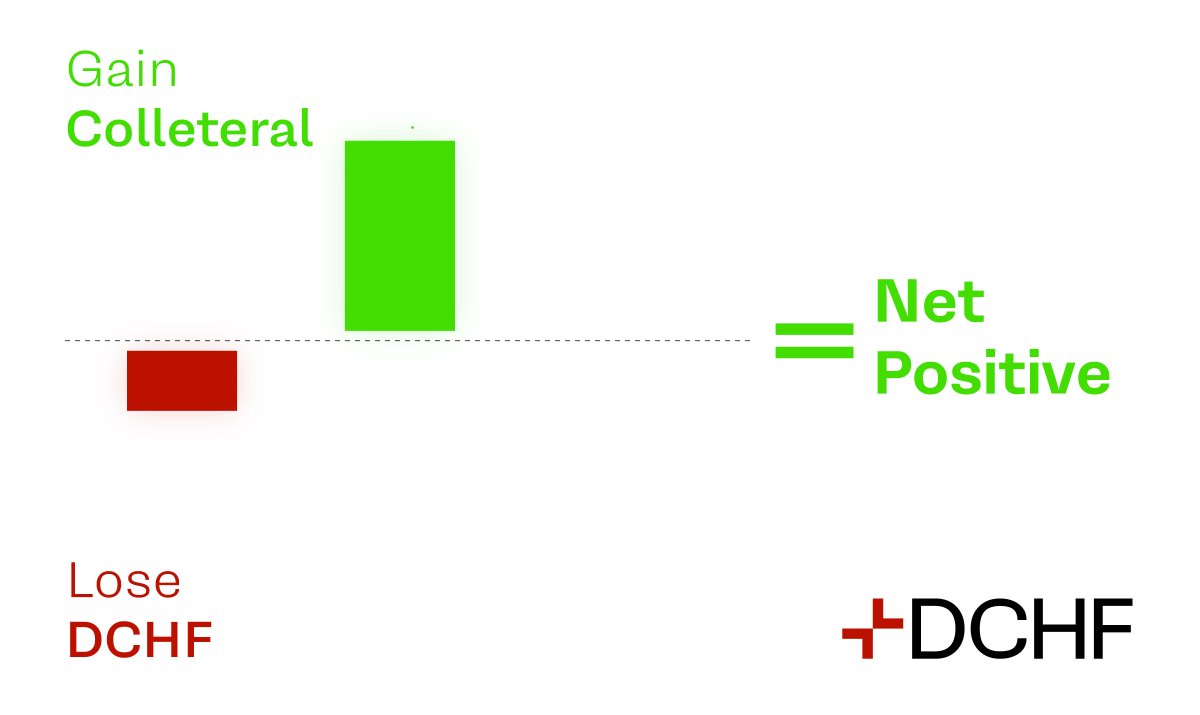
8/ When a trove is liquidated the equivalent amount of DCFH is burned from the stability pool. Over time depositors into the stability pool will lose DCFH but gain ETH or BTC from the collateral liquidated.
This amount gained will be greater than amount of DCFH lost.
This amount gained will be greater than amount of DCFH lost.
9/ $MON (native utility token similar to $LQTY on @LiquityProtocol) can be traded on Uniswap and $DCHF on Uniswap & Curve however as they just launched there is little liquidity.
10/ An alternative strategy when liquidity increases is to simply swap another stable with $DCHF and deposit directly into the stability pool.
The yield will likely decrease however as $MON emissions are turned off gradually.
The yield will likely decrease however as $MON emissions are turned off gradually.
11/ Finally. In their docs it's stated that V2 of this protocol will allow yield generating collateral from Convex as collateral (e.g. USDT/USDC/DAI).
This will allow you to earn yield while borrowing $DCFH that can also be farmed!
This will allow you to earn yield while borrowing $DCFH that can also be farmed!
11/ That's all for now. I'm excited to see how this protocol evolves over time.
If you liked this thread I would appreciate a like & retweet of the first post!:)
If you liked this thread I would appreciate a like & retweet of the first post!:)
Loading suggestions...