

Over the last year core PCE inflation (excluding food and energy) was 4.9%.
Absent the Russian invasion of Ukraine it would have been about 4.9%.
One useful gut check on this was that core inflation was ~2% in previous episodes with even larger 12-month energy price increases.
Absent the Russian invasion of Ukraine it would have been about 4.9%.
One useful gut check on this was that core inflation was ~2% in previous episodes with even larger 12-month energy price increases.
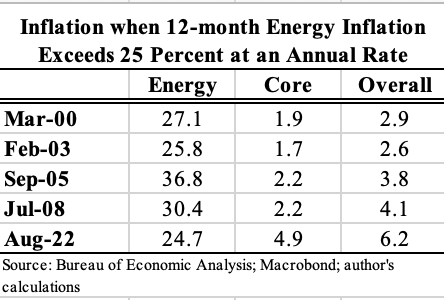
Another useful gut check on this is that energy prices fell 10% over the last two months but core CPI remained very high. Yes, there might be lags involved so this--like the previous--is only a gut check about magnitudes.
Why is the passthrough about zero? Because there are two ways higher energy prices affects core:
1. Directly increases it (e.g., airfares go up when jetfuel prices rise).
2. Behavioral decreases it (e.g., people can't afford restaurants so cut back and inflation lower there).
1. Directly increases it (e.g., airfares go up when jetfuel prices rise).
2. Behavioral decreases it (e.g., people can't afford restaurants so cut back and inflation lower there).
Going beyond gut checks here is some research on the overall passthrough incorporating both effects: jstor.org federalreserve.gov kansascityfed.org frbsf.org brookings.edu
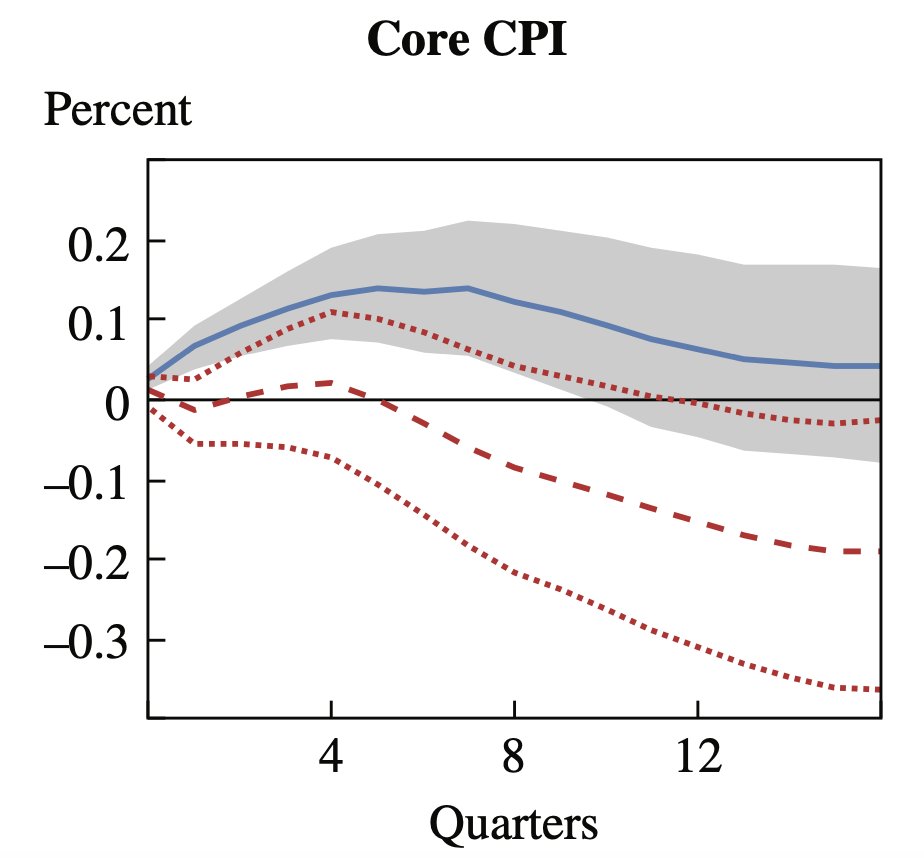
Here is one picture from a Brookings Paper on Economic Activity by de Wienne & Peersman.
This shows the response of core CPI to a food price shock (blue) and an oil price shock (red). Both are small and of uncertain sign--if anything oil increases *reduce* core inflation.
This shows the response of core CPI to a food price shock (blue) and an oil price shock (red). Both are small and of uncertain sign--if anything oil increases *reduce* core inflation.
The Russian invasion did, of course, raise prices for gasoline, electricity & food in the US and around the world.
The overall PCE inflation rate was 6.2% over the last year. Absent the Russian invasion it would have been lower--probably about 5% like core PCE inflation.
The overall PCE inflation rate was 6.2% over the last year. Absent the Russian invasion it would have been lower--probably about 5% like core PCE inflation.
Loading suggestions...