

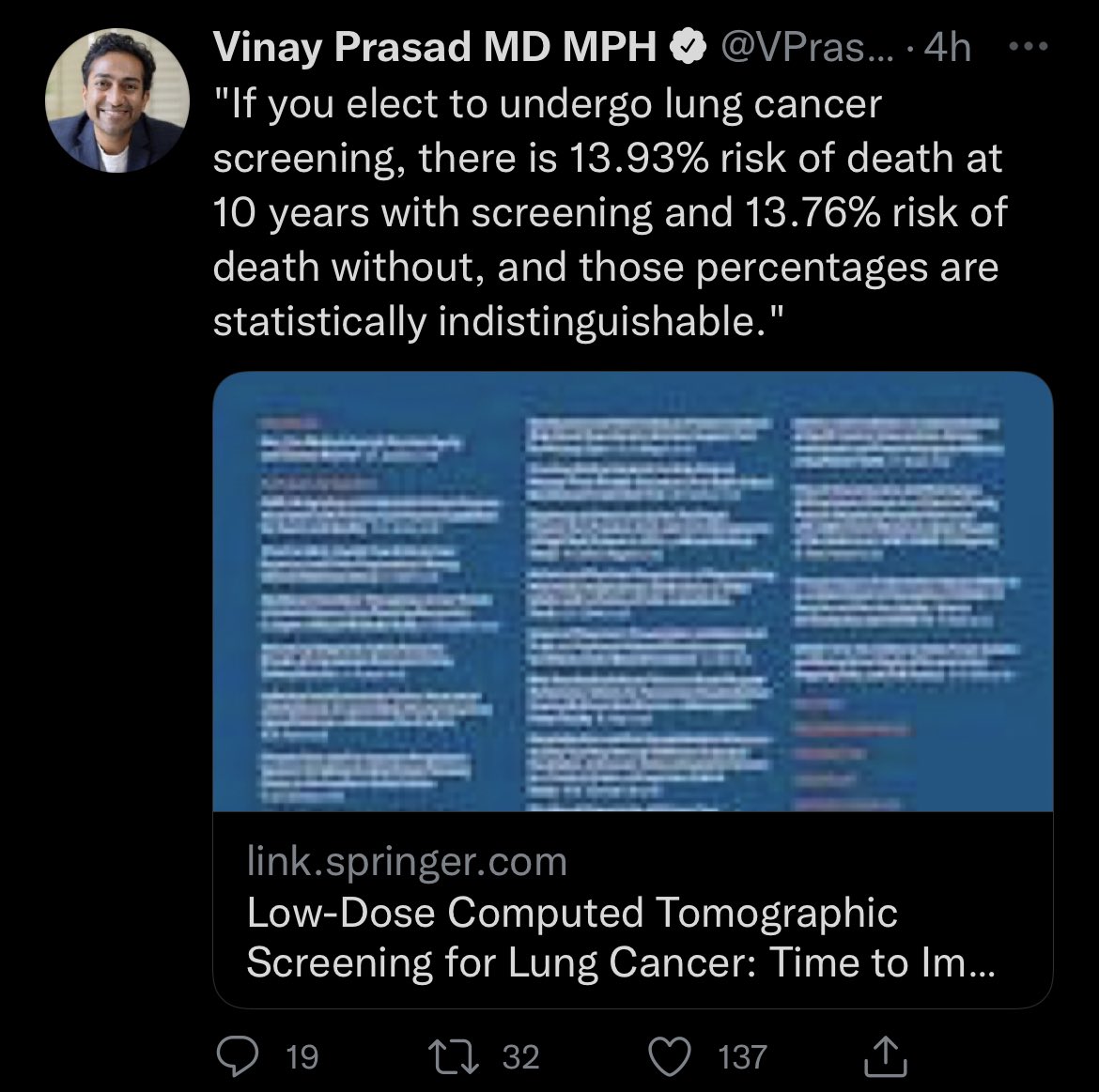
In his latest effort to win the Dunning-Kruger award, VP is now opposed to lung cancer screening.
In order for VP to consider cancer screening “worthwhile” its not enough to prevent lung cancer mortality it must prevent death from literally anything (all cause mortality)
1/
In order for VP to consider cancer screening “worthwhile” its not enough to prevent lung cancer mortality it must prevent death from literally anything (all cause mortality)
1/
For context, large RCTs have demonstrated the value of lung cancer cancer screening in high risk people: those who are older & with greater 🚬 exposure.
In particular, the NLST (2011) & NELSON (2020) trials found reduced lung cancer mortality with low dose CT screening.
2/
In particular, the NLST (2011) & NELSON (2020) trials found reduced lung cancer mortality with low dose CT screening.
2/
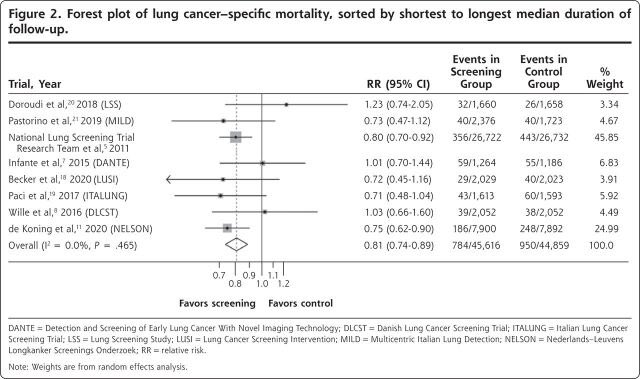
A recent meta-analysis of 9 lung cancer screening RCTs (that included almost 100,000 people) confirmed this finding: low dose CT scans reduce lung cancer mortality.
For every 265 people screened, 1 death from lung cancer is prevented.
pubmed.ncbi.nlm.nih.gov
3/
For every 265 people screened, 1 death from lung cancer is prevented.
pubmed.ncbi.nlm.nih.gov
3/

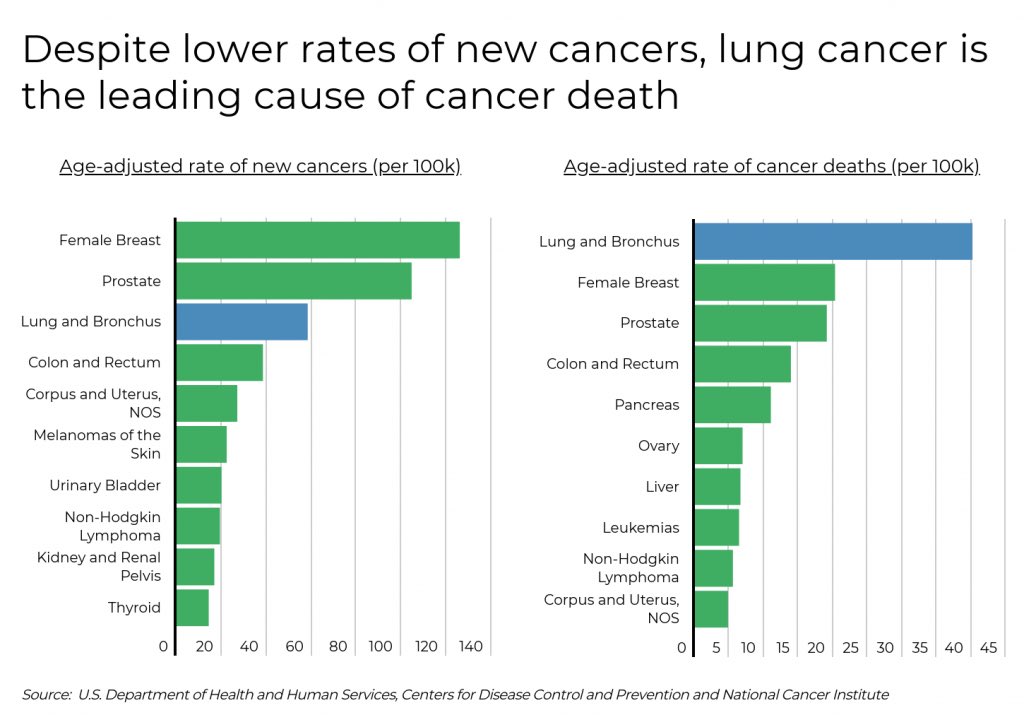
Lung cancer is by far the leading cause of cancer death so reducing mortality is big!
That’s why the US preventative services task force, the American Cancer Society, & basically every organization of experts recommends screening high risk people.
jamanetwork.com
4/
That’s why the US preventative services task force, the American Cancer Society, & basically every organization of experts recommends screening high risk people.
jamanetwork.com
4/
This brings us to VP’s latest & dumbest argument: “why doesn’t lung cancer screening reduce all cause mortality?”
The simplest answer (that VP actually acknowledges) is that it does!
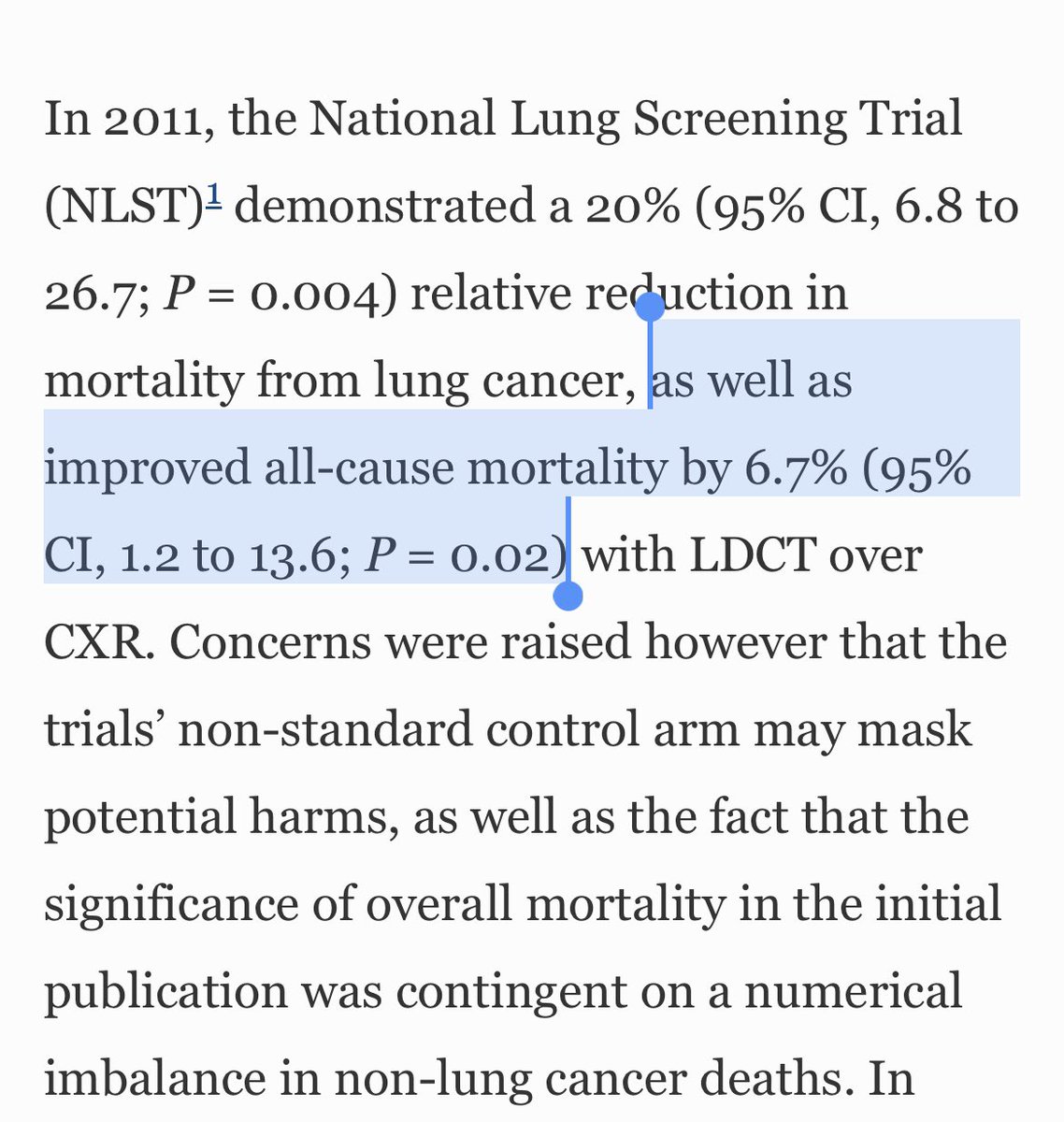
In the NLST (by far the largest RCT to date), all cause mortality was reduced by 6.7%!
5/
The simplest answer (that VP actually acknowledges) is that it does!
In the NLST (by far the largest RCT to date), all cause mortality was reduced by 6.7%!
5/
It’s also worth noting that the standard of reduced all cause mortality hadn’t been reached in *ANY* cancer screening RCT!
Does VP think we should stop screening for colon & breast cancer also?
6/
Does VP think we should stop screening for colon & breast cancer also?
6/
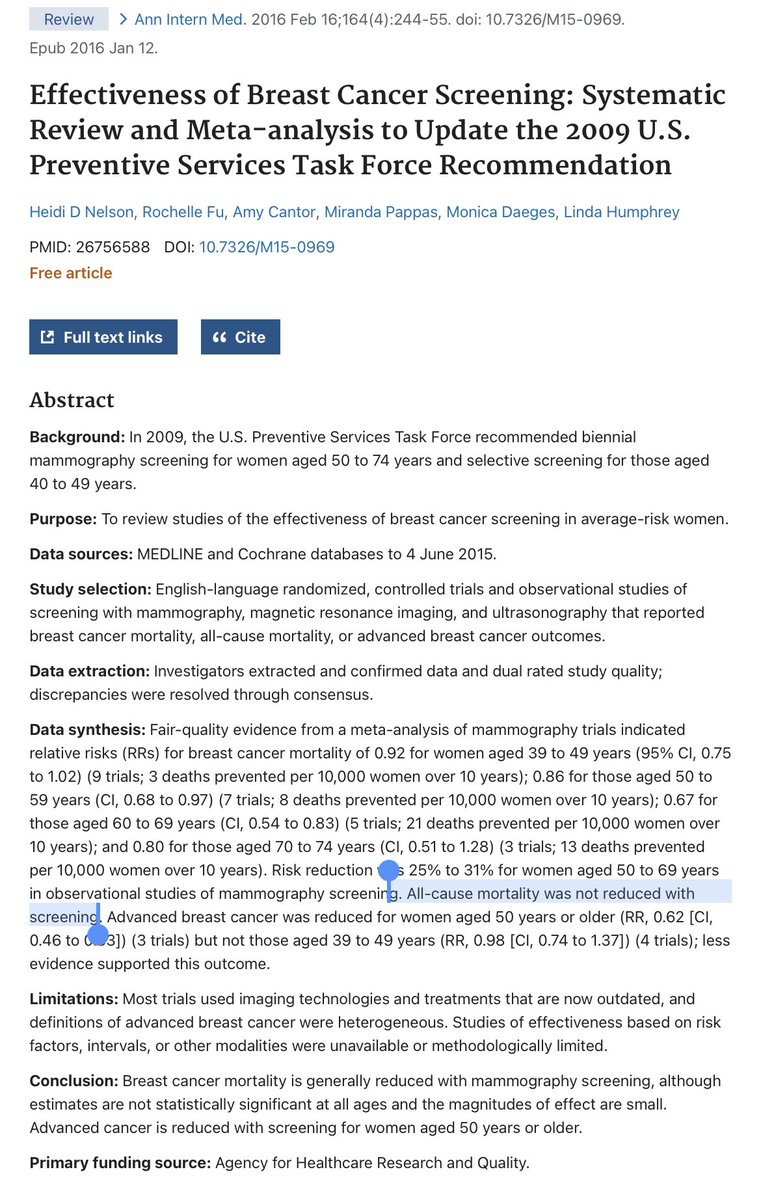
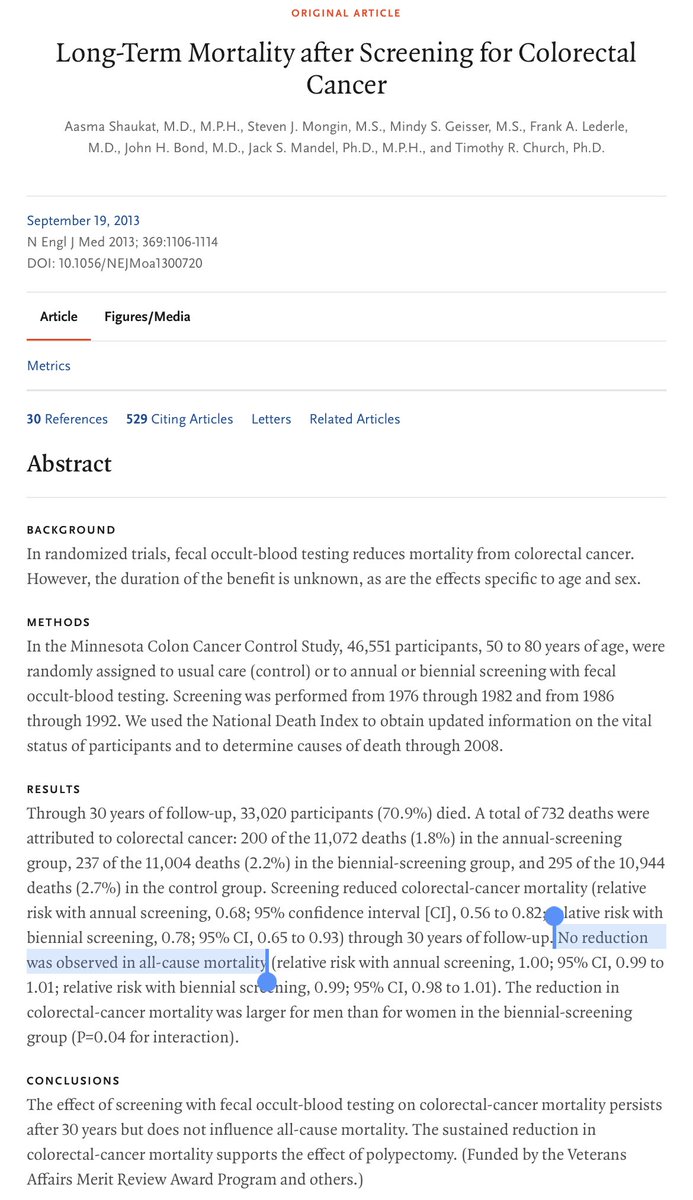
But why don’t the screening RCTs show a decrease in all cause mortality?
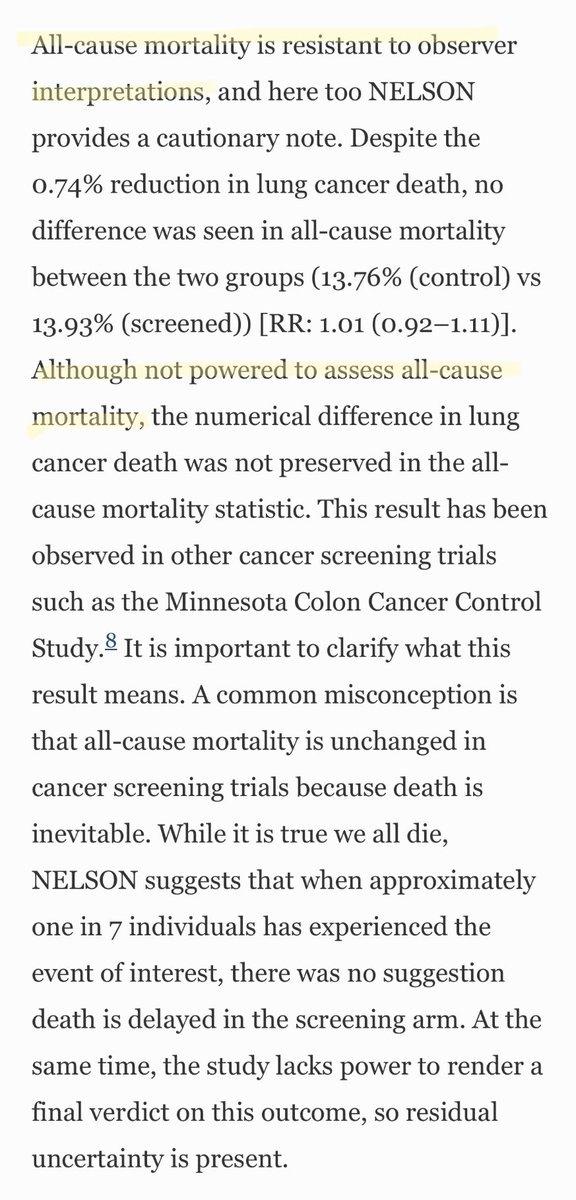
People can die from many things & the RCTs are powered to detect cancer mortality, not all cause mortality!
(Most people who gave taken an intro stats/epi course should be able to answer this btw)
7/
People can die from many things & the RCTs are powered to detect cancer mortality, not all cause mortality!
(Most people who gave taken an intro stats/epi course should be able to answer this btw)
7/
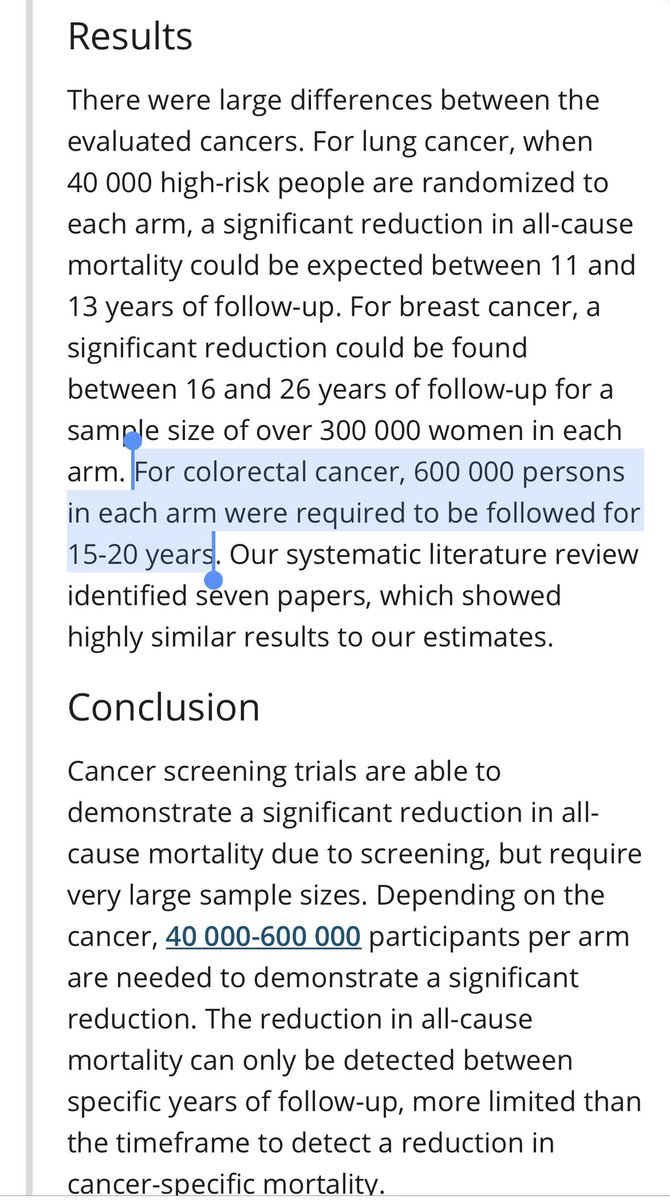
That doesn’t mean cancer screening doesn’t reduce all cause mortality, it just means you would need a truly massive RCT to detect the difference!
If we wanted to enroll 1.2m people in a colon cancer screening RCT we could prove it… in just 20 years!
onlinelibrary.wiley.com
8/
If we wanted to enroll 1.2m people in a colon cancer screening RCT we could prove it… in just 20 years!
onlinelibrary.wiley.com
8/
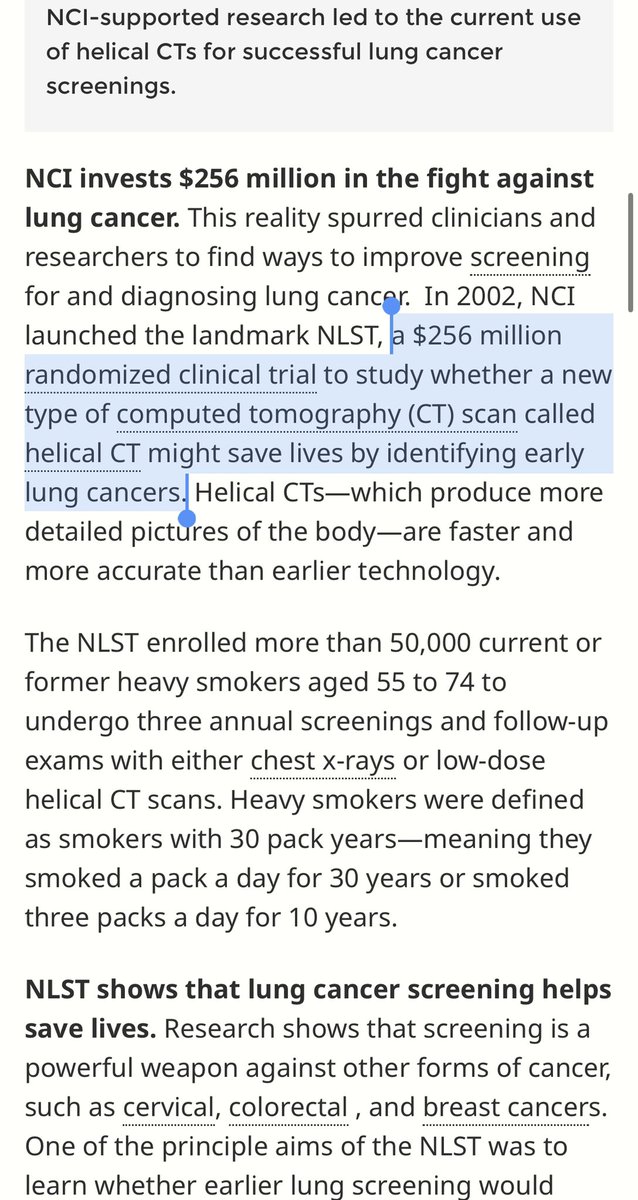
The National Lung Screening Trial (NLST) was a landmark trial that proved low dose screening CT reduces lung cancer mortality.
It took >10 years & at $256m it was also the most expensive trial ever done by the NIH!
cancer.gov
9/
It took >10 years & at $256m it was also the most expensive trial ever done by the NIH!
cancer.gov
9/
But why not do an even longer RCT more twice as large as NSLT to prove CT scans reduce all cause mortality?
(Other than a price greater than the GDP of a dozen countries?)
It would be unethical! You can’t randomize people to a control group with increased cancer mortality!
10/
(Other than a price greater than the GDP of a dozen countries?)
It would be unethical! You can’t randomize people to a control group with increased cancer mortality!
10/
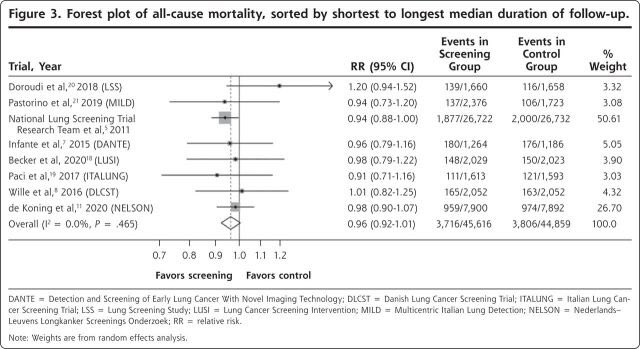
It’s also worth pointing out that even though none of these studies was powered for all-cause mortality, there actually is a strong (albeit not quite statistically significant) signal that screening CT scans *do* reduce all-cause mortality.
pubmed.ncbi.nlm.nih.gov
11/
pubmed.ncbi.nlm.nih.gov
11/
Not only does CT screening reduce cancer (& probably all cause) deaths it’s also cost effective & improves quality of life!
A 🇳🇿 Study suggested that each CT scan added 0.067 quality adjusted life years (QALY) at a cost of $2843 (or $44k per QALY)!
pubmed.ncbi.nlm.nih.gov
12/
A 🇳🇿 Study suggested that each CT scan added 0.067 quality adjusted life years (QALY) at a cost of $2843 (or $44k per QALY)!
pubmed.ncbi.nlm.nih.gov
12/
A 🇺🇸 study found USPSTF lung cancer screening guidelines were cost effective. The cost per QALY was $72 564.
(<$100k/QALY is usually considered cost effective)
jamanetwork.com
This suggests even with conservative assumptions lung cancer screening is “worth it”.
13/
(<$100k/QALY is usually considered cost effective)
jamanetwork.com
This suggests even with conservative assumptions lung cancer screening is “worth it”.
13/
Anyone who has cared for people with advanced lung cancer probably understands this intuitively: Advanced Stage lung cancer is a terrible disease & it’s treatment can be quite toxic.
Even if VP is right (he isn’t) preventing advanced lung cancer & mortality is beneficial.
14/
Even if VP is right (he isn’t) preventing advanced lung cancer & mortality is beneficial.
14/
Loading suggestions...