

Build a daily writing habit.
Here's why:
• It'll help you map out your goals (the real ones)
• It'll help you build an audience (if you wish to publish)
• It'll change your life
Here's how:
Here's why:
• It'll help you map out your goals (the real ones)
• It'll help you build an audience (if you wish to publish)
• It'll change your life
Here's how:
Let’s split it up into 3 simple steps:
1. Why write
2. How to build the habit (systems)
3. Why publish
By the way, if you enjoy this thread, comment “more” for more content like this!
Let’s get into it.
1. Why write
2. How to build the habit (systems)
3. Why publish
By the way, if you enjoy this thread, comment “more” for more content like this!
Let’s get into it.
1. Why write
It’ll change your life.
Most people don’t know what they want. They want what others want.
Writing will help you map out what you *really* want.
It’ll change your life.
Most people don’t know what they want. They want what others want.
Writing will help you map out what you *really* want.
1. Why write (contd.)
Note that writing for yourself is different from writing for your audience (or future audience).
When writing for myself, I optimize for volume to increase clarity on a topic I’m thinking a lot about.
Note that writing for yourself is different from writing for your audience (or future audience).
When writing for myself, I optimize for volume to increase clarity on a topic I’m thinking a lot about.
1. Why write (contd.)
But…
When writing for my audience, I optimize for value per word.
My goal is to keep it as short, punchy, and as value-packed as possible.
But…
When writing for my audience, I optimize for value per word.
My goal is to keep it as short, punchy, and as value-packed as possible.
2. How to build a writing habit
So you’re already sold on the fact that you should write.
This is how the process is going to work.
1. Focus on consistency
2. Focus on systems
Don’t focus on systems before you have consistency under the belt.
So you’re already sold on the fact that you should write.
This is how the process is going to work.
1. Focus on consistency
2. Focus on systems
Don’t focus on systems before you have consistency under the belt.
3. Focus on consistency
Unfortunately, there is no replacement for consistency.
Though, that’s probably a good thing,
Everyone that is not willing to commit to the long-term game loses immediately.
You’ll probably beat 90% of people just by being consistent.
Unfortunately, there is no replacement for consistency.
Though, that’s probably a good thing,
Everyone that is not willing to commit to the long-term game loses immediately.
You’ll probably beat 90% of people just by being consistent.
3. Focus on consistency (contd.)
Start with something small.
15 minutes a day. For 30 days straight.
Do whatever you have to to get it done.
If writing on your computer distracts you, write on a piece of paper.
But make sure to get your 15 minutes in. Everyday.
Start with something small.
15 minutes a day. For 30 days straight.
Do whatever you have to to get it done.
If writing on your computer distracts you, write on a piece of paper.
But make sure to get your 15 minutes in. Everyday.
4. Focus on systems
Once you’ve done something for 30 days, you’ll have built the habit (most likely).
Systems are where the fun starts.
Remember: you want to *gain* time with systems. Not waste time.
Once you’ve done something for 30 days, you’ll have built the habit (most likely).
Systems are where the fun starts.
Remember: you want to *gain* time with systems. Not waste time.
4. Focus on systems (contd.)
The key is to make it simple.
Here’s my system:
• Writing thread/blog post ideas → Apple Notes
• In-depth writing → Google Docs
• Content management → Google Sheets
Let’s get into each one individually (skip if you need to)
The key is to make it simple.
Here’s my system:
• Writing thread/blog post ideas → Apple Notes
• In-depth writing → Google Docs
• Content management → Google Sheets
Let’s get into each one individually (skip if you need to)
4.1 Apple Notes
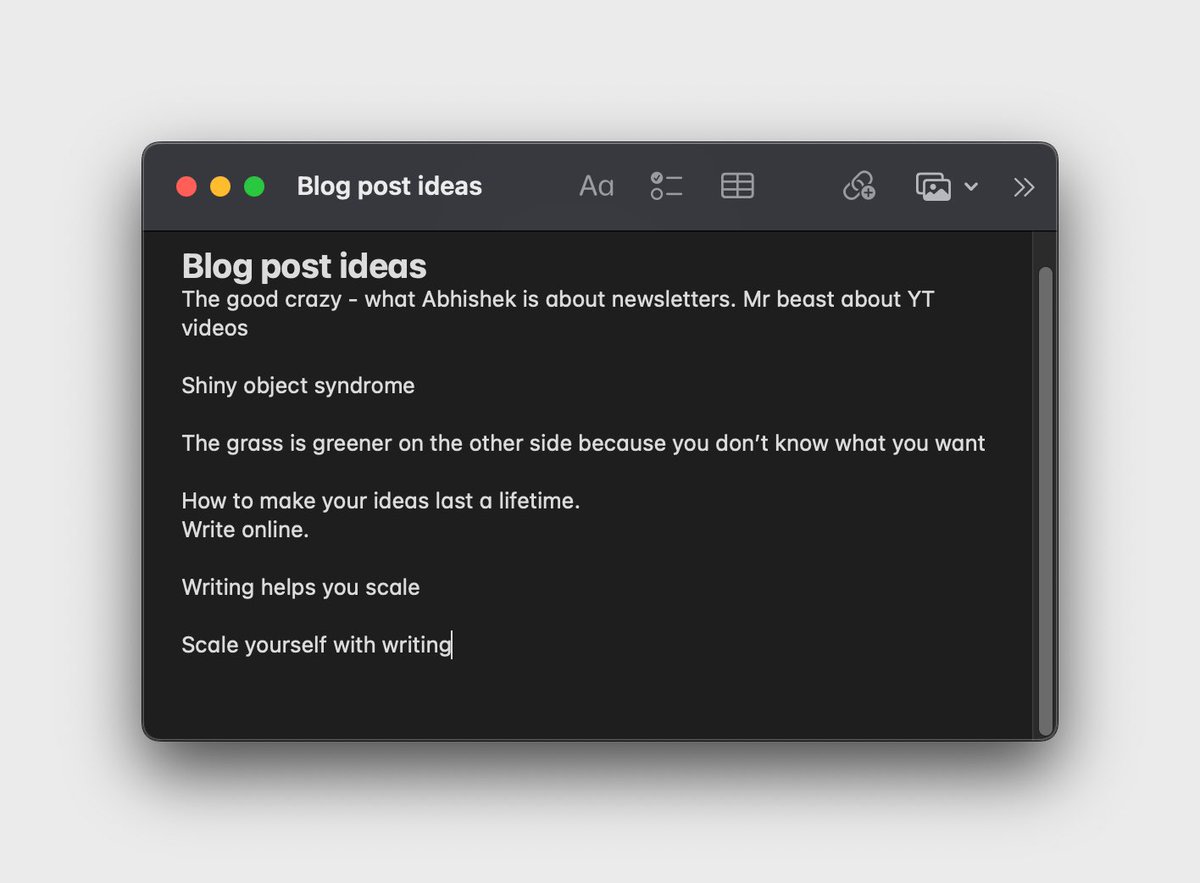
This is where I drop thread and blog post ideas.
No matter what you use (task manager, notes app, Notion), make sure it’s easy to drop ideas in there.
It must be accessible. And don’t worry about organizing just yet (that comes later).
This is where I drop thread and blog post ideas.
No matter what you use (task manager, notes app, Notion), make sure it’s easy to drop ideas in there.
It must be accessible. And don’t worry about organizing just yet (that comes later).
4.2 Google Docs
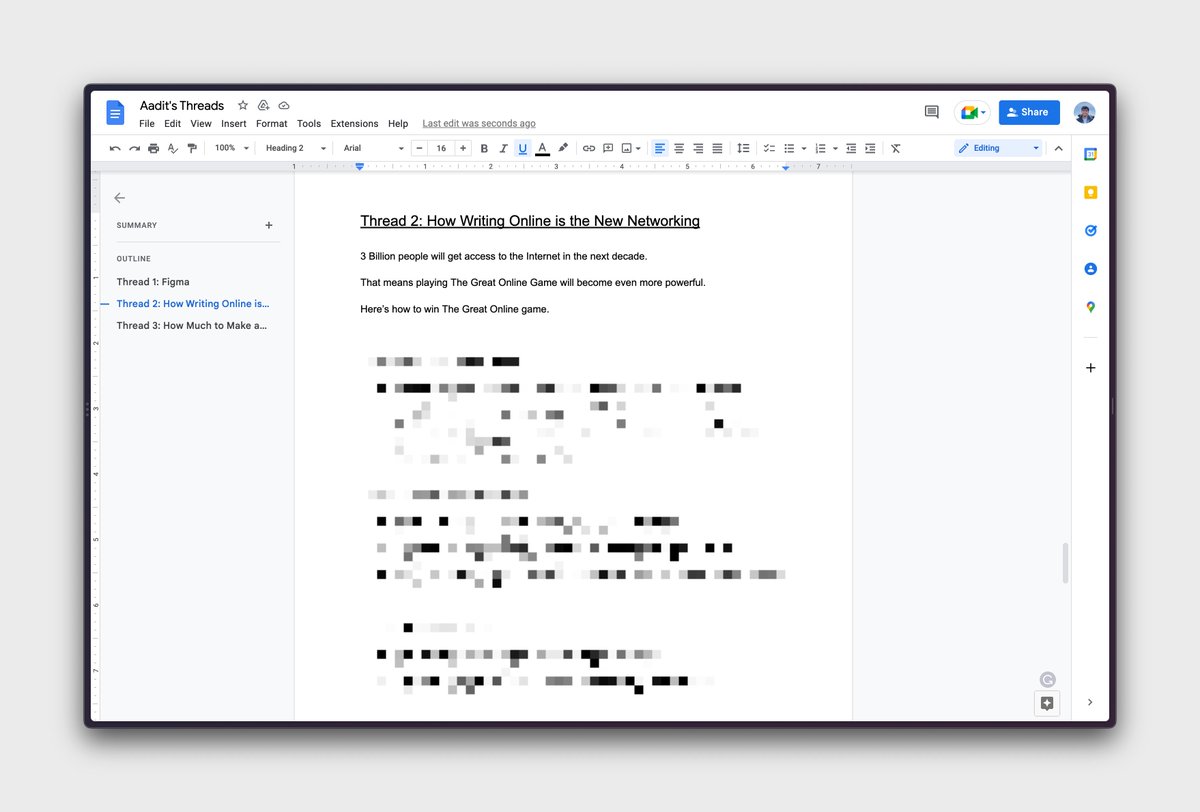
This is where I expand on the topic ideas from Apple Notes.
It doesn’t have to form into a blog post or thread just yet.
• Have a working title
• Have a working thread hook
• Worry about editing later.
Focus on volume for now.
This is where I expand on the topic ideas from Apple Notes.
It doesn’t have to form into a blog post or thread just yet.
• Have a working title
• Have a working thread hook
• Worry about editing later.
Focus on volume for now.
4.2 Google Docs (contd.)
Once you’ve written your SFD (shitty first draft), go do something else.
Play with your kids. Eat a meal. Go to sleep.
And then come back and edit tomorrow. Ruthlessly.
That’s going to turn it into a *much* better draft for publish.
Once you’ve written your SFD (shitty first draft), go do something else.
Play with your kids. Eat a meal. Go to sleep.
And then come back and edit tomorrow. Ruthlessly.
That’s going to turn it into a *much* better draft for publish.
4.3 Google Sheets
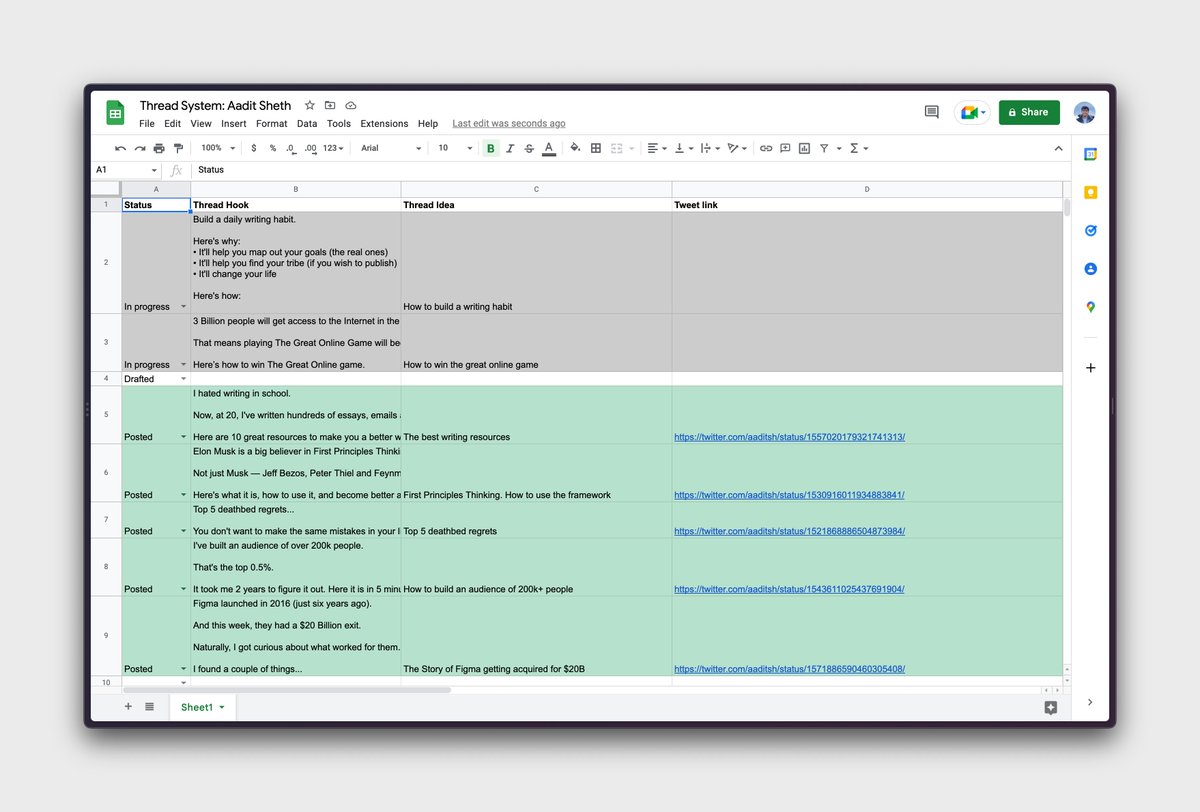
This is not required but it is part of my writing/content management process.
I use sheets to manage these:
• What have I posted already?
• What’s being drafted?
• What am I currently working on?
Thanks to @matt_gray_ for the inspiration on this template
This is not required but it is part of my writing/content management process.
I use sheets to manage these:
• What have I posted already?
• What’s being drafted?
• What am I currently working on?
Thanks to @matt_gray_ for the inspiration on this template
That’s my process! It’s simple for one reason.
I want the systems to enhance my work, not waste my time.
Feel free to steal it from me.
I want the systems to enhance my work, not waste my time.
Feel free to steal it from me.
If you found this useful:
• Follow me @aaditsh for more insights like these!
• It would mean a lot if you could retweet or quote tweet the first tweet of this thread to spread the insights and help people write more!
• Follow me @aaditsh for more insights like these!
• It would mean a lot if you could retweet or quote tweet the first tweet of this thread to spread the insights and help people write more!
I do in-depth threads every once in a while but the best stuff goes in my newsletter.
Processes, content, discoveries.
Here's our best stuff:
timebillionaires.substack.com
Processes, content, discoveries.
Here's our best stuff:
timebillionaires.substack.com
Loading suggestions...