

On the earth god Geb and the heavenly goddess Nut. [THREAD]
![On the earth god Geb and the heavenly goddess Nut. [THREAD] https://t.co/B7H03ddHHb](https://pbs.twimg.com/media/FfS7KmIWAAoXpCi.png)
The Egyptian cosmos was conceived primarily as consisting of 3 realms: the flat mountain-rimmed earth; the sky above the earth; and the atmosphere between the two. None of these realms was thought of as being simply physical, each one manifested an inner, divine presence.
To describe the Egyptian cosmos is also to describe a world of divine beings whose nature is expressed in their respective cosmological domains. These domains are only marginally physical, and insofar as they are physical they are also symbolic.
For the Egyptians, the lower realm of the earth was represented in its entirety in the image of the Beloved Land. It was pictured as a wide alluvial plain, through the centre of which the Great River flowed; on either side it was bounded by a range of mountains.
Beyond these were located the other Middle Eastern countries, which throughout Egyptian history existed on the periphery of the Egyptian universe.
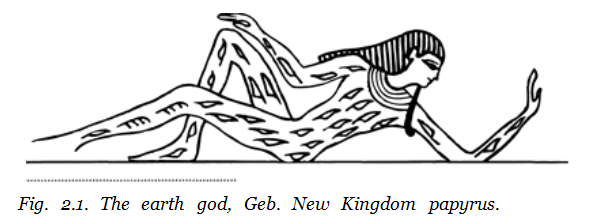
The earth itself was identified with the divine being Geb. In one text, it is described literally as the body of Geb, on whose back vegetation grows, and from whose ribs the barley springs forth. The earth was thus alive and ensouled. To tread upon it was to tread upon a god.
This image of the earth as god is clearly not based simply on sense perception, nor is it based upon logical reasoning. It is an imaginative vision that sees *through* the physical landscape into its interiority.
Here we see Geb in a typical pose. He is nearly always represented in this manner when he is portrayed as the spirit of the earth. His right leg (and often his right arm, as in previous image) is usually raised, and he rests on his left elbow and left buttock.
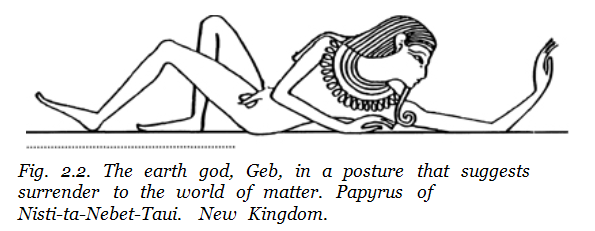
His face is turned toward the earth, seemingly in a gesture of resignation to a fate that entails having become ensnared in the realm of matter. Geb is rarely shown looking up.
It is as if, with a mixture of surprise and sadness, his gaze is arrested by what is below rather than by what is above him. What is above him is his beloved consort Nut, the goddess of heaven.
Geb always seems to lack vitality, and looks as if he is unable to raise himself up. Or is it that he has just landed, having fallen from a great height? Whichever way one sees him, Geb symbolizes the energy that lies behind the world of matter.
Geb was also pictured in other forms. Most usually, he had the form of a goose, which was the main domestic egg-laying bird in Egypt up until the reign of Thutmosis III.
Here is Geb as “the Great Cackler,” or cosmic goose. As such, his place in the total scheme of things is different from the Geb of the previous illustrations. For it is from the cosmic goose that the world egg comes into being.
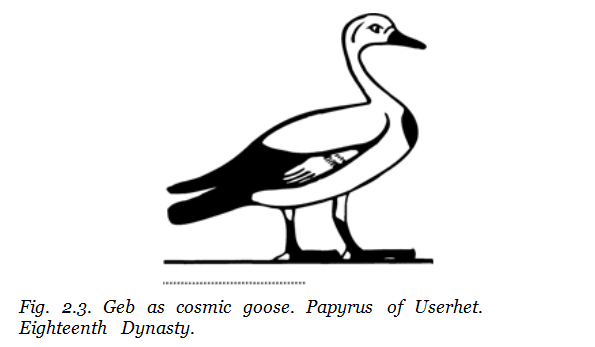
The cosmic goose would appear to be an image of the androgynous Creator of Worlds, whom in the Heliopolitan theology is Atum-Ra. Just as it is from the goose’s egg that life arises, so it is from the god Geb at the beginning of time that life emerges and takes on material form.
In these two different ways of imaging Geb we are not only presented with two different aspects of the god; we also come face to face with the paradoxical nature of polytheistic thinking ...
... which is that any single god with apparently limited functions or sphere of operation can at the same time be apprehended as the ultimate Godhead and source of all existence.
Above the earth, and looking down upon the earth god Geb, the Egyptians pictured the heavenly goddess Nut. She is usually represented as a naked woman, her body covered with stars.
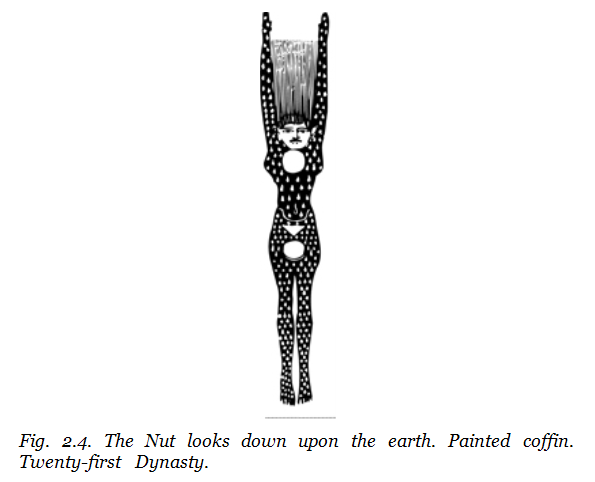
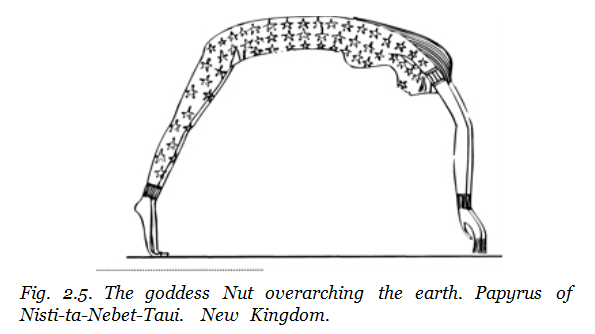
Her fingertips and toes reach out and down to touch the four cardinal points of the earth, over which her star-spangled body is outspread. This can be seen more easily in this image, which shows the goddess from the side.
It is interesting that both Geb and Nut are nearly always represented naked, which is not normally the case with other deities of the Egyptian pantheon. Perhaps this is because they were thought of primarily in their role as lovers.
Or it is because these two deities—more than any others—show themselves without reserve to the imaginative eye. For they have given themselves utterly to the world of manifestation, and hide nothing from those able to see beyond the outer surfaces of the sense-perceptible world.
With these images of Nut we have only marginally to do with the sensory phenomena of the blue sky of the day or the dark, star-filled night. But this way of representing the dome of the sky is not simply an imaginative construct projected onto the heavens.
It is rather a vision of the great cosmic being through whom the stars, the planets, and the sun all come into existence.
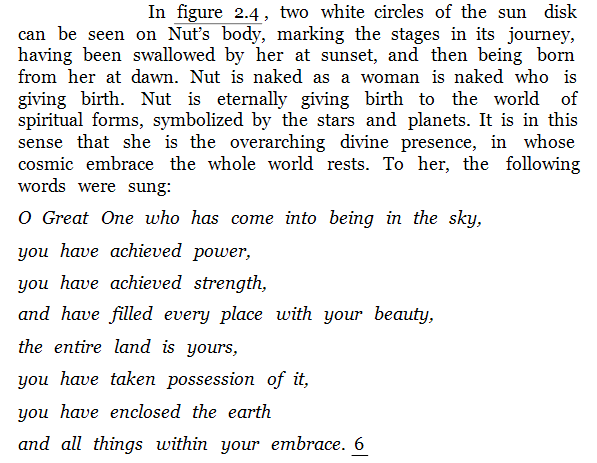
Nut is the cosmic correspondent to Geb the earth god. If she is the great mother who clothes all beings in their spiritual forms, then it is Geb who gives them material embodiment. They can be seen as 2 principles: the heavenly/spiritual and the earthly/material source of forms.
In this image, Geb takes the shape of a snake-headed man underneath the figure of Nut. This may be an allusion to the primordial nature of the god, or perhaps to the fact that snakes are the creatures that live closest to the earth.
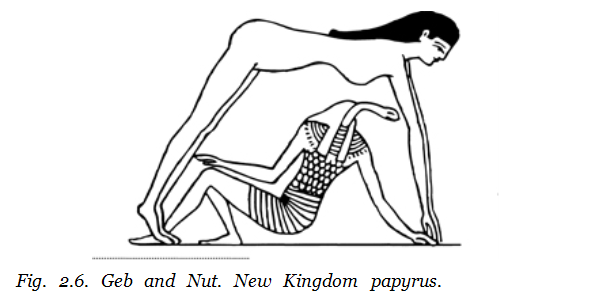
However we understand his snake form, we notice how Nut does indeed “enclose the earth” in her all-encompassing embrace.
Loading suggestions...