

On Nun, the primordial watery abyss of unrealized potentiality for existence. [THREAD]
As one Pyramid Text puts it, Nun exists “before the sky existed, before the earth existed, before that which is made firm existed.”
As one Pyramid Text puts it, Nun exists “before the sky existed, before the earth existed, before that which is made firm existed.”
![On Nun, the primordial watery abyss of unrealized potentiality for existence. [THREAD]
As one Pyram...](https://pbs.twimg.com/media/Ffbds7tXgAAxuWi.jpg)
![On Nun, the primordial watery abyss of unrealized potentiality for existence. [THREAD]
As one Pyram...](https://pbs.twimg.com/media/FfbeaVXWIAEM-NQ.jpg)
In figure 2.14, from previous thread, we also see that Osiris is surrounded by water. So also is Nut, up to her head, which apparently rests on the surface of the ocean in which Osiris is submerged. She holds the sun above the water, so it exists in a different element.
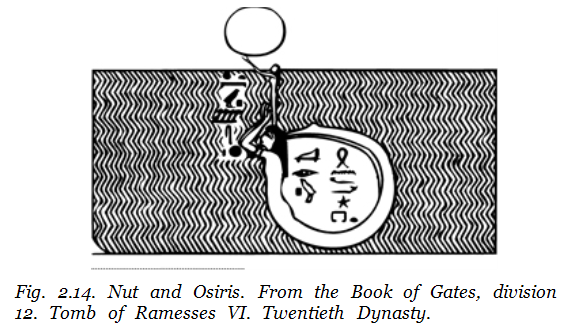
We now turn to figure 2.15, from which 2.14 is a detail. The detail is taken from the top, and in the context of the whole picture, the correct orientation of the detail is upside down. Beneath it, the space occupied by the sun disk extends to the whole length of the sun barge.
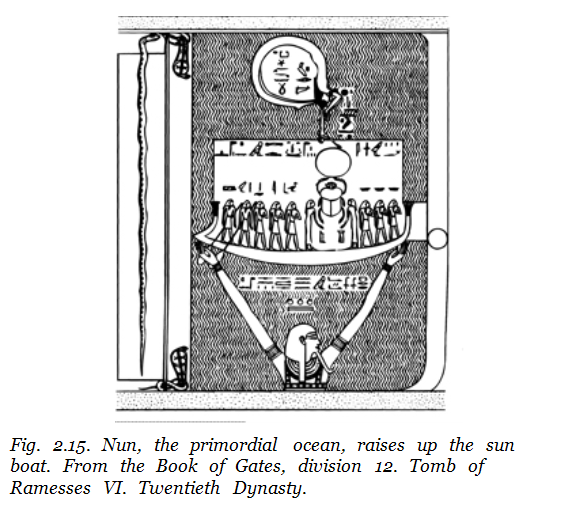
Nut can be seen to be actually receiving the disk from Kheprer, the scarab beetle, which is the form Ra takes as he comes into manifestation. Either side of Ra-Kheprer are Isis and Nephthys, who watch over his birth, and either side of them is the crew of the sun boat.
The sun boat itself makes a space, a kind of air bubble, in the ocean that now appears to be of infinite extent. The sun boat ensures that a world comes into being within this ocean. The ocean is in fact personified in the figure who holds the sun boat aloft ...
... thus indicating a further level of dependency, a deeper foundation for the manifest universe. This figure is called Nun. The text states: “These arms come up out of the water. They lift up this god [i.e. Ra].”
In lifting up the god and the retinue of gods upon his sun boat, the arms of Nun lift up the whole cosmos, which lives in and through the life-giving and light-imparting god, Ra.
The same scene is depicted in figure 2.16, but with one important difference. Nun’s gesture—so similar to that of Shu in previous figures—now itself seems to create a space in the waters, which are forced back to the boundaries of the world.
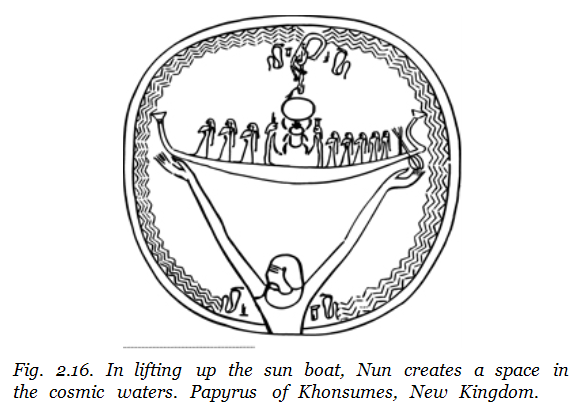
And this positioning of the cosmic ocean at the outer circumference of the world would seem to correspond best to the way in which the ancient Egyptians conceived it.
What, then, is this ocean? How are we to understand it? Of one thing we can be certain: the ancient Egyptians did not literally believe there was an ocean of water somewhat like the Mediterranean Sea defining the outermost boundaries of their cosmos.
For the waters of Nun have an altogether more subtle mode of existence than the waters that we meet with in the physical world.
In both figures, Osiris and the invisible realm that he encircles are shown to be submerged in these waters, which suggests that the waters have a more mysterious mode of being than even they have.
Nun’s nature is indeed so ineffable that it is usually described in negative terms—Nun is dark, formless, inert. Nun is the unrealized potentiality for existence, symbolized by the formless fluidity of a vast expanse of water.
Water best symbolizes the qualities of Nun because although it is the source of life, it is in itself without shape or definition; hence, it exists prior to all forms, whether manifest or unmanifest.
Nun exists prior to the gods, prior to Osiris, prior to the Dwat, and prior to the familiar world externalized in space and time. As one Pyramid Text puts it, Nun exists “before the sky existed, before the earth existed, before that which is made firm existed.”
Because of Nun’s essential unknowability, Nun is located at the boundaries of the known world... not a god, but rather “the substance & father of the gods.” Hence not even the gods can be said truly to know Nun, for Nun is the ineluctable foundation & source of existence itself.
In figure 2.17, the relationship between Nun and the whole cosmos is portrayed. The illustration is from the cenotaph of Seti I, and is the product of the mature theology of the New Kingdom (ca. thirteenth century B.C.).
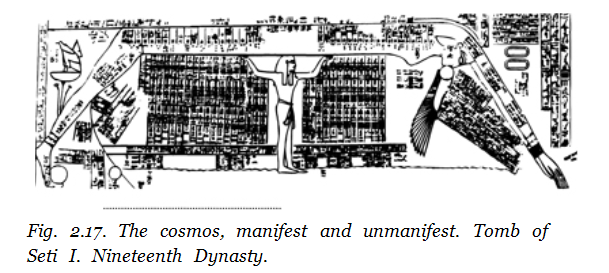
It shows Nut in her usual position, with Shu beneath her, standing on the earth (here referred to simply as “sands”). The sun disk is swallowed by Nut on the right and enters her body. In passing through her body, it traverses the regions of the Dwat and is finally reborn.
The newborn sun disk is shown on the left by Nut’s foot. Here, then, are all the main features of the ancient Egyptian cosmological picture: heaven, earth, intermediate region, sun, and the Dwat.
But something more is included in this picture that is normally absent from similar representations, which gives it a completeness the others lack. In the top right-hand corner, outside of and above Nut’s body, a text describes Nun.
The text is evidently placed here quite deliberately. It is outside the compass of Nut’s embrace, just as it is an area quite distinct from the Dwat within her body. This is what the text says:
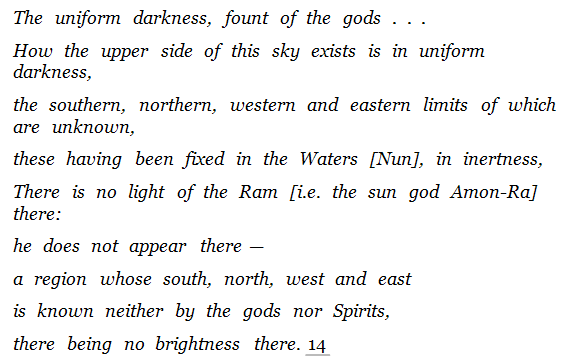
If the Dwat is the first degree of nonmanifest reality, Nun is yet more remote from the familiar world of sense-perceptible forms. For whereas the Dwat harbours spirit forms, all form dissolves in the dark waters of Nun.
Insofar as Nun is the utterly formless void or “abyss” (as it is often translated), it is beyond all categories of knowledge. Hence it can only be described in the negative terms to which mysticism universally reverts when contemplating the source of existence.
Loading suggestions...