

Over the next few years we’ll see a meaningful decline in brands selling on Amazon.
There’s three forces at play:
#1 - Consumer behavior is shifting
#2 - Off-Amazon brands perform better
#3 - The migration has already begun
Let’s take them one by one.
There’s three forces at play:
#1 - Consumer behavior is shifting
#2 - Off-Amazon brands perform better
#3 - The migration has already begun
Let’s take them one by one.
#1 Consumer Behavior is Shifting
Think about the last few items you purchased from Amazon. I’d bet most were either:
1). Something from a well-known national brand you trust
2). A low-cost sub-$100 commodity (batteries, cords, garage door opener, etc)
Think about the last few items you purchased from Amazon. I’d bet most were either:
1). Something from a well-known national brand you trust
2). A low-cost sub-$100 commodity (batteries, cords, garage door opener, etc)
Anything in the middle is increasingly being purchased off Amazon.
I recently bought a $165 filtered shower head direct from @jolieskinco.
It’s an amount I wouldn’t have spent on an untested brand on Amazon: I'd never heard of them and don't trust Amazon's reviews.
I recently bought a $165 filtered shower head direct from @jolieskinco.
It’s an amount I wouldn’t have spent on an untested brand on Amazon: I'd never heard of them and don't trust Amazon's reviews.
But @jolieskinco’s .com and brand experience is stunning (well done, @mrsharma!).
Their high-end brand experience helped convert me (and signal quality) and is something they can't replicate as well on Amazon.
I wouldn't have purchased it at their premium price point on AMZ.
Their high-end brand experience helped convert me (and signal quality) and is something they can't replicate as well on Amazon.
I wouldn't have purchased it at their premium price point on AMZ.

Takeaway: Strong branding chops are becoming tables stakes for eComm in 2022 and Amazon is a poor place to showcase premium, unique and niche brands.
Force #2 - Off-Amazon brands perform better.
Force #2 - Off-Amazon brands perform better.
I studied 600 brand via the @ecommercefuel Trends Report to determine if Amazon gives entrepreneurs an edge.
It doesn't. It actually hurts them.
Non-AMZ sellers grew rev. and profits 32% and 50% faster, respectively. And they made more money with fatter net margins.
It doesn't. It actually hurts them.
Non-AMZ sellers grew rev. and profits 32% and 50% faster, respectively. And they made more money with fatter net margins.
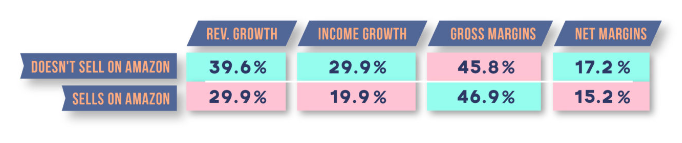
Takeaway? After years to the contrary it's off-Amazon brands that are thriving.
It's hard to develop your own traffic spigot but if you do you'll build (on average) a stronger, faster growing and more profitable company.
It's hard to develop your own traffic spigot but if you do you'll build (on average) a stronger, faster growing and more profitable company.
Force #3 - The Migration Has Begun
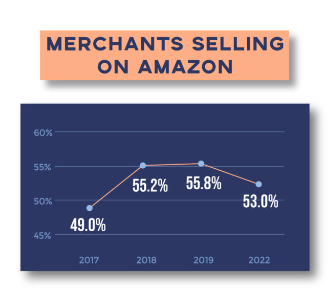
For the first time ever, the percent of stores selling on Amazon decreased. It dropped to 53% from 56% the last time I did this study a few years ago.
Why the change in adoption?
For the first time ever, the percent of stores selling on Amazon decreased. It dropped to 53% from 56% the last time I did this study a few years ago.
Why the change in adoption?
Prices went up for FBA sellers (again) this September.
The litany of long-time headaches including copycats, suspension risks, zero customer ownership remain and some are more acute than ever before.
The litany of long-time headaches including copycats, suspension risks, zero customer ownership remain and some are more acute than ever before.
A captive buyer base is wonderful, especially as traffic has gotten harder to come by over the last year.
But the costs to access those buyers continually increases and gets harder to justify ever year. We're at a point were a lot of brands are deciding to opt-out.
But the costs to access those buyers continually increases and gets harder to justify ever year. We're at a point were a lot of brands are deciding to opt-out.
Takeaway: Amazon is evolving to be known primarily for lower-cost commodity items and high-end national brands.
Fewer indy brands will be drawn to the platform and discovery for that category will happen off-Amazon.
Will be interesting to watch how it all shakes out.
Fewer indy brands will be drawn to the platform and discovery for that category will happen off-Amazon.
Will be interesting to watch how it all shakes out.
Agree? Please give the first comment in this thread a RT!
Think I'm off-base? Drop me a comment and let me know why, would love to hear your reasoning.
If you’re a 7- or 8-figure brand owner who wants to learn how to build a durable off-Amazon business join us inside ECF.
Think I'm off-base? Drop me a comment and let me know why, would love to hear your reasoning.
If you’re a 7- or 8-figure brand owner who wants to learn how to build a durable off-Amazon business join us inside ECF.
We’re a thriving group of 1,200+ vetted store owners who share their hard-won experience with each other.
Learn more and apply at eCommerceFuel.com.
Learn more and apply at eCommerceFuel.com.
(Source: Stats cited come from the 2022 @ecommercefuel Trends Report which you can read via the link below.)
ecommercefuel.com)
ecommercefuel.com)
Loading suggestions...