

If you want to be a successful entrepreneur, you MUST understand accounting.
Here are the things I wish someone had taught me when I was starting my own business.
Here are the things I wish someone had taught me when I was starting my own business.
Any business, big or small, has three financial statements.
They each have a key message. But together, they tell a powerful story.
• The balance sheet (are you healthy?)
• The income statement (are you making money?)
• The cash flow statement (are you going bankrupt?)
They each have a key message. But together, they tell a powerful story.
• The balance sheet (are you healthy?)
• The income statement (are you making money?)
• The cash flow statement (are you going bankrupt?)
Balance sheet (1/3)
It shows the financial position of your business AT a point in time.
• Assets: Everything your company owns (cash, inventories)
• Liabilities: Everything your company owes (loans, bills)
• Equity: The difference between the two components above.
It shows the financial position of your business AT a point in time.
• Assets: Everything your company owns (cash, inventories)
• Liabilities: Everything your company owes (loans, bills)
• Equity: The difference between the two components above.
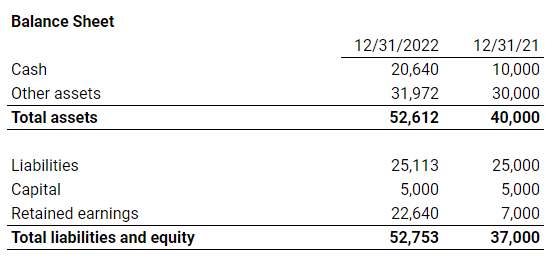
Balance sheet (2/3)
This equation will ALWAYS be true:
Assets = Liabilities + Equity
Think about a lemonade stand.
You bought $50 worth of cups and lemons.
You borrowed $15 from your mom to buy them.
Your equity in this business is $35 ($50 - $15).
Equation holds true.
This equation will ALWAYS be true:
Assets = Liabilities + Equity
Think about a lemonade stand.
You bought $50 worth of cups and lemons.
You borrowed $15 from your mom to buy them.
Your equity in this business is $35 ($50 - $15).
Equation holds true.
Balance sheet (3/3)
The balance sheet helps you assess how much risk you have in your business.
• Have you borrowed too much?
• Do you have too much inventory?
• Do you have enough cash to pay your debts?
Compare account balances with prior periods and you'll get answers.
The balance sheet helps you assess how much risk you have in your business.
• Have you borrowed too much?
• Do you have too much inventory?
• Do you have enough cash to pay your debts?
Compare account balances with prior periods and you'll get answers.
Income statement (1/3)
Different from the balance sheet, the income statement shows the performance of your business OVER a period of time.
It tells you how much you've earned vs. how much you've spent.
That's why it's also called a profit and loss statement (P&L).
Different from the balance sheet, the income statement shows the performance of your business OVER a period of time.
It tells you how much you've earned vs. how much you've spent.
That's why it's also called a profit and loss statement (P&L).
Income statement (2/3)
Its main components are:
• Sales or revenue
• Cost of goods sold (COGS)
• Operating expenses (OPEX)
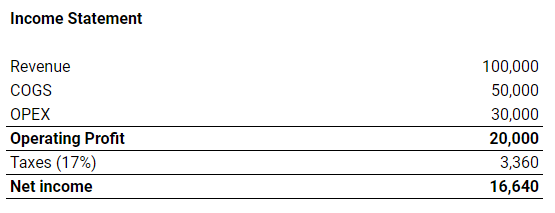
Use the formulas below to know how much money you're keeping.
Revenue - COGS - OPEX = Operating Profit
Operating Profit - Taxes = Net Income (Loss)
Its main components are:
• Sales or revenue
• Cost of goods sold (COGS)
• Operating expenses (OPEX)
Use the formulas below to know how much money you're keeping.
Revenue - COGS - OPEX = Operating Profit
Operating Profit - Taxes = Net Income (Loss)
Income statement (3/3)
The P&L helps you assess how well your business is running.
• Are sales declining?
• Are manufacturing costs increasing?
• Is my advertising spend generating new business?
Analyze trends to help you decide whether to cut costs or invest more.
The P&L helps you assess how well your business is running.
• Are sales declining?
• Are manufacturing costs increasing?
• Is my advertising spend generating new business?
Analyze trends to help you decide whether to cut costs or invest more.
Cash flow statement (1/3)
This document records inflows and outflows of cash in 3 types of activities:
• Operating: Payments from customers or to suppliers
• Investing: Purchase or sale of property, plant and equipment (PP&E)
• Financing: Borrowings from banks or dividends
This document records inflows and outflows of cash in 3 types of activities:
• Operating: Payments from customers or to suppliers
• Investing: Purchase or sale of property, plant and equipment (PP&E)
• Financing: Borrowings from banks or dividends
Cash flow statement (2/3)
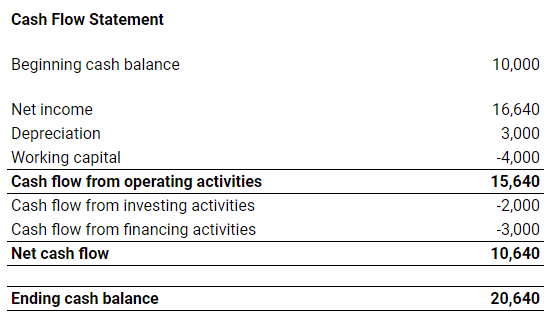
Combining all cash movements gives you the net increase (decrease) relative to a prior period.
Operating - Investing - Financing = Net Change in Cash
Add this to the beginning cash balance of the period and you'll get the number on the balance sheet.
Combining all cash movements gives you the net increase (decrease) relative to a prior period.
Operating - Investing - Financing = Net Change in Cash
Add this to the beginning cash balance of the period and you'll get the number on the balance sheet.
Cash flow statement (3/3)
This statement helps you assess if you're managing cash effectively.
• Do I have enough cash to make payroll?
• Am I buying unnecessary equipment?
• Am I paying off my debts on time?
Pay attention to the ins and outs of cash to avoid insolvency.
This statement helps you assess if you're managing cash effectively.
• Do I have enough cash to make payroll?
• Am I buying unnecessary equipment?
• Am I paying off my debts on time?
Pay attention to the ins and outs of cash to avoid insolvency.
The 3 statements are linked (1/2)
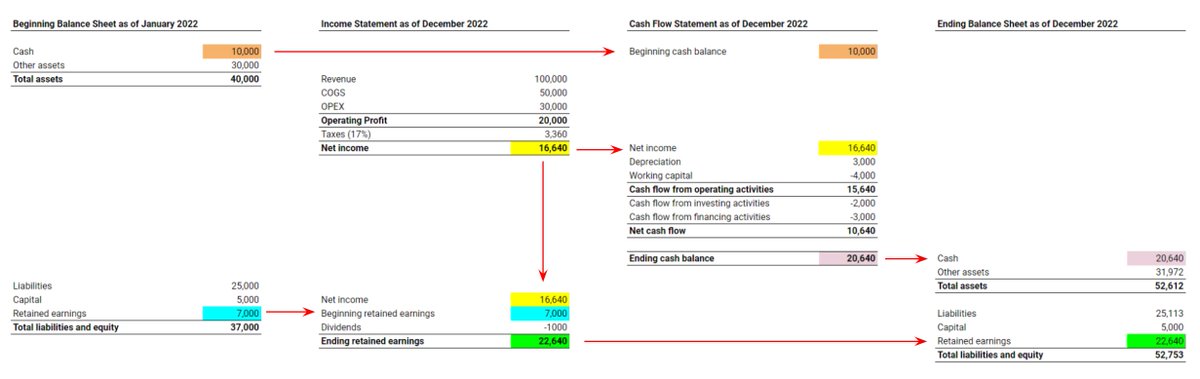
All statements must be used together to determine the overall health of your business and make better decisions.
• Net income links to the balance sheet into retained earnings and is the starting point for cash from operating activities
All statements must be used together to determine the overall health of your business and make better decisions.
• Net income links to the balance sheet into retained earnings and is the starting point for cash from operating activities
The 3 statements are linked (2/2)
• Ending cash balance in the statement of cash flows becomes the reported number in the balance sheet at the end of the period
• Beginning cash in the balance sheet becomes the starting point for the cash flow statement
• Ending cash balance in the statement of cash flows becomes the reported number in the balance sheet at the end of the period
• Beginning cash in the balance sheet becomes the starting point for the cash flow statement
Accounting is not a dark art.
In fact, it's pretty simple math.
You just have to learn the rules.
In fact, it's pretty simple math.
You just have to learn the rules.
TL;DR
• 3 financial statements in business
• The 3 statements are interconnected
• Balance sheet = is your business healthy?
• Income statement = is your business profitable?
• Cash flow statement = is your cash being put to good use?
• 3 financial statements in business
• The 3 statements are interconnected
• Balance sheet = is your business healthy?
• Income statement = is your business profitable?
• Cash flow statement = is your cash being put to good use?
If you found this thread useful:
1. Follow @theantonioreza for more content like this.
2. Retweet the first tweet of the thread with your network.
I write about money and tech to help your business grow.
1. Follow @theantonioreza for more content like this.
2. Retweet the first tweet of the thread with your network.
I write about money and tech to help your business grow.
Loading suggestions...