

A passage from a 10th-c. poem that gives a glimpse into (male) children's education in medieval Baghdad.
It’s a bit long so this is a thread 🧵.
If you persevere there’s eventually urination and violence.
🚽🗯️🧨
It’s a bit long so this is a thread 🧵.
If you persevere there’s eventually urination and violence.
🚽🗯️🧨
The passage is from a longer poem in which al-Aḥnaf al-ʿUkbarī describes his poverty and destitute living conditions. A school teacher (muʿallim) conducts classes in the building he lives in.
The teacher is loud and the students are miserable.
The teacher is loud and the students are miserable.
His boys gather from all around,
each one wretched and luckless,
he lines them up outside my room
and fearfully thunders and lightings at them.
each one wretched and luckless,
he lines them up outside my room
and fearfully thunders and lightings at them.

Their curriculum includes arithmetic, and he seems to divide them into groups, quizzing some while the rest count on their fingers (I assume the verb ʿaqada here means “to count on one’s fingers”, cf. Lane sv)
He makes them do math in the afternoon,
testing some and telling others practice on their own.
testing some and telling others practice on their own.

They memorizing the famous “Hanging Poems,” namely Imruʾ al-Qays’s Muʿallaqah.
When it’s time for them to leave I see them
cracking wide jaws to recite,
“Stop, let’s weep a beloved’s and encampment’s memory”;
the sound of it infuriates and repels me.
cracking wide jaws to recite,
“Stop, let’s weep a beloved’s and encampment’s memory”;
the sound of it infuriates and repels me.

That’s the first line of the Muʿallaqah; about 13 lines later in it the speaker has sex with a pregnant woman while she’s simultaneously nursing her infant. Feel free to bring that up next time you’re arguing about school districts censoring books.
The kids steal his food.
And if the boys need bread for their lunch
my bread’s there for them to pilfer.
my bread’s there for them to pilfer.

And I guess use his toilet?
His boys urinate around my home (ʿindī)
and if I try to stop them, they fly into a rage.
and if I try to stop them, they fly into a rage.

The teacher responds by inciting his children to violence if the speaker tries to stop them:
He’s furious if I try to close the door,
and points, with an evil whose heat seethes,
telling them, “go try to get in!
Don’t be afraid of him, break the door down!”
They get boards and smack me in the head …
*reading (lā tafzaʿūhu)
and points, with an evil whose heat seethes,
telling them, “go try to get in!
Don’t be afraid of him, break the door down!”
They get boards and smack me in the head …
*reading (lā tafzaʿūhu)
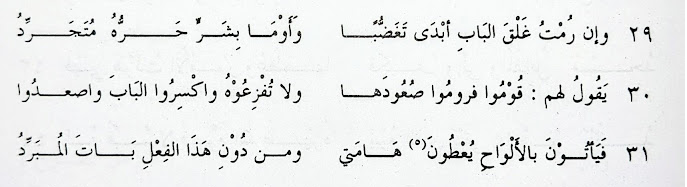
I'm not sure what mubarrid means in the last hemistich (suggestions welcome on anything, several words aren't in dictionaries). Maybe there is a typo and it's a reference to the grammarian Mubarrad, but I don't know of him getting hit with boards.
I have tweeted from this poem before, but I wanted to go back and translate this part because an Emirati friend was recently describing the agony of trying the memorize a muʿallaqa.
Here's the old thread on the rediscovery of al-Aḥnaf's poetry.
Here's the old thread on the rediscovery of al-Aḥnaf's poetry.
—al-Aḥnaf al-ʿUkbarī (Baghdad, 10th c.), Dīwān, ed. Sulṭān ibn Saʿd al-Sulṭān p. 197
Loading suggestions...