

Jonathan makes a series of points here in favour of mass migration dismissing my concerns. I want to deal with each head on as they are claims, that while false, are often used by those who argue for mass migration.
So lets start with this one, the most common of the arguments:
So lets start with this one, the most common of the arguments:
In January 2020 the BBC published an immigration briefing (link below) based on research that was published by the governments Migration Advisory Committee (MAC) and carried out for them by Oxford Economics.
This report concluded that in 2016/2017 migrants overall paid in £4.3 billion less than they took out. So okay maybe the claim that "every study" will tell you migrants pay more than they put in was a bit of hyperbole? Perhaps this was a one off? But it isn't.
Research into the fiscal impact of immigration over the past two decades has consistently found an overall negative contribution by the migrant population.
But don't just take my word for it. Research published in the Economic Journal in 2014 showed the overall contribution of immigrants to have been minus £114 billion between 1995 and 2011 (also linked below).
Okay so there have been numerous studies demonstrating that migration has had a net negative effect, but how can you be sure I'm not just cherry picking studies to support your argument?
Well to answer that I will use not my words but the words of the House of Lords Select Committee on Economic Affairs which concluded "the fiscal impact [of immigration] cannot be used to justify large-scale immigration". In other words the claim above is based on a false premise.
Ah but Ben, isn't it true that migrants are far less likely to claim benefits than British people? Again no, not really.
While the mass immigration lobby often claim this they do so on the basis of either an abnormally wide definition as to include all retired Brits receiving the state pension, or they go the other way using a narrow definition as to only count unemployment or out-of-work benefits.
When we look at the figures produced by the Department of Work and Pensions we see the reality that while working-age migrants claim less *out-of-work* benefits when*in-work* benefits eg tax credits are included they claim broadly same level of benefits as UK working age average.
In conclusion the first response in @Jonathan1Gibson's reply was false.
So lets address the 2nd response. First thing to point out is like the initial reply this is also a very common point asserted by the mass migration lobby - albeit another false one.
So lets address the 2nd response. First thing to point out is like the initial reply this is also a very common point asserted by the mass migration lobby - albeit another false one.
Lets go back a few years to January 2012 where The Migration Advisory Committee (MAC) reported that 100 additional non-EU migrants might be associated with a reduction in employment of 23 native workers over the period 1995-2010. The government noted this occurred...
"both during periods of economic growth and downturn".
In 2018 MAC published a report showing "some evidence that migration reduces employment & raises unemployment of some groups" importantly it was the most vulnerable groups in society that were the most disaffected.
In 2018 MAC published a report showing "some evidence that migration reduces employment & raises unemployment of some groups" importantly it was the most vulnerable groups in society that were the most disaffected.
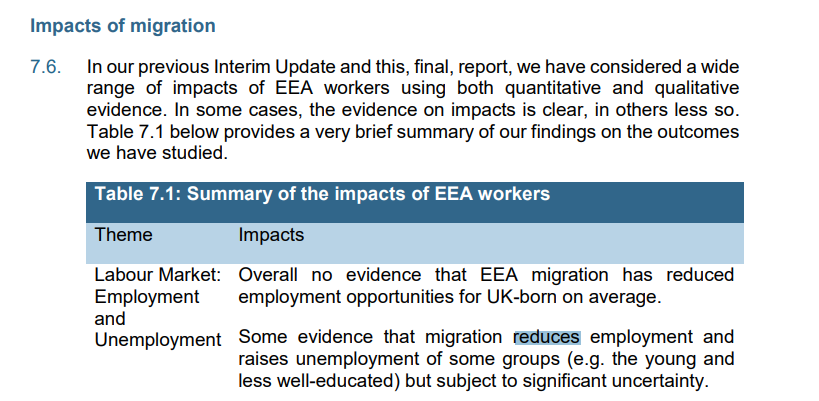
Now the evidence on this is not strong with MAC admitting their methodology remains subject to significant uncertainty, however available evidence seems to suggest mass migration has negatively impacted employment especially on vulnerable groups.
Of course employment for employments sake is not good either so lets look at wages.
Here we can turn to a report by the Bank of England published in December 2015 (link below) that found the immigrant to native ratio has a small negative impact on average British wages.
Here we can turn to a report by the Bank of England published in December 2015 (link below) that found the immigrant to native ratio has a small negative impact on average British wages.
Like the MAC paper above they go on to add "Our results also reveal that the biggest impact of immigration on wages is within the semi/unskilled services occupational group."
This was a hugely important paper as while the findings accord well with "intuition and anecdotal evidence" these findings had "not been recorded previously in the empirical literature".
In short therefore the second response by @Jonathan1Gibson that was also incorrect.
In short therefore the second response by @Jonathan1Gibson that was also incorrect.
The third response and final direct response made in favor of mass immigration was a rebuttal to my tongue -in-cheek comment telling him to look at the ruins of the economy around us.
Now he is of course correct that the short term impacts facing the UK economy are down primarily to Covid disruption and the War in Ukraine. However, these impact of that has been exacerbated by an economy addicted to mass-migration and near zero interest rates.
The evidence for some of the negative economic effects of migration I have already covered extensively in this thread and tbh I don't want to get side tracked into a discussion on interest rates here.
A final point before I wrap this up on a response @Jonathan1Gibson made to another account that I was tagged in.
Although not part of his central rebuttal to my QT its a common argument made by those in favour of mass migration and so is worth addressing.
Although not part of his central rebuttal to my QT its a common argument made by those in favour of mass migration and so is worth addressing.
Another similar claim that follows the same premise as that one is "Britain is only the 39th most crowded country in the world".
Both these points however are grossly misleading on two fronts; first they assume equal distribution of migrants across the UK, and second they don't take into account the rate of change and thus the rate at which new services must be provided.
Let’s start with the first reason, distribution. Migration to the UK is not uniform, that's to say migrants don't evenly disperse across the whole UK. In fact, 90% of immigrants to the UK come to England, despite England only constituting 53% of total UK landmass.
To use UK wide population density and/or land use is therefore misleading. England's population density stands at 430 people per square kilometer. So how does that compare? Well, it’s nearly twice as crowded as Germany and, three and a half times as crowded as France.
In fact, looking at it from a global angle, the only large countries that are more crowded than England are Bangladesh, Taiwan, Rwanda and South Korea. Yet again the pro-mass-migration argument suddenly doesn't look so convincing.
The second objection to this claim is around rate of change. The graph below shows since the explosion of in net migration in the early 90's (before which UK net migration was stable around replacement level) it has now come to stabilise at between 200 and 300 thousand every year
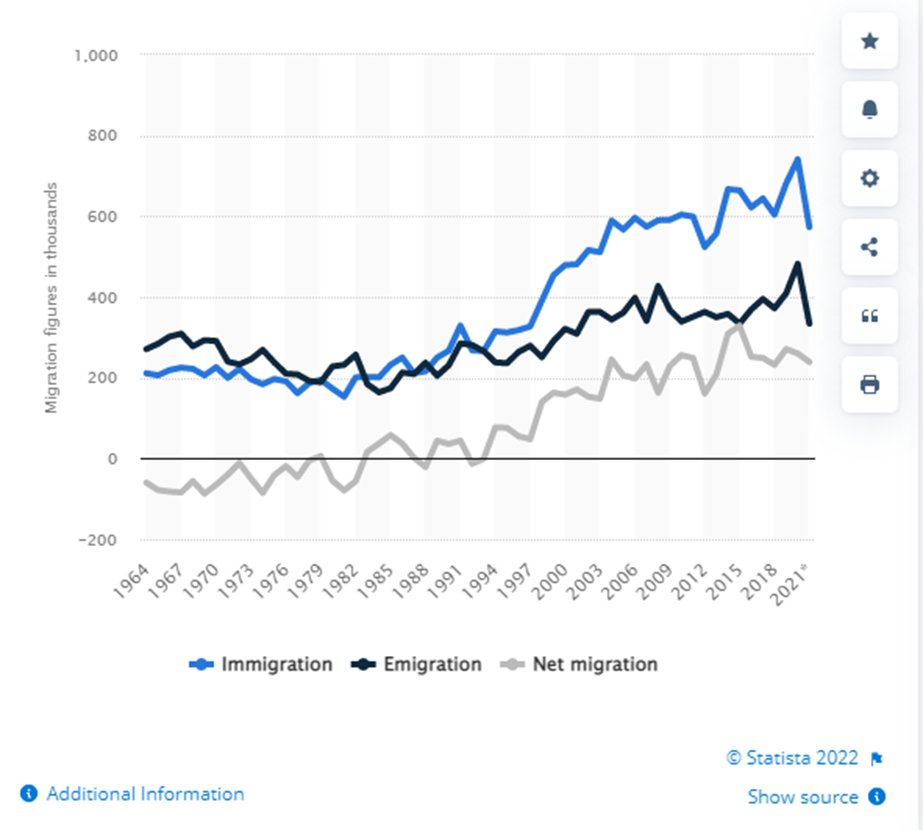
Despite an estimated 239,000 people (net) moving to the UK in 2021 the number of deswellings completed in the financial year ending June 2021 was 42,660.
Before I go further, I want to pre-empt the response and iron out definitions of the following statistics "dwellings completed" and "net additional dwellings". I have used the former for the above statistic and I want to quickly explain why.
To do so I'm going to use the example of HMO's which are rising sharply. If you build a new house that would increase the number of "dwellings completed" and the "net additional dwellings" by one.
If you take that existing property and file a HMO application with the council (say a HMO with 6 person capacity) the "dwellings completed" statistic would not increase. However, despite not a single brick being laid the number of "net additional dwellings" would increase by 5.
The "net dwellings completed" statistic which is used by people who want to inflate the rate at which the UK can adapt to unprecedented leaps in its population for this reason, however is totally unsustainable pasting over ever growing cracks in brick and mortar supply.
Homes is just one example of society being unable (arguably unwilling) to keep up with rate of change in terms of bricks and mortar. If you're interested in the contradiction of those who talk of supply but never demand see my interaction with K.Niemietz👇
Okay so this turned out *A LOT* longer than I expected (sorry about that) but I believe is a pretty robust defence to just some of the most common *economic* arguments employed by those advocating for continued mass-immigration.

Loading suggestions...