

THE US STOCK MARKET BASICS🇺🇸📈
Everything you need to know about the US Stock market as a beginner investor
//THREAD
Everything you need to know about the US Stock market as a beginner investor
//THREAD
Many new investors are overwhelmed by the size of the US markets.
The numbers below tell us why.
•The JSE has 448 listed instruments.
•The US has 15 493 listed instruments.
The numbers below tell us why.
•The JSE has 448 listed instruments.
•The US has 15 493 listed instruments.
Why should you invest in the US stock market?
No other financial market is as large, accessible, transparent, and liquid as the U.S. market.
Its transaction volume, market capitalization, and number of listed companies make this market a unique investment opportunity.
No other financial market is as large, accessible, transparent, and liquid as the U.S. market.
Its transaction volume, market capitalization, and number of listed companies make this market a unique investment opportunity.
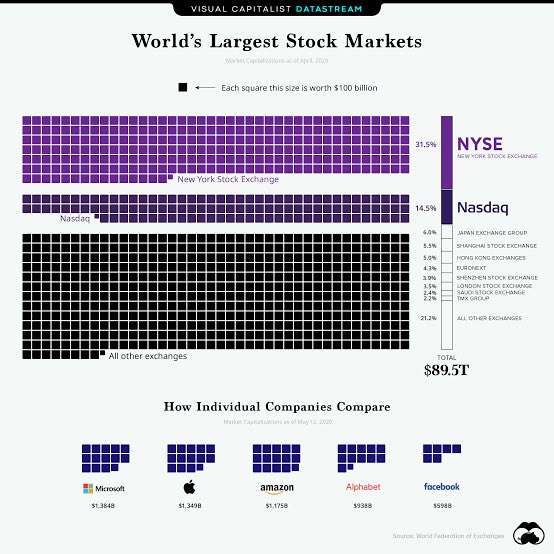
Looking at the NYSE alone, the value of the share trading for 2018 was 7.6 times that of London and 8.3 times that of Hong Kong
The U.S. markets are also the biggest in terms of turnover too. This means you have a good chance of finding a buyer or seller of any stock at any time
The U.S. markets are also the biggest in terms of turnover too. This means you have a good chance of finding a buyer or seller of any stock at any time
LIQUIDITY
The U.S. stock markets represent the biggest single concentration of wealth in history.
Together, the New York Stock Exchange and NASDAQ comprise the deepest financial market in the world.
The higher the liquidity, the easier it is to buy and sell.
The U.S. stock markets represent the biggest single concentration of wealth in history.
Together, the New York Stock Exchange and NASDAQ comprise the deepest financial market in the world.
The higher the liquidity, the easier it is to buy and sell.
The US market is extremely liquid.
DIVERSIFICATION
U.S. markets offer access to a large variety of American companies seeking capital.
With close to 5,000 companies to choose from, you can invest in major corporations and global brands that list their shares here.
DIVERSIFICATION
U.S. markets offer access to a large variety of American companies seeking capital.
With close to 5,000 companies to choose from, you can invest in major corporations and global brands that list their shares here.
SECURITIES & EXCHANGE COMMISSION (SEC)
One huge difference between the JSE & the NYSE/NASDAQ is the Securities and Exchange Commission (SEC)
Who is the SEC? The SEC is a U.S. government oversight agency responsible for regulating the securities markets and protecting investors
One huge difference between the JSE & the NYSE/NASDAQ is the Securities and Exchange Commission (SEC)
Who is the SEC? The SEC is a U.S. government oversight agency responsible for regulating the securities markets and protecting investors
The SEC can itself bring civil actions against lawbreakers and works with the Justice Department on criminal cases.
Another thing that frustrates & scares investors are the SEC Forms. They don't need to be scary. They are there to protect investors.
Another thing that frustrates & scares investors are the SEC Forms. They don't need to be scary. They are there to protect investors.
important forms you need to read when you do research:
1.Form 4
2.Form 8-K
3.Form 10-K
4.Form 10-Q
5.Form S-1
1.Form 4
2.Form 8-K
3.Form 10-K
4.Form 10-Q
5.Form S-1
1/
Form 4
•Remember when Elon pulled his Twitter poll stunt and sold billions worth of Tesla shares? That's where the Form 4 comes in.
•Form 4 must be filed with the SEC whenever there is a material change in the holdings of company insiders.
Form 4
•Remember when Elon pulled his Twitter poll stunt and sold billions worth of Tesla shares? That's where the Form 4 comes in.
•Form 4 must be filed with the SEC whenever there is a material change in the holdings of company insiders.
•If a party fails to disclose required information on a Form 4, civil or criminal actions could result.
•It must be filed within two business days starting from the end of the day the material transaction occurred.
•It must be filed within two business days starting from the end of the day the material transaction occurred.
2/
Form 8-K
•The SEC requires companies to file an 8-K to announce significant events relevant to shareholders.
•Companies have four business days to file an 8-K for most specified items.
Form 8-K
•The SEC requires companies to file an 8-K to announce significant events relevant to shareholders.
•Companies have four business days to file an 8-K for most specified items.
•Public companies use Form 8-K as needed, unlike some other forms that must be filed annually or quarterly.
•Form 8-K is a valuable source of complete and unfiltered information for investors and researchers.
•Form 8-K is a valuable source of complete and unfiltered information for investors and researchers.
3/
Form 10-K
•A 10-K is a comprehensive report filed annually by public companies about their financial performance.
•The report is required by the U.S. Securities and Exchange Commission (SEC) and is far more detailed than the annual report.
Form 10-K
•A 10-K is a comprehensive report filed annually by public companies about their financial performance.
•The report is required by the U.S. Securities and Exchange Commission (SEC) and is far more detailed than the annual report.
•Information in the 10-K includes corporate history, financial statements, earnings per share, and any other relevant data.
•The 10-K is a useful tool for investors to make important decisions about their investments.
•The 10-K is a useful tool for investors to make important decisions about their investments.
This form has 5 Sections:
•Business
This provides an overview of the companys main operations, including its products and services (i.e., how it makes money)
•Risk factors
These outline any and all risks the company faces or may face in the future.
•Business
This provides an overview of the companys main operations, including its products and services (i.e., how it makes money)
•Risk factors
These outline any and all risks the company faces or may face in the future.
•Selected financial data.
This section details specific financial information about the company over the last five years.
This section presents more of a near-term view of the companys recent performance.
This section details specific financial information about the company over the last five years.
This section presents more of a near-term view of the companys recent performance.
•Managements discussion and analysis of financial condition and results of operations.
Also known as MD&A, this gives the company an opportunity to explain its business results from the previous fiscal year. This section is where the company can tell its story in its own words
Also known as MD&A, this gives the company an opportunity to explain its business results from the previous fiscal year. This section is where the company can tell its story in its own words
Financial statements and supplementary data.
This includes the companys audited financial statements including the income statement, balance sheets, and statement of cash flows
A letter from the companys independent auditor certifying the scope of their review is also included
This includes the companys audited financial statements including the income statement, balance sheets, and statement of cash flows
A letter from the companys independent auditor certifying the scope of their review is also included
4/
Form 10-Q
•SEC Form 10-Q is a comprehensive report of financial performance submitted quarterly by all public companies to the Securities and Exchange Commission.
Form 10-Q
•SEC Form 10-Q is a comprehensive report of financial performance submitted quarterly by all public companies to the Securities and Exchange Commission.
•Form 10-Q contains financial statements, management discussion and analysis, disclosures, and internal controls for the previous quarter.
•Companies must file their 10-Qs 40 or 45 days after the end of their quarters, depending on the size of their public float.
•Companies must file their 10-Qs 40 or 45 days after the end of their quarters, depending on the size of their public float.
•A snapshot of the company's financial position, Form 10-Q provides investors with information they can compare to previous periods and use to evaluate the outlook for the stock's performance.
•Form 10-Q is not an audited statement, unlike the annual Form 10-K companies are also required to file.
5/
Form S-1
•SEC Form S-1 is an SEC registration required for U.S. companies that want to be listed on a national exchange.
•It is basically a registration statement for a company that is usually filed in connection with an initial public offering.
Form S-1
•SEC Form S-1 is an SEC registration required for U.S. companies that want to be listed on a national exchange.
•It is basically a registration statement for a company that is usually filed in connection with an initial public offering.
•Any amendments or changes that have to be made by the issuer are filed under SEC Form S-1/A.
•The issuer is responsible for any material misrepresentations or omissions.
•The issuer is responsible for any material misrepresentations or omissions.
Why Go Directly Offshore?
•Ultimately, offshore investments are made because investors can enhance their portfolio diversification and get access to much broader and deeper markets with the second-degree benefit of diversifying away from country and currency concerns.
•Ultimately, offshore investments are made because investors can enhance their portfolio diversification and get access to much broader and deeper markets with the second-degree benefit of diversifying away from country and currency concerns.
•In addition, they provide protection against poor local economic policy which may push the country over the fiscal cliff and cause a spike in inflation and interest rates, and result in, inter alia, the ZAR weakening further.
•This is not to say that you should not have a local component to your portfolio but rather that you should almost always have a foreign component.
This article was written by the one and only @SoulFairy3 ,be sure to check her out and give her a follow!
If you enjoyed the thread, follow us @FinMeUp and like and RT the first tweet of the thread👇
If you enjoyed the thread, follow us @FinMeUp and like and RT the first tweet of the thread👇
Loading suggestions...