

More fun pulmonary physiology:
🤿A person takes a deep breath of ambient air & free dives (e.g. holds her breath without a SCUBA tank) in the ocean. At a depth of 40m an arterial blood gas is drawn.
Compared to an ABG drawn at the surface, the divers PaO2 at 40m is:
🤿A person takes a deep breath of ambient air & free dives (e.g. holds her breath without a SCUBA tank) in the ocean. At a depth of 40m an arterial blood gas is drawn.
Compared to an ABG drawn at the surface, the divers PaO2 at 40m is:
The answer is INCREASED.
We know because people have free-dived with an arterial line: mean PaO2 at 40m was 197 mmHg (after 45s of breath holding!)
ncbi.nlm.nih.gov
But why? Understanding requires a deep dive into the alveolar gas equation. A 🫁 pulm #physiology🧵.
2/
We know because people have free-dived with an arterial line: mean PaO2 at 40m was 197 mmHg (after 45s of breath holding!)
ncbi.nlm.nih.gov
But why? Understanding requires a deep dive into the alveolar gas equation. A 🫁 pulm #physiology🧵.
2/


Before getting to the fun stuff, we should acknowledge that it’s *weird* for your PaO2 to increase while breath holding.
For comparison look how PaO2 DECREASES if you hold your breath on land: it plummets from 110 to 60 mmHg in just 35 seconds!
What makes diving different?
3/
For comparison look how PaO2 DECREASES if you hold your breath on land: it plummets from 110 to 60 mmHg in just 35 seconds!
What makes diving different?
3/

To understand this case, we need to review the alveolar gas equation:
PAO2 = (FiO2 x (Patm - PH2O)) - PaCO2 / RQ
Basically, the partial pressure of O2 in the alveolus depends on the FiO2, the atmospheric pressure (Patm), & the content of CO2 in arterial blood (PaCO2).
4/
PAO2 = (FiO2 x (Patm - PH2O)) - PaCO2 / RQ
Basically, the partial pressure of O2 in the alveolus depends on the FiO2, the atmospheric pressure (Patm), & the content of CO2 in arterial blood (PaCO2).
4/

Sidebar: This is actually a *simplification*. Fortunately the assumptions that allow us to simplify apply in every case we'd actually encounter in the ICU, so we never need to worry about the complex version... phew!😅
🤓 If you're curious though:
journals.physiology.org
5/
🤓 If you're curious though:
journals.physiology.org
5/


If we plug some values into the simplified alveolar gas equation, we can see what the normal partial pressure of O2 is in our alveoli.
(I'm assuming you're are at sea level with an atmospheric pressure of 1 atm = 1000 mbar = 760 mmHg)
We get a PAO2 of ~100 mmHg
6/
(I'm assuming you're are at sea level with an atmospheric pressure of 1 atm = 1000 mbar = 760 mmHg)
We get a PAO2 of ~100 mmHg
6/

Be careful not to confuse:
- alveolar O2 pressure (PAO2) with
- arterial O2 pressure (PaO2)
PAO2 (I pronounce it "P big-A O2" to avoid confusion) is O2 is in the alveoli. We estimate it using the alveolar gas equation
PaO2 is O2 is in arterial blood. We measure on an ABG.
7/
- alveolar O2 pressure (PAO2) with
- arterial O2 pressure (PaO2)
PAO2 (I pronounce it "P big-A O2" to avoid confusion) is O2 is in the alveoli. We estimate it using the alveolar gas equation
PaO2 is O2 is in arterial blood. We measure on an ABG.
7/
It's crucial to differentiate alveolar (PAO2) from arterial (PaO2) oxygen pressure because we like to compare those values to see how efficiently O2 is getting from alveolus into the blood!
Aa difference (some all it "Aa gradient") is just PAO2 - PaO2
(more later I promise)
8/
Aa difference (some all it "Aa gradient") is just PAO2 - PaO2
(more later I promise)
8/

🤿 Now that we've mastered the alveolar gas equation, let's go back our diver, who held her breath & descended to 40m.
As we descend under water the barometric pressure increases by 1 atmosphere every 10m. What effect does this pressure have on the air in her lungs 🫁?
9/
As we descend under water the barometric pressure increases by 1 atmosphere every 10m. What effect does this pressure have on the air in her lungs 🫁?
9/
Imagine she takes a balloon; as she descends the🎈is gonna be compressed by the rising water pressure.
Boyle's law tells us that the volume of the balloon is inverse to the pressure.
P ∝ 1 / V
If the pressure increases 5 fold, the🎈 volume has to decrease by 5 fold also!
10/
Boyle's law tells us that the volume of the balloon is inverse to the pressure.
P ∝ 1 / V
If the pressure increases 5 fold, the🎈 volume has to decrease by 5 fold also!
10/
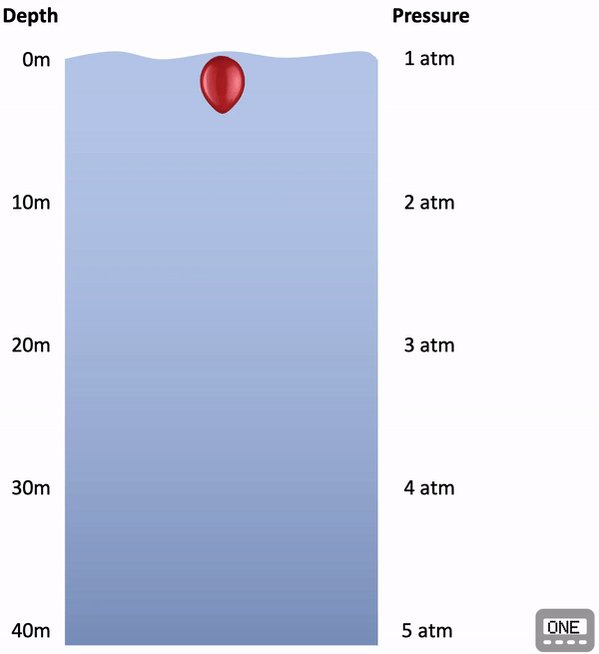
The same thing is going to happen to the divers lungs.
At the surface when she takes a breath she will be at total lung capacity (TLC) ≈ 6 liters
When she reaches a depth of 40m, her lungs will be at residual volume (RV) ≈ 1.2 liters
No wonder they call this "squeeze!"
11/
At the surface when she takes a breath she will be at total lung capacity (TLC) ≈ 6 liters
When she reaches a depth of 40m, her lungs will be at residual volume (RV) ≈ 1.2 liters
No wonder they call this "squeeze!"
11/
What is going to happen to the partial pressure of oxygen in her alveoli (PAO2)?
Let's use our new friend the alveolar gas equation to find out:
12/
Let's use our new friend the alveolar gas equation to find out:
12/

Wow! Her PAO2 went up to 738 mmHg! With that much partial pressure of oxygen in the alveoli it's going to drive a lot more O2 into her blood.
That's exactly what we saw in the art line study!
This phenomenon is called *hydrostatic induced hyperoxia*
13/
That's exactly what we saw in the art line study!
This phenomenon is called *hydrostatic induced hyperoxia*
13/

But wait a second! If the PAO2 went up to >700 mmHg, why did the PaO2 *only* increase to ~ 200 mmHg.
Quick review of what we/ve learned: what is her Aa difference?
Quick review of what we/ve learned: what is her Aa difference?
Free diving to 40m has massively increased her Aa difference! Why?
15/
15/

Exposing her lungs to 5 atm of pressure decreased her lung volume from ~6 liters at the surface to 1.2 liter at 40m, but it didn't *uniformly* shrink all her alveoli like the balloon. It caused some of her alveoli to collapse completely!
This is extreme atelectasis!
16/
This is extreme atelectasis!
16/
Atelectasis can cause blood to flow past the alveoli without participating in gas exchange, causing right to left SHUNT.
This might seem confusing because she isn't hypoxemic. But remember that despite 5x increase in her PAO2, her PaO2 only doubled. That's a lotta shunt!
17/
This might seem confusing because she isn't hypoxemic. But remember that despite 5x increase in her PAO2, her PaO2 only doubled. That's a lotta shunt!
17/
🥤As an analogy, imagine a 2L bottle of your favorite carbonated beverage.
🫧 How do they get so much CO2 dissolved in there?
They apply 4 atmospheres of CO2 above the liquid. This forces more CO2 into solution. yum 😋
This is just like a higher PAO2 driving up PaO2!
18/
🫧 How do they get so much CO2 dissolved in there?
They apply 4 atmospheres of CO2 above the liquid. This forces more CO2 into solution. yum 😋
This is just like a higher PAO2 driving up PaO2!
18/

We should talk about what happens when she ascends to the surface, but maybe it's better to save that for a future pulm physiology tweetorial.
19/
19/
Bottom line: we learned
- to use the alveolar gas equation to calculate alveolar partial pressure of oxygen (PAO2)
- why comparing PAO2 & arterial oxygen (PaO2) with Aa difference can be useful
- some cool diving physiology like hydrostatic induced hyperoxia & lung squeeze
20/20
- to use the alveolar gas equation to calculate alveolar partial pressure of oxygen (PAO2)
- why comparing PAO2 & arterial oxygen (PaO2) with Aa difference can be useful
- some cool diving physiology like hydrostatic induced hyperoxia & lung squeeze
20/20
Loading suggestions...