

Tax Harvesting can help you save up to ₹10,000💸💸 in Taxes on your Equity Investments every financial year!!
In this 🧵, let's understand what Tax Harvesting is and how you can use it to reduce your LTCG liability.
In this 🧵, let's understand what Tax Harvesting is and how you can use it to reduce your LTCG liability.

✳️First, we need to understand what LTCG is?
🔸Capital gains earned over and above ₹1 lakh on selling Equities, including shares and mutual funds, after one year are called Long-Term capital Gains (LTCGs).
🔸These LTCGs are taxed at the rate of 10%.
🔸Capital gains earned over and above ₹1 lakh on selling Equities, including shares and mutual funds, after one year are called Long-Term capital Gains (LTCGs).
🔸These LTCGs are taxed at the rate of 10%.
🔸Note that the first ₹ 1 Lakh of LTCG is exempt from 10% tax.
✳️Now let's understand what Tax Harvesting is and how it works?
🔸Tax Harvesting is a technique that utilizes the ₹ 1 Lakh annual LTCG exemption by selling and buying back part of your investment such that you realize gains and not pay taxes on the exempt ₹ 1 Lakh of LTCG.
🔸Tax Harvesting is a technique that utilizes the ₹ 1 Lakh annual LTCG exemption by selling and buying back part of your investment such that you realize gains and not pay taxes on the exempt ₹ 1 Lakh of LTCG.
🔸This process can be repeated every Financial Year to take advantage of the ₹1 lakh exemption in case of LTCG.
🔸Through this, one can save tax of up to ₹10,000 every year.
🔸Through this, one can save tax of up to ₹10,000 every year.
✳️Tax Harvesting with an example:
🔸Assume you have invested ₹400,000 in an Equity Mutual fund on 20th Jan 2021, and on Jan 28th, 2022, the value of this investment becomes ₹500,000.
🔸Now, if you redeem this, your gains will be ₹ 100,000 and your tax liability will be zero.
🔸Assume you have invested ₹400,000 in an Equity Mutual fund on 20th Jan 2021, and on Jan 28th, 2022, the value of this investment becomes ₹500,000.
🔸Now, if you redeem this, your gains will be ₹ 100,000 and your tax liability will be zero.
🔸That's because the first ₹ 1 Lakh of LTCG is exempt from 10% tax.
🔸Next, you invest this entire amount, i.e., ₹ 500,000 soon after redeeming. Your investment cost will be reset to ₹ 500,000.
🔸Next, you invest this entire amount, i.e., ₹ 500,000 soon after redeeming. Your investment cost will be reset to ₹ 500,000.
🔸Now, say your investment value increases to ₹ 600,000 after another year. When you redeem, your gains will be ₹ 1,00,000 – which is still exempt.
🔸Had you not redeemed and reinvested the amount, your long-term gains would have been ₹ 200,000 (₹ 600,000-₹ 400,000), and you would have needed to pay a 10% tax on the amount that exceeded the limit of Rs. 1 lakh.
🔸So, a tax of ₹ 10,000 (10% of 100,000).
🔸So, a tax of ₹ 10,000 (10% of 100,000).
🔸Tax Harvesting helps you save this ₹ 10,000.
🔸Repeat this process and you can save up to ₹ 10,000 of your LTCG Tax Liability every year.
🔸Repeat this process and you can save up to ₹ 10,000 of your LTCG Tax Liability every year.
✳️A few things to Note-
🔸You should consider Tax Harvesting once the holding period of your equity/mutual fund (in part or in full) is greater than 12 months.
🔸If the duration is less than 12 months, your investment will incur a short-term capital gain (STCG) of 15 percent.
🔸You should consider Tax Harvesting once the holding period of your equity/mutual fund (in part or in full) is greater than 12 months.
🔸If the duration is less than 12 months, your investment will incur a short-term capital gain (STCG) of 15 percent.
🔸It is very important to Reinvest the amount immediately without wasting any time. At times, people wait too long to reinvest or reinvest only partially. This can seriously hamper your financial goals.
🔸Also, it is important that one considers the Cost Involved in tax harvesting.
🔸While you save 10% on the LTCGs amount, you incur small charges in the form of security transaction tax, stamp duty, brokerage, and so on, which are most likely not more than 1% of the amount.
🔸While you save 10% on the LTCGs amount, you incur small charges in the form of security transaction tax, stamp duty, brokerage, and so on, which are most likely not more than 1% of the amount.
✳️Here is a chart from @bemoneyaware that explains Tax Harvesting and its benefits in detail
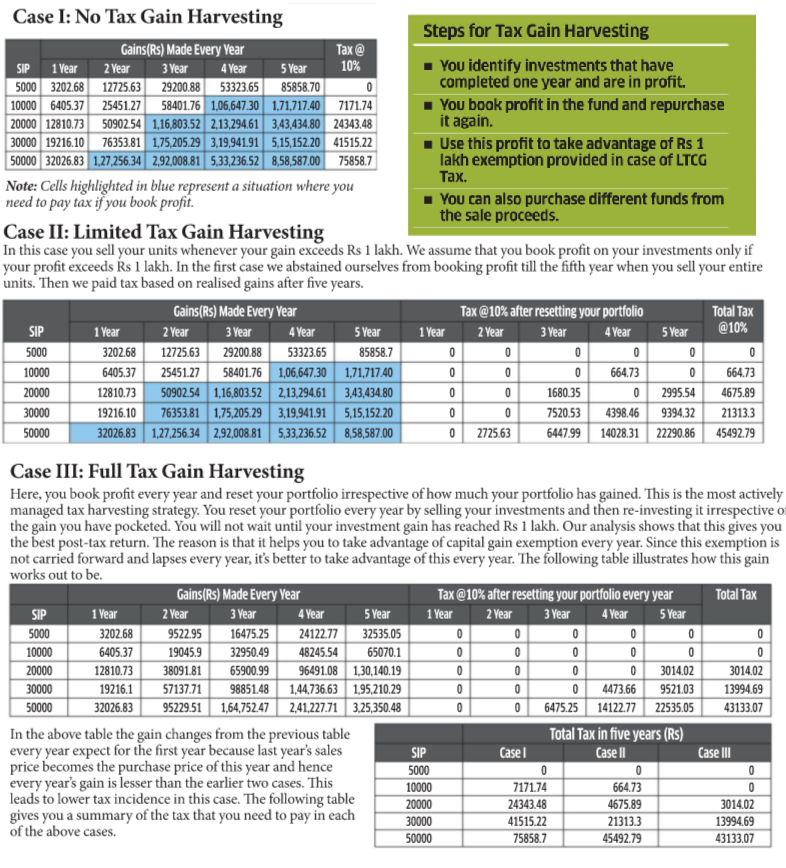
That's the end of the Thread!!
If you Liked this Thread, Like❤ and Retweet🔃 the first Tweet to share the information with other Invesors and Tax Enthusiasts.
If you Liked this Thread, Like❤ and Retweet🔃 the first Tweet to share the information with other Invesors and Tax Enthusiasts.
Follow me @garimabajpai for more such amazing stuff on Finance, Taxation and Investing!!
Loading suggestions...