
Education
Business
Finance
Investing
Risk Management
Investment Strategies
Options Trading
Option Selling
Straddle Strategy
Long-term Options

Short Straddle is the highest payoff strategy in Option Selling.
However, it comes with huge risks as well.
You become good at managing Straddles with adjustments.
Here's a step-by-step breakdown on them:
Collaborated with @niki_poojary
🧵
However, it comes with huge risks as well.
You become good at managing Straddles with adjustments.
Here's a step-by-step breakdown on them:
Collaborated with @niki_poojary
🧵
1/ Longer-term short straddle:
If you're a fan of very big ranges for your trades, you'll get the biggest one in long-term options.
Long Term can be 3 months, 6 months, or a year away as well.
The only drawback with longer-term straddles is the slippage.
Example:
If you're a fan of very big ranges for your trades, you'll get the biggest one in long-term options.
Long Term can be 3 months, 6 months, or a year away as well.
The only drawback with longer-term straddles is the slippage.
Example:

In the above example, in the March expiry, we have collected 1500 points in the 18000 Nifty Straddle.
This is actually low risk compared to the monthly or weekly Straddles.
Beginners:
Can try their hands at long-term options.
You'll get sufficient time to adjust and learn.
This is actually low risk compared to the monthly or weekly Straddles.
Beginners:
Can try their hands at long-term options.
You'll get sufficient time to adjust and learn.
2/ Weekly expiries will have a very short range:
Higher risk.
Frequent adjustments.
Below is an example of a weekly Straddle in Bank Nifty.
Premium Collected: 700 points
Bank Nifty at times, moves more than this in a day.
Higher risk.
Frequent adjustments.
Below is an example of a weekly Straddle in Bank Nifty.
Premium Collected: 700 points
Bank Nifty at times, moves more than this in a day.

Due to these small ranges, people prefer to do weekly Iron Fly instead of Straddles.
This takes care of the undefined risk in a small range in Straddles.
Also requires very slow and easier adjustments.
This takes care of the undefined risk in a small range in Straddles.
Also requires very slow and easier adjustments.
Now how to adjust a Short Straddle?
First of all, your straddle can go wrong very quickly if you adjust too fast too quickly.
This is why it is important to learn not to adjust till your breakeven arrives in certain scenarios.
Every trader has a different risk appetite.
First of all, your straddle can go wrong very quickly if you adjust too fast too quickly.
This is why it is important to learn not to adjust till your breakeven arrives in certain scenarios.
Every trader has a different risk appetite.
Some will prefer adjusting only when it touches the breakeven, some adjust at a small distance itself.
Some want to skip this procedure altogether and do a % stop-loss on their straddles.
You will know your method with experience only as there is no fixed formula.
Some want to skip this procedure altogether and do a % stop-loss on their straddles.
You will know your method with experience only as there is no fixed formula.
4/ When does a short straddle come into loss:
The moment the underlying price moves towards one end of the breakeven point, your short straddle will be in loss.
Adjustments would require additional funds, so don't go all in with your capital for shorting straddles.
The moment the underlying price moves towards one end of the breakeven point, your short straddle will be in loss.
Adjustments would require additional funds, so don't go all in with your capital for shorting straddles.
5/What to do when at a loss in a short straddle?
There are various ways with which one can manage once it goes bad:
- Opening a new straddle
- Rolling up the winning side
- Going inverted
- Opening ratio spread etc.
Methods are explained in detail below:
There are various ways with which one can manage once it goes bad:
- Opening a new straddle
- Rolling up the winning side
- Going inverted
- Opening ratio spread etc.
Methods are explained in detail below:
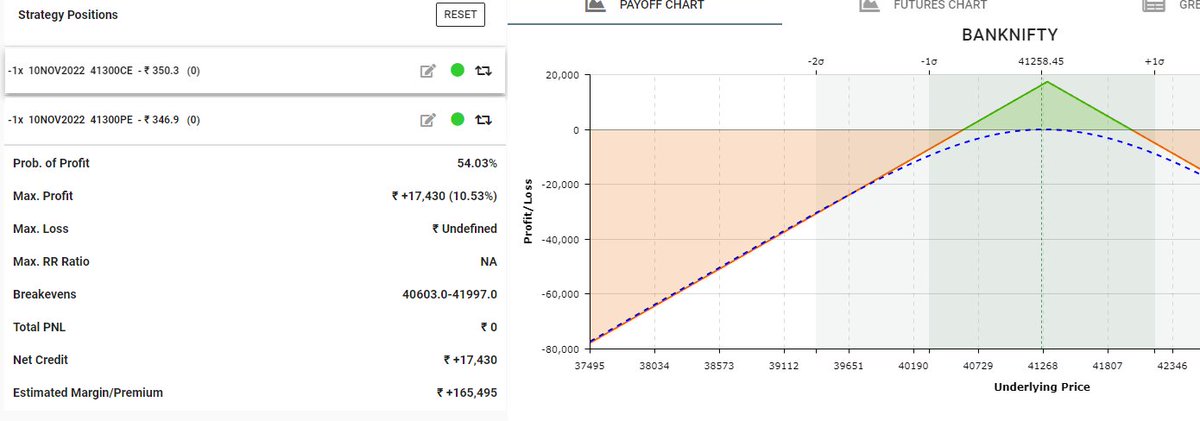
6/ Go inverted:
If one side of the straddle is challenged, the opposing short option could be rolled toward the underlying to receive additional credit.
Additional credit widens the break-even point on the challenged side of the position.
How payoff changes: An example
If one side of the straddle is challenged, the opposing short option could be rolled toward the underlying to receive additional credit.
Additional credit widens the break-even point on the challenged side of the position.
How payoff changes: An example
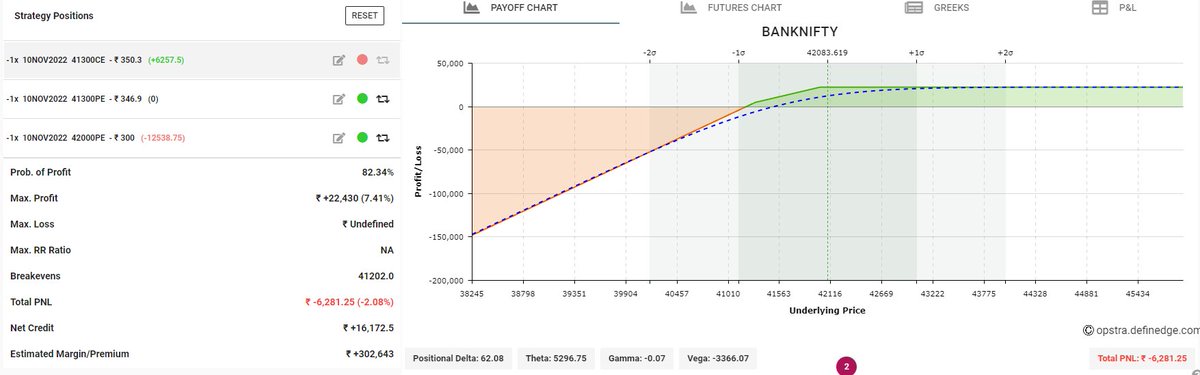
7/ Inverted short straddle continued:
An inverted position, means the short call is below the short put
Recommended when the options are near to expiry.
An inverted position, means the short call is below the short put
Recommended when the options are near to expiry.
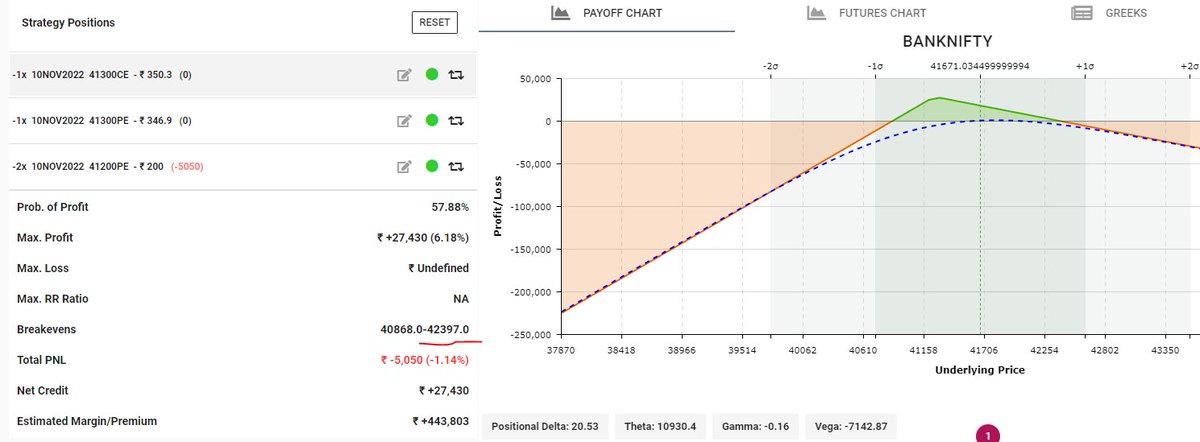
8/ Sell extra legs of winning side:
If the underlying is going up then one can sell 2/3 times of the winning side, to increase the upper break even.
Look how the payoff increases on the upside:
If the underlying is going up then one can sell 2/3 times of the winning side, to increase the upper break even.
Look how the payoff increases on the upside:

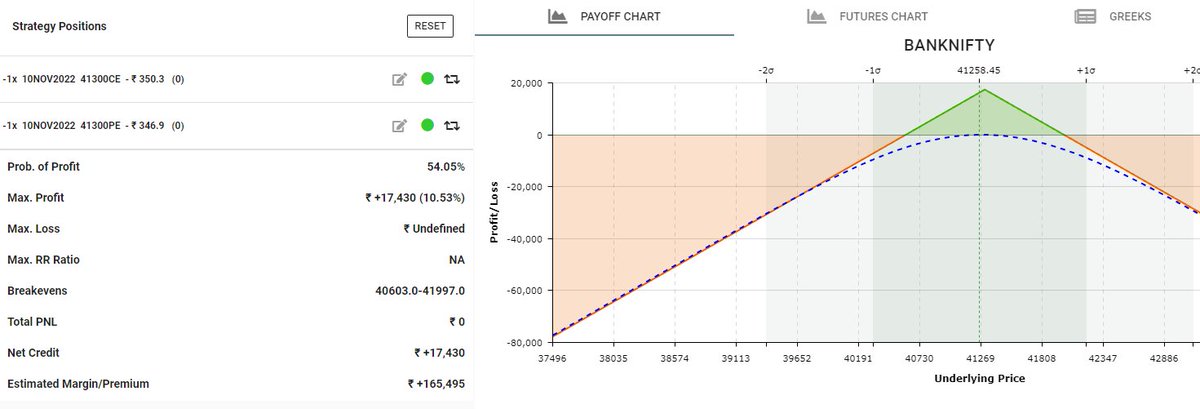
9/ Sell one more straddle:
If one side of the straddle is challenged, open a new straddle where the underlying is trading, without closing the older straddle.
The break-even range would be wider.
Now the payoff would be like a short strangle.
We increased breakeven.
If one side of the straddle is challenged, open a new straddle where the underlying is trading, without closing the older straddle.
The break-even range would be wider.
Now the payoff would be like a short strangle.
We increased breakeven.

10/ Do a ratio on the losing side:
If the underlying is moving up continuously then open a CE ratio spread & vice-versa on the downside.
If the underlying is moving up continuously then open a CE ratio spread & vice-versa on the downside.
11/ Shift your straddle to where the market is trading at:
Close the old straddle and open a new straddle where the market is trading at.
Close the old straddle and open a new straddle where the market is trading at.
12/ Do multiple short straddles, max is triple straddles:
-Eg: Short straddle initiated at 37k, thereafter market moved to 38k hence open a new straddle at 38k.
- Thereafter market moved to 36k so open a fresh straddle at 36k.
-Eg: Short straddle initiated at 37k, thereafter market moved to 38k hence open a new straddle at 38k.
- Thereafter market moved to 36k so open a fresh straddle at 36k.
13/ Using technicals for Short straddles:
If you've sold a straddle that has the breakeven beyond the support and resistance on the chart.
Then you can adjust proactively one the respective S/R is taken out.
If there is a range BO, you can go directional as well.
If you've sold a straddle that has the breakeven beyond the support and resistance on the chart.
Then you can adjust proactively one the respective S/R is taken out.
If there is a range BO, you can go directional as well.
14/ When to call it quits?
When it hits the 2x of the total premium collected from the short straddle.
This should be done only when one has done few adjustments to save the position.
When it hits the 2x of the total premium collected from the short straddle.
This should be done only when one has done few adjustments to save the position.
15/ When to book profit?
ATM options have the maximum extrinsic value however it is certain that one leg would into ITM.
Take profit when you've received 25% of the max profit.
Don't let greed overtake you and exit basis defined % to be profitable in the long run.
ATM options have the maximum extrinsic value however it is certain that one leg would into ITM.
Take profit when you've received 25% of the max profit.
Don't let greed overtake you and exit basis defined % to be profitable in the long run.
16/ Alternatives to reduce the risk:
Convert short straddle in Ironfly, by buying legs/hedges, with a pre-defined risk.
Rather than buying both leg, one can buy only one leg (directional side) aka broken iron-fly.
Convert short straddle in Ironfly, by buying legs/hedges, with a pre-defined risk.
Rather than buying both leg, one can buy only one leg (directional side) aka broken iron-fly.
Everything requires back-test & forward test:
Back-test these adjustments for the past 3-4 months.
After gaining confidence, forward test it for another 3 months with a single lot.
Understand the nuances, and only if the is profitable, you should scale up.
Back-test these adjustments for the past 3-4 months.
After gaining confidence, forward test it for another 3 months with a single lot.
Understand the nuances, and only if the is profitable, you should scale up.
If you like such threads, here's the last one I wrote on Dow Theory.
That's a wrap!
If you enjoyed this thread:
1. Follow us @Adityatodmal & @niki_poojary for more threads on Price action, Option Selling & Trading growth.
We've got you covered.
2. RT the first Tweet to share it with your audience.
I appreciate it!
If you enjoyed this thread:
1. Follow us @Adityatodmal & @niki_poojary for more threads on Price action, Option Selling & Trading growth.
We've got you covered.
2. RT the first Tweet to share it with your audience.
I appreciate it!
Loading suggestions...