

“Don’t time the market” is bad advice from people who didn’t get the memo.
If you understand mkt timing, things like FTX/Binance drama wouldn't stress you even if you aren't an insider.
The unfairly simple, drama-free way to time the crypto market, IQ optional 👇
If you understand mkt timing, things like FTX/Binance drama wouldn't stress you even if you aren't an insider.
The unfairly simple, drama-free way to time the crypto market, IQ optional 👇
Below I’ll discuss 3 metrics of crypto mkt timing. All are extremely easy. None require PhD in finance or crystal ball abt Fed’s next move.
They’re based on the concept of ‘market breadth’— possibly most under-rated investing concept on earth.
They’re based on the concept of ‘market breadth’— possibly most under-rated investing concept on earth.
Market breadth: How many listings in a market are participating in a particular market move.
There’re around 10k tokens w/ 2ndary mkt trading rn. Tomorrow if total crypto mkt cap rises, it can be due to price increases from 50 tokens or from 5000 tokens. Mkt breadth in former case is narrower than in latter.
Why is it important?
If a mkt move is broad-based, it signals strong money inflow/demand in mkt followed by strong rotation. Both lead to more persistent up trend.
If a mkt move is broad-based, it signals strong money inflow/demand in mkt followed by strong rotation. Both lead to more persistent up trend.
On other hand, after a strong mkt move, 2 things happen: 1) strong demand attracts new listings into mkt (increasing supply), and 2) all tokens that can be bought have already risen a lot— mkt running out of new narratives. These lead to eventual mkt drawdown.
Mkt breadth tells you abt the *macro* climate of crypto mkt w/o resorting to complicated economic analysis & they’re easy to measure.
How?
There’re many ways. Here’re some of my favorites:
1. # of tokens w price increase divided by # of tokens w price drop
How?
There’re many ways. Here’re some of my favorites:
1. # of tokens w price increase divided by # of tokens w price drop
For example, we can count the # of tokens w/ price growth > 25% versus those w/ < -25% in a month. Ratio btw the two has a historical median value of 0.75.
In other words, in a typical month for every 3 tokens that make a 25% up move, there’re abt 4 tokens that make 25% down move.
When the ratio goes above median, it’s a sign of above-usual increase in mkt demand.
When the ratio goes above median, it’s a sign of above-usual increase in mkt demand.
In chart below, green bars are periods when this ratio is > 0.75. Red line is monthly total crypto mkt return.

If you only go long when green bar shows up, w/ this one metric alone you’d do better than 95% of investors.
You say, “Wow Tascha, is this magic?” Yes it is. You’re welcome.
You say, “Wow Tascha, is this magic?” Yes it is. You’re welcome.
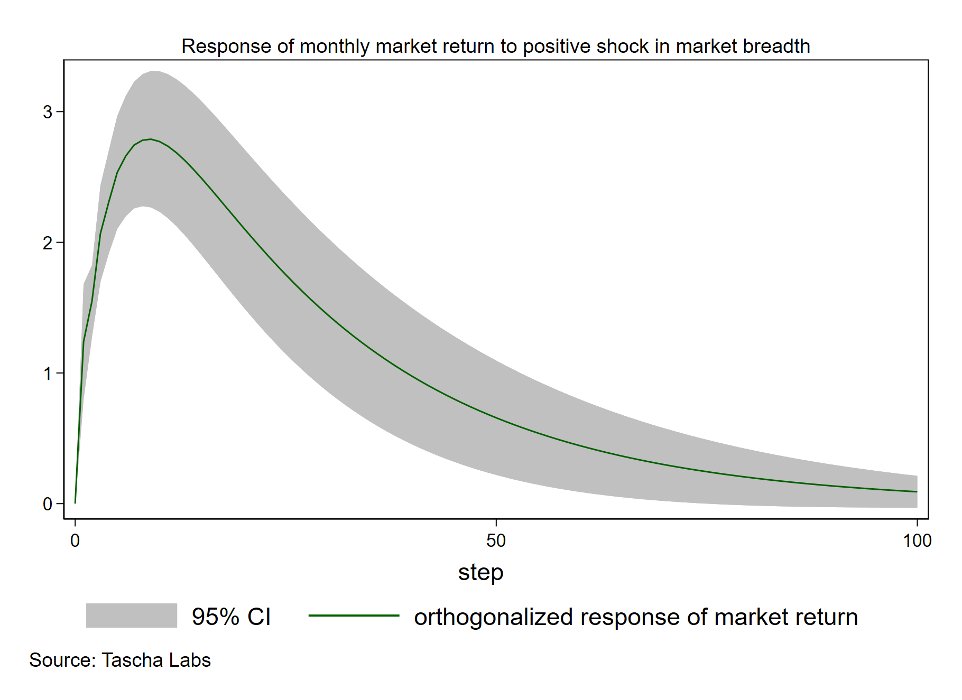
Here’s estimated response of mkt return w.r.t. a trigger in this breadth indicator. When green bar is triggered, it leads to a mkt return boost that lasts on average 1.5 months.
For those w/ short memory, here’s how this breadth indicator has behaved in 2022. We had 2 bear mk rallies this yr so far, a small one in March/April, a bigger one in July. In both cases breadth indicator went up to > 0.75.
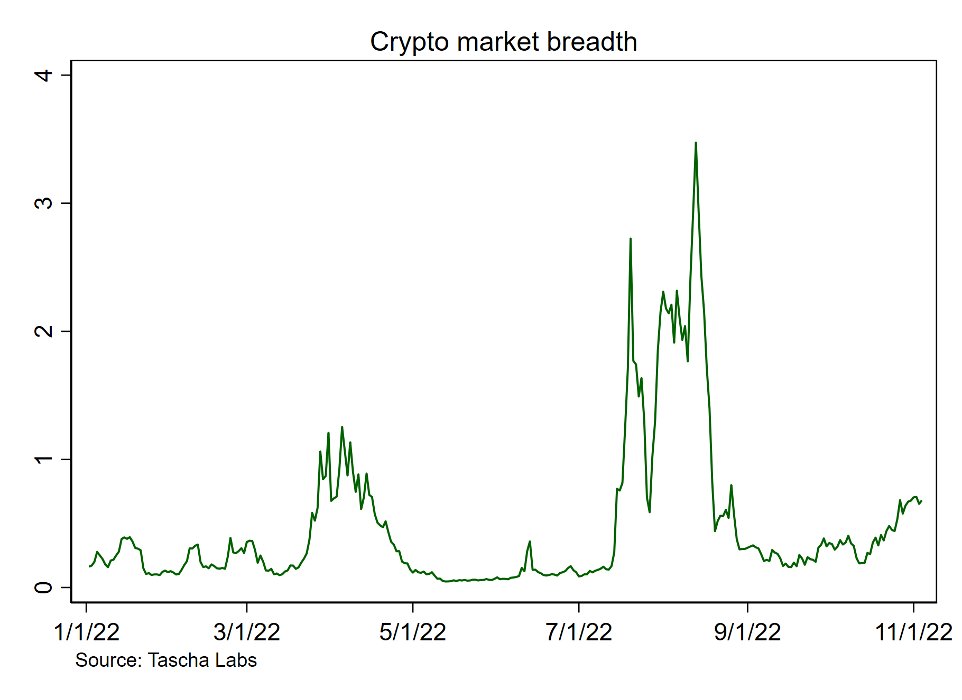
As of this writing, the indicator was on the rise for 2 wks. It was getting close to 0.75.
‘Tis one of the reasons why I recently said we *might* have had a local bottom.
Alas, it didn’t get to the threshold. And w/ sell off b/c of you-know-what since yesterday we likely won't see 0.75 anytime soon.
Alas, it didn’t get to the threshold. And w/ sell off b/c of you-know-what since yesterday we likely won't see 0.75 anytime soon.
2. Share of tokens w/ price above a moving average threshold
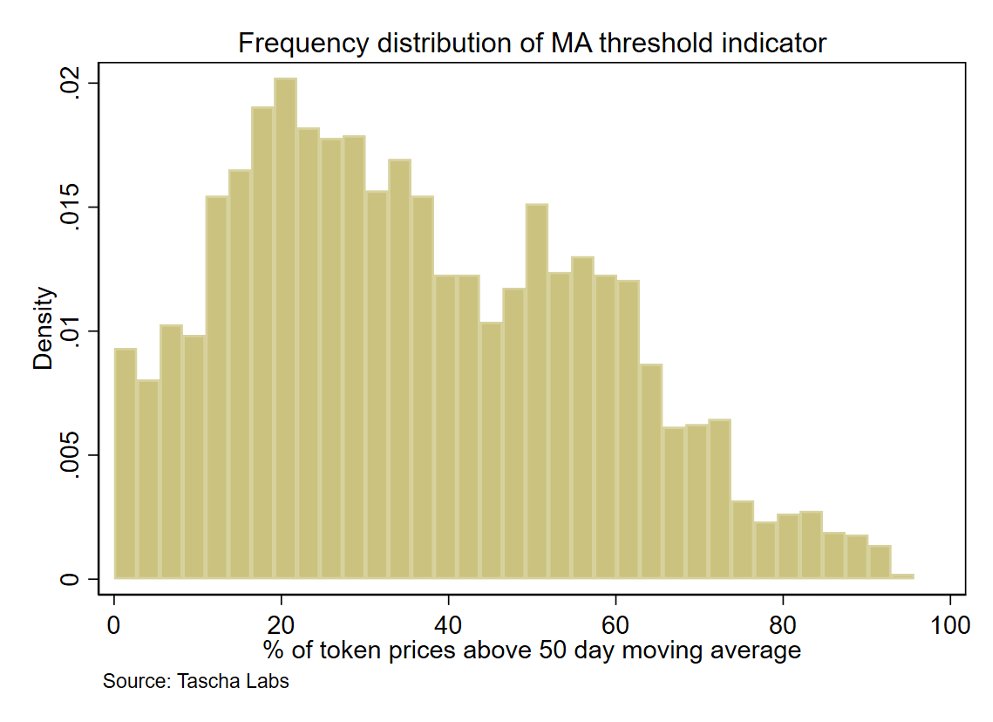
For example, we can count the # of tokens w/ current price above 50 day moving average, as percent of total token listings. Median of this variable is abt 33%.
For example, we can count the # of tokens w/ current price above 50 day moving average, as percent of total token listings. Median of this variable is abt 33%.
When this share goes very high, i.e. prices of most tokens have risen substantially, it’s a signal that mean reversion could be abt to kick in. Vice versa.
In chart below red bars are periods when this indicator is > 90 percentile of its historical distribution (65%), green bars are when it goes < 10 percentile (11%).
Notice it doesn’t give out many signals (b/c we set the threshold pretty extreme at 10 & 90 percentile). But when green bar does show up, it’s among the most opportune entry points you can find.
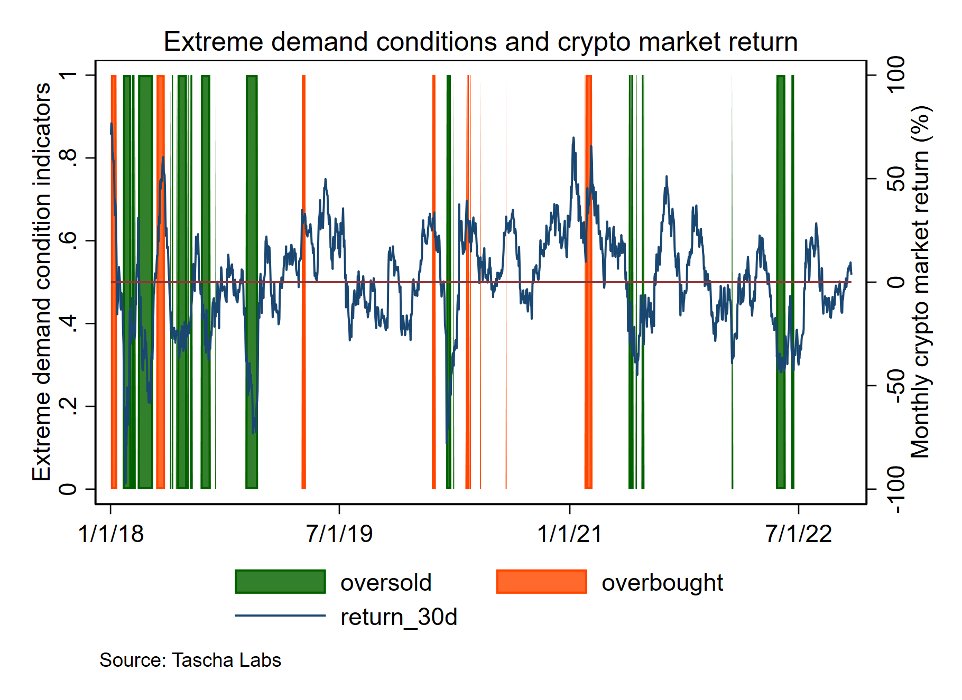
Red bar as exit point works similar but works less well w/ threshold set at 90 percentiles. Why? B/c distribution of this indicator is skewed to downside. So at 90 percentile we’re catching very few signals. If you want to catch more just set threshold lower.
Still, this is esp useful if you’re the type that don’t trade often. You can take those rare signals & rest of time you sit pretty & enjoy life. If you like actions just narrow the thresholds & look at this in combination w/ the 1st type of breadth indicator discussed above.
(BTW, like this so far? I help you get smarter about web3 & macro. [Subscribe to my newsletter] for updates 👉 taschalabs.com .)
3. Growth of new token listing
There’re abt 10k tokens actively traded in crypto mkt right now. Median token listing growth is around 5% per month historically.
There’re abt 10k tokens actively traded in crypto mkt right now. Median token listing growth is around 5% per month historically.
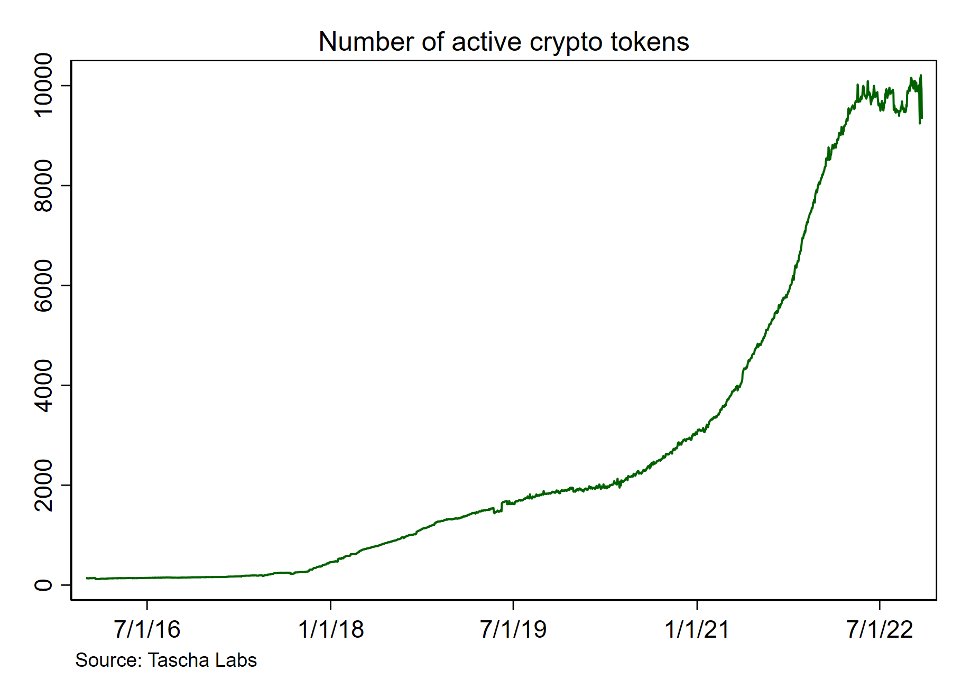
When listing growth reaches extreme high, it’s sign of a red hot mkt that may mean revert eventually as excessive supply floods mkt.
’Tis less an issue in crypto than in stocks b/c mkt caps of most new tokens are tiny. Case in point. 60% of stocks in US equity mkt are ‘micro caps’ w/ mkt cap < $300 mil. In crypto ‘micro caps’ are 98% of tokens.
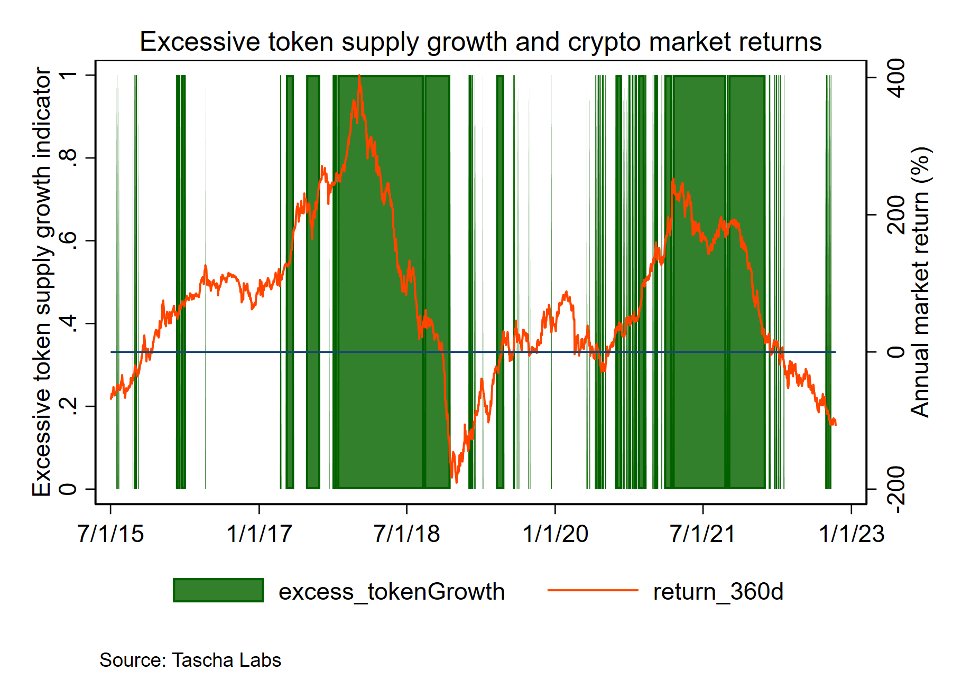
So mechanically, supply impact from increasing number of token listings is limited. Still it gives you a sense of supply *sentiment*, which is really the mkt sentiment. Here green bars are periods when monthly token listing growth > 5%, against mkt annual return.
Here’s estimated response of 30 day mkt return w.r.t. a trigger in the excess supply growth indicator. The negative impact is subtle, but can last for over a month.
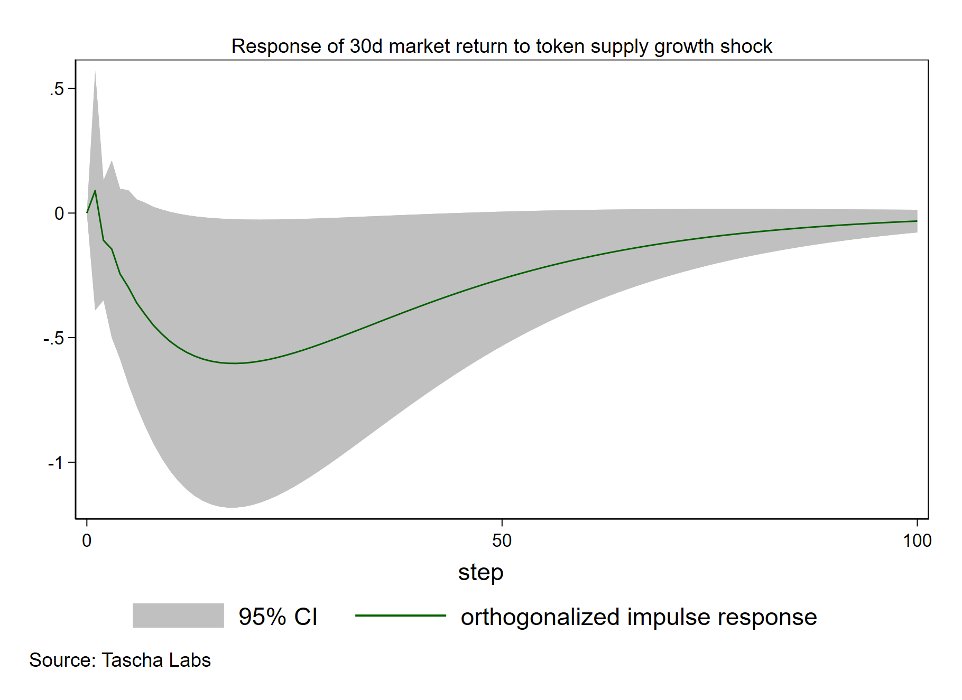
This indicator is slow moving so it doesn’t mean you need to get out of mkt as soon as supply growth goes extreme. But it’s a good supplementary indicator on top of other mkt breadth variables to help you form a view.
You say, “But Tascha, do I have to calculate these indicators myself??”
Good news: You used to. Now you don’t. @Artemis__xyz, a web3 analytics platform I’m advising, is building the 1st crypto macro dashboard that include these metrics & much more.
Sign up for their email list artemis.xyz to get notified once this dashboard is out.
Sign up for their email list artemis.xyz to get notified once this dashboard is out.
If you like this,
• Retweet 1st tweet in thread
• Subscribe to my newsletter on web3 macro to help you get smarter, richer, freer 👉 taschalabs.com
• Retweet 1st tweet in thread
• Subscribe to my newsletter on web3 macro to help you get smarter, richer, freer 👉 taschalabs.com
Loading suggestions...