

Wanna build ML models that generate business value? 📈
You need to think beyond "abstract" evaluation metrics (like mean-squared error or accuracy).
Add business metrics to the combo 🚀 💼
This is how you do it ↓
You need to think beyond "abstract" evaluation metrics (like mean-squared error or accuracy).
Add business metrics to the combo 🚀 💼
This is how you do it ↓
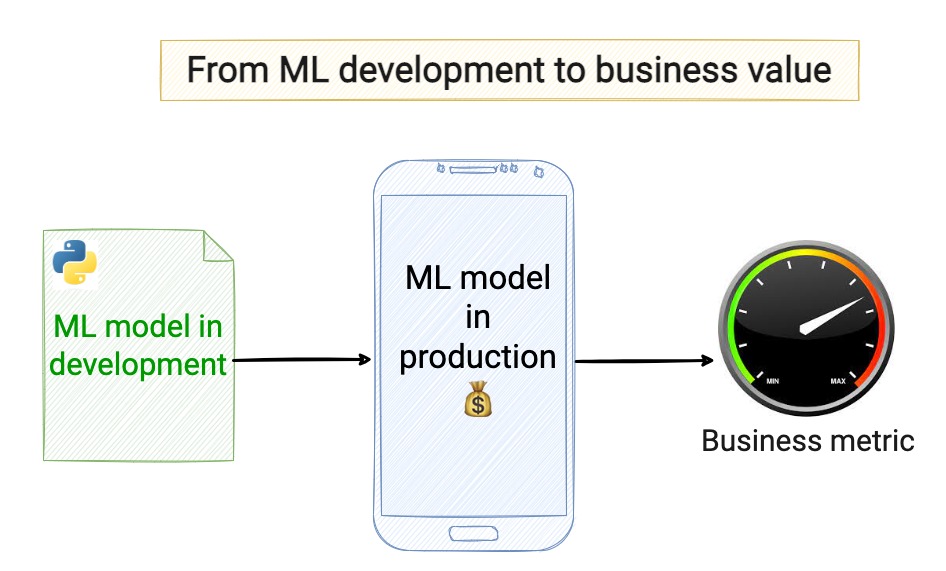
In a real-world project, a Machine Learning model has to move business metrics in the right direction.
If it doesn't, it is not good. No matter how complex or fancy your ML is.
The question is: how do you measure the business impact of your model, before releasing it? 🤔
If it doesn't, it is not good. No matter how complex or fancy your ML is.
The question is: how do you measure the business impact of your model, before releasing it? 🤔
Example: Imagine you work at Tesla, building the next generation of self-driving cars 🚗
You wanna build a better version of the autopilot system, which decides in real-time what the car should do next.
You wanna build a better version of the autopilot system, which decides in real-time what the car should do next.
You have historical data with labels you can use to train your ML model, in this case, a classifier with 4 possible outputs:
⬆️ - go straight
⬅️ - turn left
➡️ - turn right
✋ - stop
And you manage to build a model with 99.99% accuracy.
Is this accuracy *good*, or not?
⬆️ - go straight
⬅️ - turn left
➡️ - turn right
✋ - stop
And you manage to build a model with 99.99% accuracy.
Is this accuracy *good*, or not?
To answer this, you need to translate this abstract accuracy metric into something meaningful for the business.
For example, what is the likelihood of a car crash?
For example, what is the likelihood of a car crash?
To greenlight your new autopilot system, the team needs to ensure that the likelihood of a car crash is
→ lower than the current system's (baseline 1)
→ lower than the probability of a crash when a human drives the car (baseline 2)
→ lower than the current system's (baseline 1)
→ lower than the probability of a crash when a human drives the car (baseline 2)
To compute the likelihood of a car crash, you need to
→ immerse the ML agent into a traffic simulation engine.
→ let it drive as much as possible, and
→ record every crash event.
This way you get your crash likelihood.
→ immerse the ML agent into a traffic simulation engine.
→ let it drive as much as possible, and
→ record every crash event.
This way you get your crash likelihood.
You compare this metric with the 2 baselines and decide if the model is "good" when
(your_system_crash < baseline 1) AND (your_system_crash < baseline 2)
If either one of these inequalities does not hold, the model is NOT good enough, and you need to work on it further.
(your_system_crash < baseline 1) AND (your_system_crash < baseline 2)
If either one of these inequalities does not hold, the model is NOT good enough, and you need to work on it further.
To sum up,
→ Real-world ML models are ultimately evaluated in terms of business metrics.
→ An ML model is "good" when its implied business metric beats the status quo (aka current baseline).
→ Real-world ML models are ultimately evaluated in terms of business metrics.
→ An ML model is "good" when its implied business metric beats the status quo (aka current baseline).
Wanna become a freelance data scientist?
Join my e-mail list and get my eBook "How to become a freelance data scientist", for FREE ↓
freelance-data-science.carrd.co
Join my e-mail list and get my eBook "How to become a freelance data scientist", for FREE ↓
freelance-data-science.carrd.co
Every week I share real-world Data Science/Machine Learning content.
Follow me @paulabartabajo_ so you do not miss what's coming next.
Wanna help?
Like/Retweet the first tweet below to spread the wisdom ↓↓↓
Follow me @paulabartabajo_ so you do not miss what's coming next.
Wanna help?
Like/Retweet the first tweet below to spread the wisdom ↓↓↓
Loading suggestions...