

The FTX collapse is one of the biggest black swan events in crypto history.
It has already damaged the entire industry, but the ramifications run deeper than you may think.
🧵: How far will the FTX contagion spread? 👇
It has already damaged the entire industry, but the ramifications run deeper than you may think.
🧵: How far will the FTX contagion spread? 👇
In this mega thread, I'll cover:
• The 5 sectors that have been damaged by FTX's collapse
• The individual entities which have been most affected
• How much further the contagion could spread
• The 5 sectors that have been damaged by FTX's collapse
• The individual entities which have been most affected
• How much further the contagion could spread
This last week has been one of the most devastating weeks in crypto history.
But the mutilation may not be over yet.
Let's run through the top 5 impacted sectors and the potential ramifications. 👇
But the mutilation may not be over yet.
Let's run through the top 5 impacted sectors and the potential ramifications. 👇
1. EXCHANGES
There's been many exchanges which have confirmed negligible exposure to FTX:
• Kraken (9000 $FTT tokens)
• Coinbase ($15m)
• Crypto(dot)com ($10m)
There's been many exchanges which have confirmed negligible exposure to FTX:
• Kraken (9000 $FTT tokens)
• Coinbase ($15m)
• Crypto(dot)com ($10m)
However, there are many exchanges which still haven't clarified their exposure.
This is a bad sign.
It's very likely we see more exchanges go under in the near future.
This is a bad sign.
It's very likely we see more exchanges go under in the near future.
This isn't just due to direct FTX exposure, but also the sentiment hit caused by user's lack of trust in centralised exchanges.
We’ve seen record outflows from many of the top exchanges over the past week.
I believe this fundamentally impacts the crypto exchange business model.
We’ve seen record outflows from many of the top exchanges over the past week.
I believe this fundamentally impacts the crypto exchange business model.
For example, $898m of $BTC was moved out of Gate(dot)io in just an hour.
We're witnessing de-risking on a huge scale.
We're witnessing de-risking on a huge scale.
As an industry, we need to introduce proof of reserves as an industry-wide standard across both CEFI and DEFI.
But furthermore, proof of liabilities are ESSENTIAL, or else reserve figures are inapt.
But furthermore, proof of liabilities are ESSENTIAL, or else reserve figures are inapt.
For example, Alameda may of had ~$14b of assets on its balance sheet (mostly illiquid), but there was no way of telling how leveraged they were.
We need full transparency in terms of collateral, outstanding loans and liabilities.
We need full transparency in terms of collateral, outstanding loans and liabilities.
2. MARKET MAKERS
Market makers provide liquidity in cryptocurrency markets and thus ensure sufficient liquidity in the order books.
If market makers go down, you experience liquidity issues - which impacts the ability to buy/sell tokens.
Market makers provide liquidity in cryptocurrency markets and thus ensure sufficient liquidity in the order books.
If market makers go down, you experience liquidity issues - which impacts the ability to buy/sell tokens.
This is an issue, as the inability to sell an asset drives its market price down, or worse, renders the market price indecipherable.
Not only does this affect centralised exchanges, but also DeFi as many protocols rely on price data and oracles from CeFi.
Not only does this affect centralised exchanges, but also DeFi as many protocols rely on price data and oracles from CeFi.
Alameda was one of the biggest market makers of many tokens.
But another big market maker, Jump Crypto, is now being rumoured to be facing issues due to their FTX exposure.
However, they have dispelled these rumours (for now).
But another big market maker, Jump Crypto, is now being rumoured to be facing issues due to their FTX exposure.
However, they have dispelled these rumours (for now).
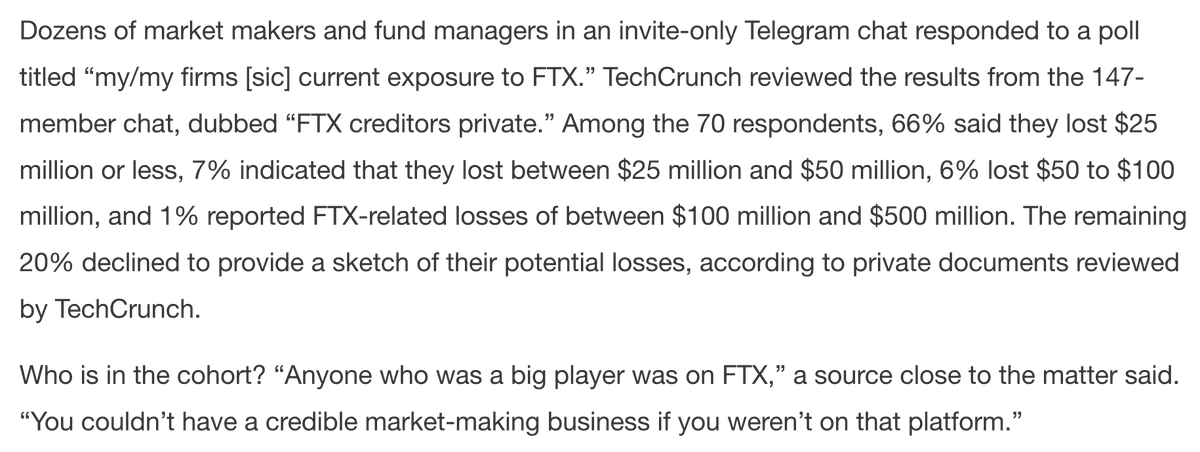
TechCrunch did a survey amongst market makers which revealed that:
• 66% lost $25m or less
• 7% lost between $25m-$50m
• 6% lost $50m-$100m
• 1% lost $100m-$500m
• 20% declined to comment
These numbers are pretty telling.
• 66% lost $25m or less
• 7% lost between $25m-$50m
• 6% lost $50m-$100m
• 1% lost $100m-$500m
• 20% declined to comment
These numbers are pretty telling.
3. FUNDS
When funds go down, this is a big issue as they hold a significant amount of tokens across a variety of ecosystems.
Many of the big funds had FTX exposure. Let's go through them. 👇
When funds go down, this is a big issue as they hold a significant amount of tokens across a variety of ecosystems.
Many of the big funds had FTX exposure. Let's go through them. 👇
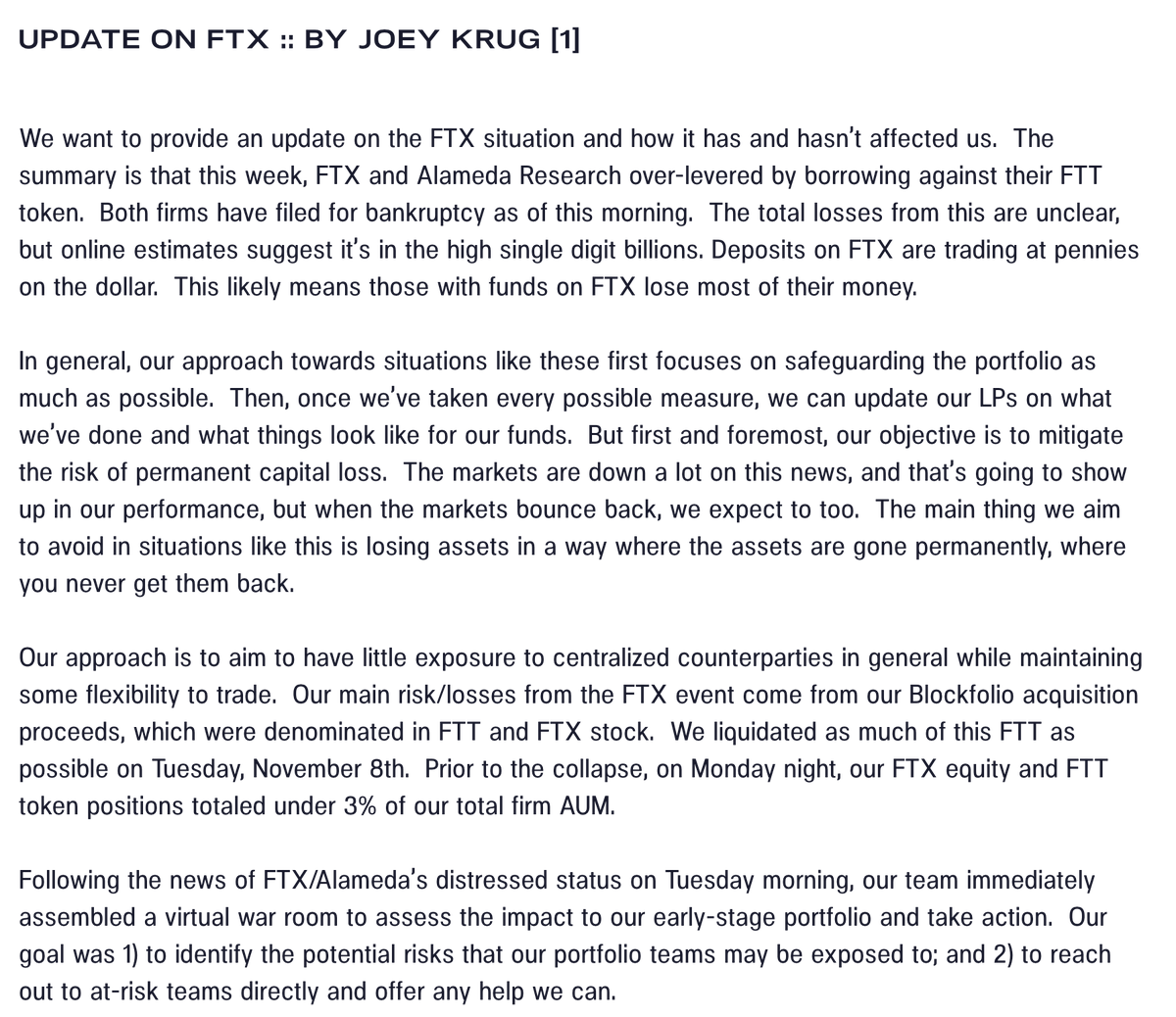
Sino Global, who once managed $300m of assets in January, confirmed a 'mid seven figure' exposure to FTX.
Pantera Global, one of crypto's biggest funds, had 3% of their AUM in FTX.
Sequoia Capital lost $150m in their Global Growth fund, and $63.5m in their SCGE fund.
Some funds have fared even worse.
Galois Capital, famous for shorting LUNA, has 50% of their assets stuck on FTX.
Galois Capital, famous for shorting LUNA, has 50% of their assets stuck on FTX.
Multicoin Capital, one of the largest crypto VCs, also lost more than half of its flagship fund's capital in about 2 weeks.
Ikigai, a $30m VC fund, had the majority of their assets on FTX.
This makes for tough reading.
This makes for tough reading.
On the flipside, many funds will come out and tell you they're ok.
We saw the exact same thing with FTX, Celsius, LUNA, Voyager etc. before they collapsed.
But there WILL be more blood.
We saw the exact same thing with FTX, Celsius, LUNA, Voyager etc. before they collapsed.
But there WILL be more blood.
Just as the 3AC collapse was the first domino for lenders like Genesis, the FTX bankruptcy will be the first domino for many funds, who are now more vulnerable than ever.
All it takes is another future black swan to put the nail in the coffin.
All it takes is another future black swan to put the nail in the coffin.
4. LENDERS
Centralised lending platforms took the biggest hit from both the 3AC and FTX collapses.
Why? Because many lending platforms are intertwined.
Issue a loan > lender defaults > other platforms take a loss > can't pay out users.
A classic case of counterparty risk.
Centralised lending platforms took the biggest hit from both the 3AC and FTX collapses.
Why? Because many lending platforms are intertwined.
Issue a loan > lender defaults > other platforms take a loss > can't pay out users.
A classic case of counterparty risk.
BlockFi is unique as it received a loan from FTX as part of its 3AC-inflicted bailout.
However, they took the loan in $FTT, which ended up collapsing in price alongside FTX.
However, they took the loan in $FTT, which ended up collapsing in price alongside FTX.
BlockFi is now expected to file for bankruptcy.
Genesis was the next domino to fall.
They were the biggest creditor to 3AC, lending out $2.4b.
The collapse of 3AC caused significant strain, as they were only able to claim $1.2b following their collapse in June.
They were the biggest creditor to 3AC, lending out $2.4b.
The collapse of 3AC caused significant strain, as they were only able to claim $1.2b following their collapse in June.
Thus, when FTX went under, this was the final straw.
They had $175 million in locked funds on FTX, and experienced unprecedented withdrawals in the midst of an already shaky balance sheet.
They had $175 million in locked funds on FTX, and experienced unprecedented withdrawals in the midst of an already shaky balance sheet.
They cited "extreme market dislocation and loss of industry confidence caused by the FTX implosion" as their reasoning for halting withdrawals.
Their affiliated product, Gemini Earn also paused their service.
What's even more concerning is that their holding company, DCG, appears to be experiencing a liquidity crunch and looking to raise outside capital.
The contagion runs deep.
The contagion runs deep.
One of the first crypto lending platforms, SALT, was also an another casualty, pausing withdrawals and deposits on Wednesday.
At this point, who is even left in the lending space?
It really feels like the end of CEFI as we know it.
The business model has proven to have too many points of failure.
It really feels like the end of CEFI as we know it.
The business model has proven to have too many points of failure.
5. RETAIL
This is where true damage is done. Why?
Because you have 1000s of users who have lost some (if not all) of their funds.
There are many cases of people keeping their life savings in FTX.
This is where true damage is done. Why?
Because you have 1000s of users who have lost some (if not all) of their funds.
There are many cases of people keeping their life savings in FTX.
Then you have millions of investors (likely including yourself) who have experienced losses as a result of the systemic effects of FTX collapsing.
This has a huge impact on consumer sentiment, which as we know is a key driver behind crypto asset price performance.
This has a huge impact on consumer sentiment, which as we know is a key driver behind crypto asset price performance.
The FTX situation is causing unprecedented damage to lenders as many companies were already heavily compromised following 3AC's bankruptcy.
The knock-on effects are occurring quicker and more fiercely than ever before.
The knock-on effects are occurring quicker and more fiercely than ever before.
After Celsius, Voyager, BlockFi, Genesis and many more centralised financial entities have gone under, the future of CeFi looks shaky.
The obvious solution is DeFi. But, I'll introduce a major caveat:
Many DeFi protocols rely on both oracle data and liquidity from centralised exchanges.
The recent issues with Solana DeFi exemplifies this.
If there's a lack of liquidity on exchanges, that also harms DeFi.
Many DeFi protocols rely on both oracle data and liquidity from centralised exchanges.
The recent issues with Solana DeFi exemplifies this.
If there's a lack of liquidity on exchanges, that also harms DeFi.
So why do we need CeFi in the first place?
Well, it's undeniable that the UI, infrastructure and liquidity of CeFi products are far superior to their DeFi counterparts.
"If we could trade 1000s of pairs on dYdX with deep liquidity, then we would" - @LDrogen
Well, it's undeniable that the UI, infrastructure and liquidity of CeFi products are far superior to their DeFi counterparts.
"If we could trade 1000s of pairs on dYdX with deep liquidity, then we would" - @LDrogen
The truth is that the tech isn't ready yet.
We're still years away from fully functional DeFi applications which can support the needs of both mass retail and institutional clients.
But we'll get there (eventually).
We're still years away from fully functional DeFi applications which can support the needs of both mass retail and institutional clients.
But we'll get there (eventually).
The only way we move forward as an industry is to embrace what crypto was built to do.
And that is via utilising the benefits of immutable, permissionless, decentralised protocols.
And that is via utilising the benefits of immutable, permissionless, decentralised protocols.
I hope you've found this thread helpful.
Follow me @milesdeutscher for more.
Also Like/Retweet the first tweet below if you can. 💙
Follow me @milesdeutscher for more.
Also Like/Retweet the first tweet below if you can. 💙
Loading suggestions...