

Game of Thrones, Lord of the Ring, Harry Potter, Star Wars, Zelda, Avatar… Fictions set in large and rich imaginary worlds are more and more popular around the world. Why do humans tend to enjoy fictional environments that differ from the real world? A long thread ⬇️ (1/74)


More mysteries… First, there is variability in this widespread cultural preference: some people hate imaginary worlds. Why doesn’t everybody enjoy them? Second, imaginary worlds could have been invented way earlier in history. Why is it a recent cultural phenomenon? (2/74)

Why this long thread? Because our @BBSJournal Target Article was just released, in which with Nicolas Baumard we put forward a general hypothesis about the psychological foundations of fictions with imaginary worlds. (3/74)

And this Target Article comes with no less than 33 fascinating commentaries by scholars coming from a wide range of disciplines, from psychology to philosophy, anthropology, neuroscience , history, literature , biology… (4/74)
In this thread, I’ll sum up everything: our hypothesis, each commentary we received, and our response to the commentaries, giving what I hope is an accurate account of the answer researchers can bring at the moment to the question "Why imaginary worlds?" (5/74)

Our hypothesis is straightforward: humans minds find imaginary worlds interesting because they evolved a cognitive adaptation the function of which is to prompt exploration. Basically, humans, just like other animals, are curious: they detect and seek new information. (6/74)

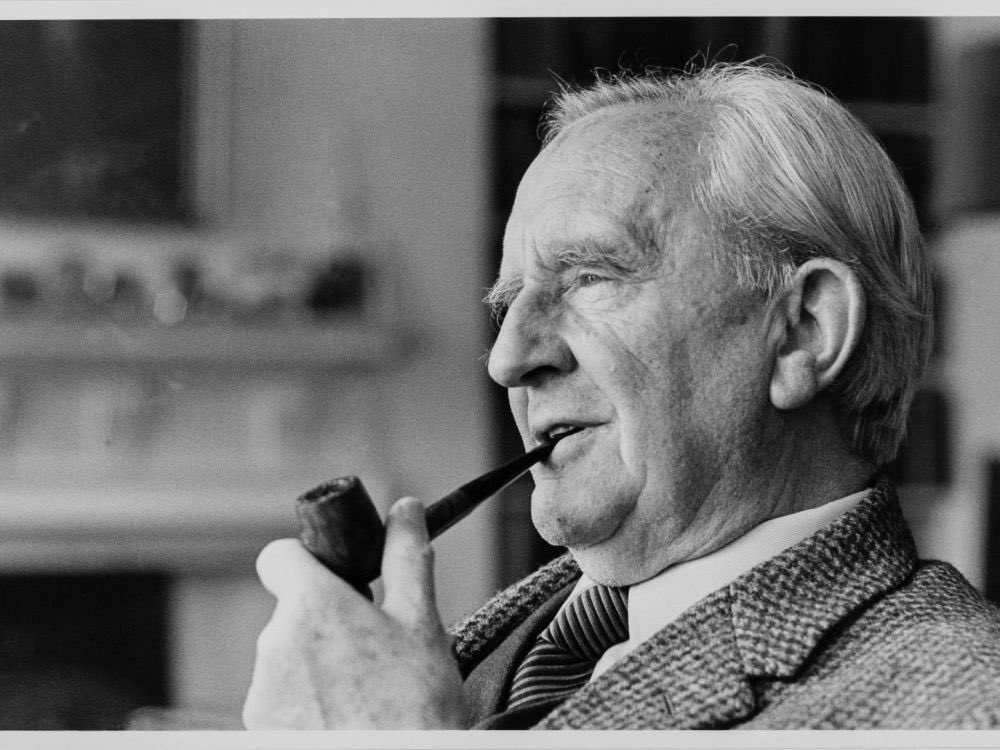
This is what #Tolkien thought, when he wrote "Part of the attraction of The Lord of the Rings relies on the intrinsic feeling of reward we experience when viewing far off an unvisited island or the towers of a distant city". (7/74)
But also @ShigeruMlyamoto, the creator of #Zelda who stated that "he wanted to create a game world that conveyed the same feeling you get when you are exploring a new city for the first time". (8/74)

First, we focus on this hypothesis and its implications at the ultimate level: the explanatory level that focus on the challenges in ancestral environments that served as selection pressures for cognitive and behavioral traits (some examples to understand the concept). (9/74)

This strategy of seeking new information evolved through natural selection, even before the divergence of humans, because it brought benefits to those curious organisms who therefore survived longer, reproduced more, and spread their genes in the population. (10/74)


It is an adaptive response to the evolutionary challenge of uncertainty: in an uncertain world, organisms who try to make their ecology more predictable fare better. This is why animals are curious too (e.g., they look longer at unfamiliar objects). (11/74)

There is evidence from studies in environmental aesthetics that, on average, humans rate higher images that prompt exploration. What makes a setting appealing is the promise of novel information, inferred from cues indicating that an enrichment in knowledge is possible. (12/74)

In humans, the dopamine system reacts specifically to novel stimuli even if they do not involve primary reward. For instance, data from experiments with injections of a selective dopamine transporter inhibitor show that dopamine crucially enhances novelty-related value. (13/74)

But such exploratory preferences vary. Behavioral ecologists and evolutionary biologists predict that organisms shouldn’t explore at the same rate in secure and affluent ecologies versus in dangerous and harsh ecologies. It is the effect of phenotypic plasticity. (14/74)

At the ultimate level, cognitive and spatial exploration is a kind of long-term investment: you incur costs now, hoping to discover information that will be beneficial in the future. This strategy is costlier in harsh environments, because: (15/74)
(1) it is risky: one may not find any valuable information or innovative ideas, and come back empty handed (which is costlier with no secure amount of resources to begin with); (16/74)
(2) it is time- and energy-consuming, and therefore represents big opportunity costs: in harsh environments one is better off spending time and energy in more pressing needs; (17/74)
(3) it is a future-oriented strategy: one shouldn’t invest in information valuable only in the long-term in a dangerous environment. (18/74)
To sum up, exploration is a better strategy in conditions of relative safety. Importantly, its means that organisms living in scarcity explore less because exploitative strategies are better adapted to that type of environment. (19/74)
For instance, in different parrot species, the presence of habitat, fruits and buds accelerates the timing of first contact after the introduction of a novel object. (20/74)

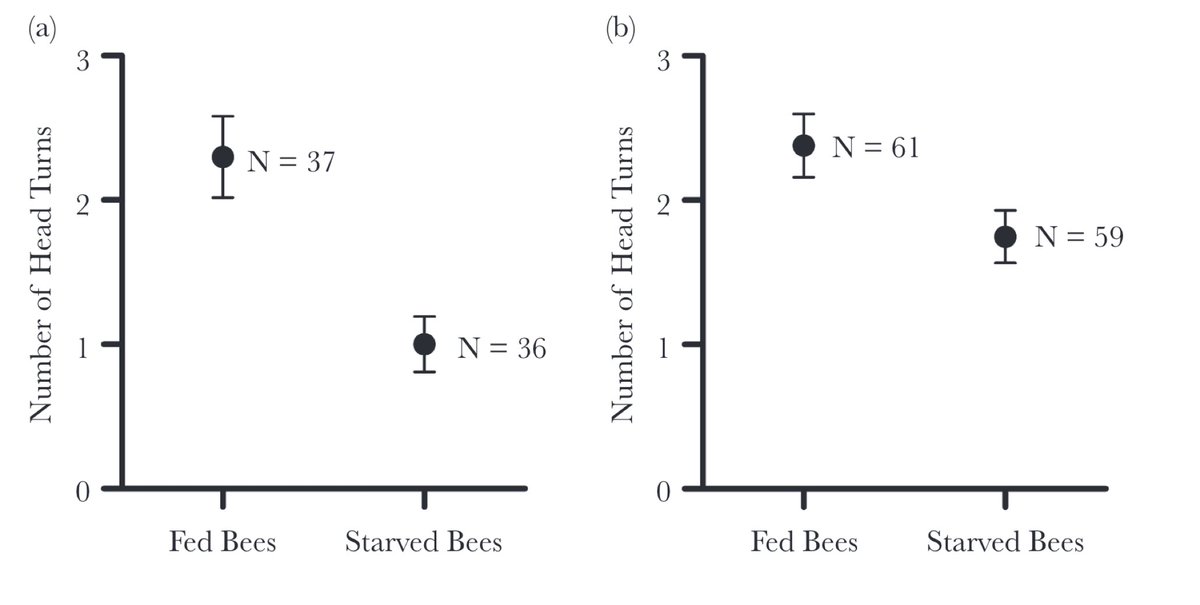
In spatial uncertainty experiment, fed honeybees explore more than starved ones. (21/74)
Closer to humans: the longer time orangutans have spent protected and fed by humans, the more curious they are. (22/74)

In humans: across time, more affluent societies explore more scientifically. Today, population levels of openness to change and novelty are correlated to GDP per capita. Humans explore more in periods of prosperity (in diachrony) and in affluent countries (in synchrony). (23/74)


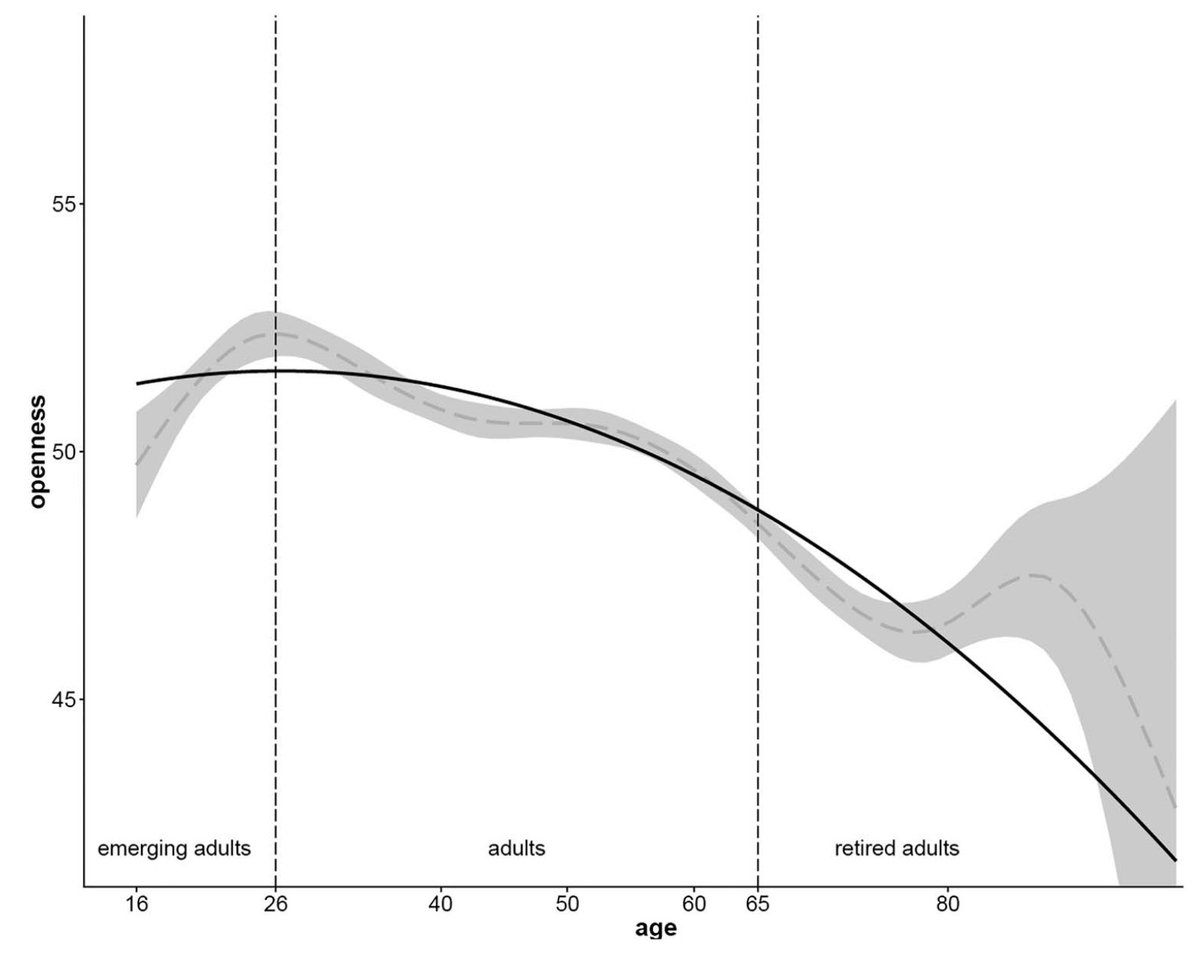
Of course variation in curiosity is not fully explained by ecological variation. Curiosity also varies with age. Typically, organisms go through an early period of exploration followed by a later period of exploitation (a developmental division of labor). (24/74)
More precisely, exploratory preferences increase continuously until adolescence and start to decrease then. (25/74)
In the Hadza, a group of Tanzanian hunter-gatherers, and data collected with GPS devices, this life-history pattern is observable with two measures: distance and number of steps. (26/74)

There is a wealth of experimental evidence showing that children spend more time and energy exploring multiple options than adults do in exploration-exploitation tasks, but also in many other experimental tasks such as the bandit task or problem-solving tasks. (27/74)

It is consistent with how exploration varies with security and affluence: in childhood up until adolescence, humans are usually protected and fed by their parents through resource transfers, and this is the case in hunter-gatherers (see bold line). (28/74)

Such interindividual differences in curiosity and exploration are captured by the personality trait Openness, which also seem to follow the same evolution across age and the same variation according to socio-economic status. (29/74)


Coming back to the cultural domain and our main hypothesis, we therefore predicted that: people (1) higher in Openness, (2) younger, and (3) living in more affluent and secure contexts should enjoy more fictions with imaginary worlds. (30/74)
Correlational models with both experimental and observational data support such predictions (these preliminary results are part of a forthcoming empirical article). (31/74)

This theory could therefore explain why imaginary worlds emerged recently in history. A large enough number of potential consumers had to be better-off, and therefore curious enough, for such fictions to be interesting and appealing to a broad audience. (32/74)
To sum up, the exploration hypothesis posits that imaginary worlds fall into the actual domain of human curiosity: people are interested to them in the extent to which they are curious about the real world, and under the same circumstances. (33/74)

In the paper, we develop further this exploration hypothesis, its implications on culture, and we derive more predictions, for instance about the exaggeration of cultural content (the stimulus-intensification hypothesis). (34/74)
Commentators proposed many alternative explanations or corrections to our models. Here there are, with for each of them the short abstract. (35/74)
Arnett’s proposal (that imaginary worlds are a spinoff of a tendency to create imaginary realities) is in our view consistent with ours, that humans recycle their evolved simulation capacity to create imaginary worlds. (36/74)

@sarahruthbeck and Paul Harris point to important future directions in developmental psychology, while specifying what kind of imaginative thinking emerge at what ages. (37/74)

While we focus on the neurotypical population, @zoophilosophy and Veit rightfully extend our framework to autistic people and the cultural implications of higher systemizing quotient. (38/74)

Buttrick and Oishi don’t agree with our ultimate account of curiosity and the reasons why it varies between and within societies. They propose an alternative based on socioecological factors, with no ultimate explanation. (39/74)
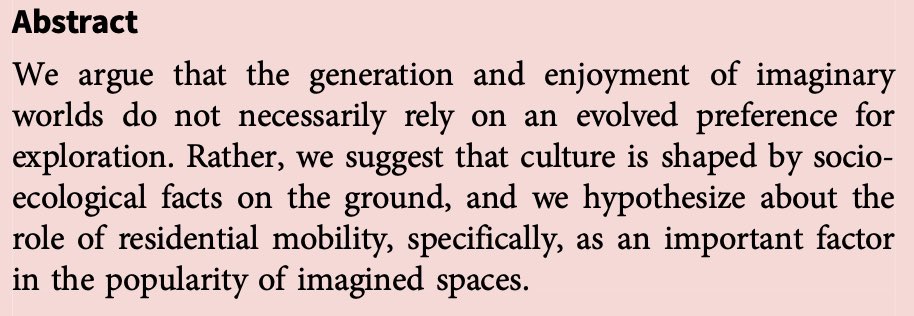
We agree with @rebeccadunk and Mar that, Openness being the driver of our preference for imaginary world, our model should be revised and focus on information-seeking cognition (not spatial exploration when it is for reward). (40/74)

@abazuel and Gomez extends our framework and proposes that imaginary worlds "provide us with what the physical world offered our ancestors: a sense of potentiality, and a key to the unknown". (41/74)

Gabriel, Green, Naidu, and @DrEParavati offer a complementary hypothesis: imaginary worlds offer opportunities to connect with others. We agree. However, this seems true of any entertaining device, not just for those set in imaginary worlds. (42/74)


@SeanPGoldy and Piff rightfully detail the proximate domain of our framework, convincingly arguing that ‘awe’ is a central emotion in information-seeking cognition (prompting exploration by rewarding the realization of big knowledge gaps). (43/74)


Hogan supports our hypothesis and ground it in a larger research program on the evolutionary bases of fictional narratives. We agree that one central mechanism that make narrative fictions possible is simulation, that evolved to make costless trial-and-errors. (44/74)

@adlightner , @Cynthiann_H and @ed_hagen develop further the creators’ evolutionary costs and benefits: creators of imaginary worlds receive reputational benefits because they become some kind of knowledge specialist. (45/74)

We view Llewellyn’s commentary as a magnifying glass of broader cumulative processes: creators selectively retain elements from their past that they re-use in the building of imaginary worlds. (46/74)

We agree with Moore and Hills that imagination or simulation skills are adaptive. Our own imaginary simulations are adaptive. Yet, we still see others’ imaginary worlds in popular fictions as entertainment. (47/74)
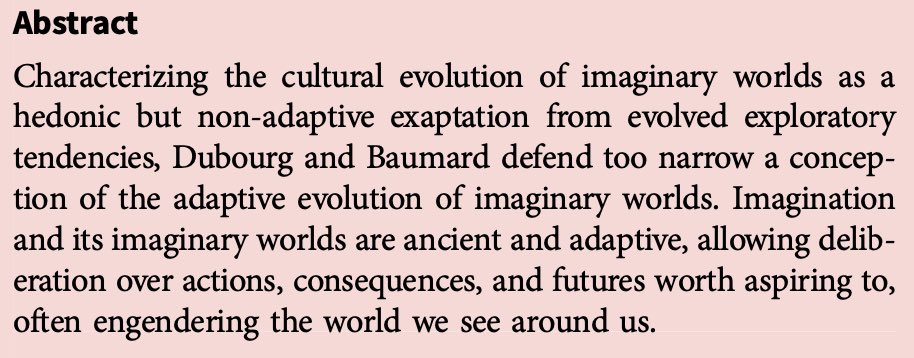
Likewise, Nissel and Woolley argue that personal developments of imaginary worlds can be beneficial in the real world (e.g., coping with trauma by fostering psychological distance). (48/74)

We completely agree with Norman and @ThaliaGoldstein that all fictions, even those set in real settings, prompt exploration (we argue this is a matter of degree), and that distance from reality should be further investigated. (49/74)
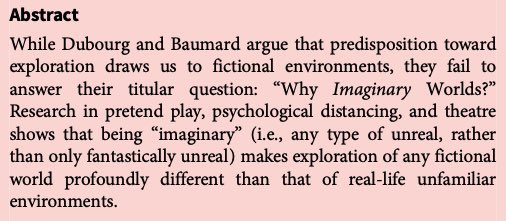
@angelanyh and Lee persuasively argue that young children may not enjoy imaginary worlds, not because they don’t enjoy new information, but because they don’t enjoy fiction that much. (50/74)

@KeithOatley propose to extend our theoretical framework by including more kinds of informational input, such as information about novel objects or new characters. (51/74)

Pianzola, Riva, Kukkonen and @FabryCom rightfully point to gaps in our model, that we should investigate next, notably the way the imaginary world is presented in the fiction, prompting (or not) a feeling of presence. (52/74)

Rodríguez-Fuentes and Ulloa propose that authors of fan fiction are curious explorers: extending canonic world, they would acquire new fictional knowledge (and, as they argue, better self-knowledge). (53/74)

@CatherineSalmon and Burch rightfully point to potential future research directions about sex-related differences in preferred kinds of exploration and, therefore, preferred fictional genres. (54/74)

Scalise Sugiyama argue that a complete theory of the human appeal for imaginary worlds should also include the factual information in such worlds, which could be useful in the real world. (55/74)
@MorbidPsych and @MathiasClasen convincingly argue that we are curious about new threats in imaginary world, triggering our morbid curiosity (an important additional explanatory factor in our model). (56/74)

@andrewshtulman grounds our hypothesis in the broader theory that studies counterintuitive cultural content, and provide many arguments and examples in favor of the entertainment hypothesis. (57/74)

Sitek and Konieczna extend our framework and discuss the cultural implications of neurodegenerative diseases, and more specifically aphantasia (the inability to create mental images). (58/74)

@oleg_sobchuk rightfully discusses the granularity of our definitions: we agree that the appeal of novel information (not just spatial) explain the success of imaginary worlds. (59/74)

We also fully agree with Sugiyama who extends the scope of novelty-based preferences in other cognitive domains (not just spatial information). (60/74)

Solin and @DrMarkGriffiths propose that, in video games especially, self-exploration is also appealing: people can safely experiment in imaginary worlds. (61/74)

Weisberg and Sobel report important results from development psychology which seem to challenge our main hypothesis if we focus on the reality/fantasy distinction. We also focus on the world-dominant/story-dominant distinction. (62/74)

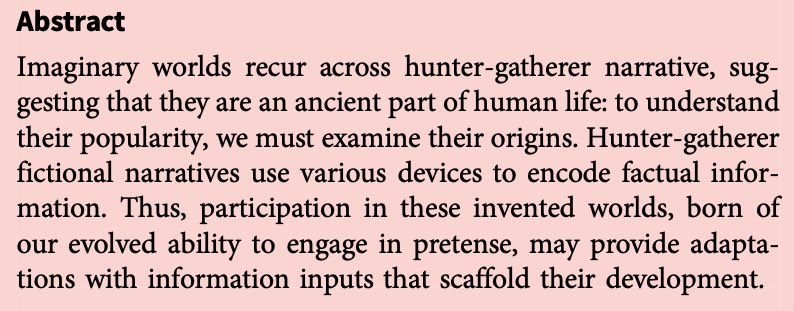
Polly Wiessner traces the long history of storytelling. This is an important complementary account which leads to thinking more about how to measure changes in subtle and specific fictional content. (63/74)

@danicajwilbanks , @jordan_w_moon , Stewart, @kurtjgray, and Varnum defend and summarize a general adaptive view of fiction, closer to the simulation hypothesis, which is an alternative to the entertainment hypothesis. (64/74)

Winner proposes many potential alternative explanations which are more or less compatible with our hypothesis and points to new research directions. (65/74)


Mark Wolf put forward some exemples from literary history that serve as limitations of our hypothesis related to the association between ecological conditions and exploratory preferences. (66/74)

Wylie, @alix_alto , and @ana_gram_ argue that imaginary words enable coordination around shared moral values (we agree and add that association between Openness and Leftist ideology could be further studied). (67/74)

In our Response, (1) we mitigate the importance of adaptive benefits for the consumers, at the ultimate level. Our entertainment hypothesis states that benefits for the producers are in principle sufficient for entertaining narratives to emerge. (68/74)

(2) We detail what is specific about human spatial exploration, versus other other cognitive mechanisms: narrative fictions do co-opt a myriad of cognitive preferences. (69/74)

(3) We emphasize the idea that what matters to explain the cultural evolution of fiction are broad trends of psychological changes in potential audiences, notably evoked by changes in ecological conditions. (70/74)
I deeply thank all the commentators for such a fruitful and useful discussion, but also @paulbloomatyale and the original reviewers for their feedback and help in improving different versions of the Target Article. (71/74)
And many thanks to @Sacha_Altay , @BoonFalleur , @ValerianChambon , @Charlesddamp , @LFitouchi , @OliverWithAnI, @hugoreasoning, and @V_Thouzeau. And of course to Nicolas Baumard my co-author and supervisor. (72/74)
All images and graphs in this thread come from studies that are cited in the article. Please do ask if you want the precise references (which are sadly impossible to mention in a twitter thread). (73/74)
Thanks, especially if you ended up reading the whole thread… and don’t hesitate to send me feedback, questions, or comments, or to ask for the Target Article. (74/74)
Loading suggestions...