
Thread. @DalitChef writes: In “Tarak Mehta Ka Ulta Chashma,” Gukul Dham Society is a perfect reflection of Brahmin India.
-Gada
-Mehta
-Sodhi
-Bhide
-Hathi
-Pande
-Iyer
All are Savarna Characters. No SC, ST, OBC. Muslim lives outside. Read a thread on urban apartment ghettos…
-Gada
-Mehta
-Sodhi
-Bhide
-Hathi
-Pande
-Iyer
All are Savarna Characters. No SC, ST, OBC. Muslim lives outside. Read a thread on urban apartment ghettos…

Indian urban localities are as segregated as our villages. About 80 per cent of Rajkot’s localities have no Dalit (Scheduled caste) inhabitants. Source- Study based on 2011 Census Data, by Naveen Bharathi, Deepak Malghan and Andaleeb Rahman.

The term ‘urban Indian’ is an oxymoron. There is nothing urban about India and Indian modernity is hollow on most things that actually count. Indians carry their embryonic, primordial identities with us everywhere they go.
It does not change even with our moving from rural settings to the most modern urban landscapes. It is erroneous to say that caste bias doesn’t exist in urban India, which is a cliché thrown at you to argue against reservation policy or any other affirmative action programme.
The inconvenient truth in India is that we live in segregated spaces. We easily accept that Indian cities are segregated on the basis of religion. We justify that people of different cultures living in different spaces is not a pathology, rather it is a natural way of living
Hindus and Muslims living in different colonies is justified on the basis of food habits and culture, and so on and so forth. But with caste, these justifications fall by the wayside.
Around 60 per cent of Kolkata’s localities do not have a single Dalit resident. Around 20 per cent of Bengaluru’s colonies have no Dalit residents. Source- Census Report, 2011
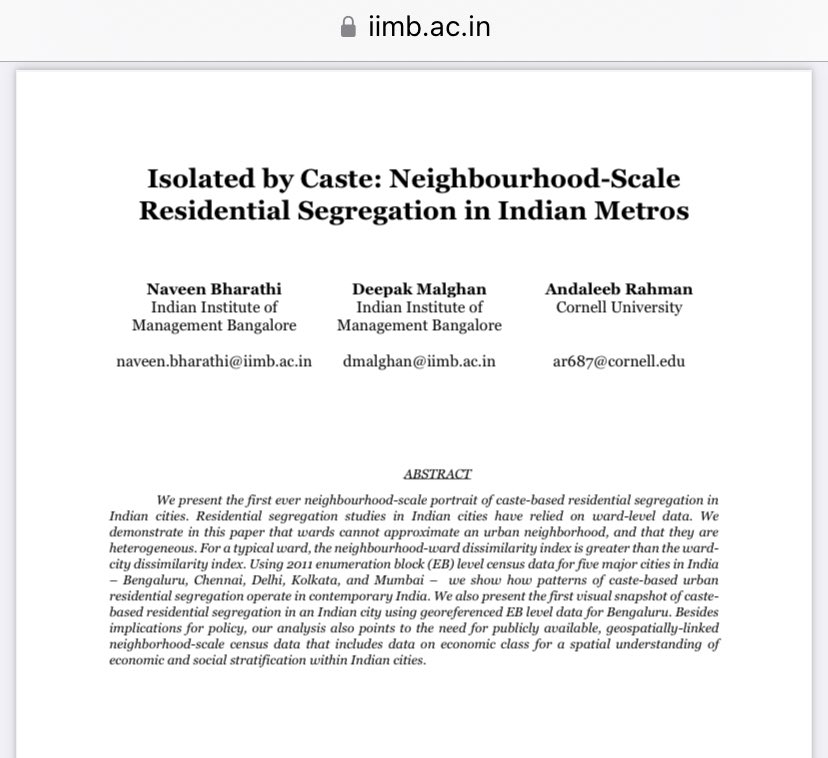
These are some of the findings of a 2018 paper titled ‘Isolated by Caste: Neighbourhood-Scale Residential Segregation in Indian Metros’ published by the Indian Institute of Management Bangalore and authored by Naveen Bharathi, Deepak Malghan and Andaleeb Rahman.

This study is the first attempt to find out residential segregation on the basis of caste in Indian cities with enumeration block (EB) as a unit. Enumeration Block-level data collection is a novelty in the Census operation, as it was done for the first time in 2011.
Earlier the unit for collection of data was a ward, which is a large unit consisting of at least 30,000 people. It was technically almost impossible to map residential segregation, given the palpable diversity at this level.
This has shattered many myths and presuppositions about the process of modernity and urbanisation in India. Some of these myths are:
1. With the advent of modernity and urbanisation, the caste system will wither away.
2. Rural and uneducated folks are more casteist than the urban and educated people.
3. In urban spaces, the markers of class such as, job, education and wealth matter more than caste identities.
2. Rural and uneducated folks are more casteist than the urban and educated people.
3. In urban spaces, the markers of class such as, job, education and wealth matter more than caste identities.
4. In urban spaces, caste identities will merge into class identities.
Now we have data to prove that these myths, sometimes spread with noble intentions, are quite off the mark and in many cases blatantly wrong.
Now we have data to prove that these myths, sometimes spread with noble intentions, are quite off the mark and in many cases blatantly wrong.
There are, however, some supporting facts that also prove the hypothesis that the caste system can co-exist with modernity. One of the seminal studies in this field was done by Sukhadeo Thorat and Paul Attewell in 2007.
It demonstrated that if two CVs were sent to a prospective employer, one with an upper-caste and another with a Dalit surname, the possibility of getting an interview call wouldn’t be the same for both. This is true for both multinational and private sector companies.
Studies also proved that caste biases are prevalent in the job market. The instances of caste discrimination and exclusion of lower–caste scholars from faculties in the modern university system also prove that the mere existence of ‘modern institutions’ will not annihilate caste.
The pioneering study by Bharathi, Malghan and Rahman has provided some new entry points, and it should change the way urban sociology works in India.
In India, food habits, surnames, skin colour and nasal index act as crude and bigoted markers of caste. But it would be a good sociological study to find out how the upper castes, property agents and housing societies determine caste.
The other conundrum is that of how the system of segregation works in cities such as Kolkata where industrialisation was ushered in quite early and the city has a tradition of Left and socio-cultural reform movement.
Kolkata will be an interesting case study, given that the 2011 Census data says the population of the Scheduled Castes in the city is 5.38 per cent, but is 23 per cent in the whole state.
It should be a matter of scrutiny to enquire about the exclusion of SCs (Scheduled Tribes population is only 0.28 per cent in Kolkata) in the process of urbanisation in West Bengal.
Similarly, the exclusion of SCs from Gujarat’s urbanisation also warrants some serious research; we are fed with stories of only Hindu-Muslim divide there. It will be interesting to know why Gujarat’s cities are segregated more caste-wise.
Read the research paper here. @iimb_official Isolated by Caste: Neighbourhood-Scale Residential Segregation in Indian Metro. iimb.ac.in
Loading suggestions...