
Systems 101 (aka Process):
In trading the fine line between a system and just process is pretty thin.
The main difference being that a system seeks to create something tangible like a trigger which can be measured and observed where a process is mostly action orientated.
1/
In trading the fine line between a system and just process is pretty thin.
The main difference being that a system seeks to create something tangible like a trigger which can be measured and observed where a process is mostly action orientated.
1/
Not too long of a thread but the reality is that if we cannot measure something it's hard to build belief and confidence.
Sometimes people will have a process & assimilate their intuition based on experience and observation which builds the aforementioned belief/confidence.
2/
Sometimes people will have a process & assimilate their intuition based on experience and observation which builds the aforementioned belief/confidence.
2/
The reason why that is more difficult to understand is that it has a lot of volatility associated with the results and the outcomes can vary.
Some things really are difficult for our minds and emotions to overcome and we don't always see the objectively correct perspective.
3/
Some things really are difficult for our minds and emotions to overcome and we don't always see the objectively correct perspective.
3/
The starter guide is to put your ideas or thesis into some sort of code or custom indicator.
That visual will represent the expression of your thoughts onto the chart.
Because we're able to see it, we can identify very quickly what the validity of it may be.
4/
That visual will represent the expression of your thoughts onto the chart.
Because we're able to see it, we can identify very quickly what the validity of it may be.
4/
You test it on basically whatever you tend to trade and for as many charts as you can and it'll become very obvious whether or not the idea holds any water.
Fret not if it doesn't, fortunately you're just in the lab putting in the reps. You don't strike gold on first swing.
5/
Fret not if it doesn't, fortunately you're just in the lab putting in the reps. You don't strike gold on first swing.
5/
@naval mentioned, "10,000 hours... [more like] 10,000 iterations" or something to that effect.
Luckily we can observe others and get inspiration for where to start.
Further we can verify their methods by doing the testing on our own.
6/
Luckily we can observe others and get inspiration for where to start.
Further we can verify their methods by doing the testing on our own.
6/
When people ask me about it I usually reference to my @chatwithtraders interview: youtu.be
During that conversation I am not being misleading or too simplistic, it's the actual truth.
Listen carefully. I also have further nuanced takes in other interviews.
7/
During that conversation I am not being misleading or too simplistic, it's the actual truth.
Listen carefully. I also have further nuanced takes in other interviews.
7/
All of those are on my pinned post put into one neat playlist titled "all interviews".
A lot of the time people will ask how to do it & then there are a subset of people who got the memo & can show me their systems.
The difference: that subset listened w/out feeling fooled.
8/
A lot of the time people will ask how to do it & then there are a subset of people who got the memo & can show me their systems.
The difference: that subset listened w/out feeling fooled.
8/
It's really as simple as throwing conditions at the charts and seeing what resonates, there is no perfect system.
For every give there is a take. You want to aim for profitable trading statistics above all that makes it possible for, say, a 30% win rate system to make money.
9/
For every give there is a take. You want to aim for profitable trading statistics above all that makes it possible for, say, a 30% win rate system to make money.
9/
When you increase the certainty, or win rate, through higher time frames or significantly more conservative means, it will affect your returns because risk was applied after the major volatility.
When taking on more volatility, one might have bigger winners due to...
10/
When taking on more volatility, one might have bigger winners due to...
10/
...a wider range of play and much more room to employ risk management tactics such as adding to winners or simply riding high on a great average cost.
The sacrifice will be in win rate.
In essence the most important thing is to create the conditions that are...
11/
The sacrifice will be in win rate.
In essence the most important thing is to create the conditions that are...
11/
1) Mathematically profitable
2) Realistic
3) Fit your ambitions
*I always say it'll be short then this happens*
12/
2) Realistic
3) Fit your ambitions
*I always say it'll be short then this happens*
12/
Mathematically Profitable:
I have to toot my own horn unfortunately but I did record a comprehensive webinar that you can view for free by going into my discord (discord.gg) and doing a free trial, then finding my member videos "Equity Curve Sim Webinar".
13/
I have to toot my own horn unfortunately but I did record a comprehensive webinar that you can view for free by going into my discord (discord.gg) and doing a free trial, then finding my member videos "Equity Curve Sim Webinar".
13/
Realistic3
I always seek to "build in failure" which means I don't look at top ticks, precision entries or quick executions.. Rather I look for the worst entries/exits that my system musters & make it basically impossible to underperform worse on.
If that holds, I'm happy.
14/
I always seek to "build in failure" which means I don't look at top ticks, precision entries or quick executions.. Rather I look for the worst entries/exits that my system musters & make it basically impossible to underperform worse on.
If that holds, I'm happy.
14/
Fit your ambitions:
If you have a specific time you need to be off the desk by then do right by it and maximize under those constraints. Some do daytrades with no overnight exposure.
Do you even care to maximize the move or good enough serves you just fine?
15/
If you have a specific time you need to be off the desk by then do right by it and maximize under those constraints. Some do daytrades with no overnight exposure.
Do you even care to maximize the move or good enough serves you just fine?
15/
Chances are that you will be able to have much more consistency and peace of mind but give up the money you subsequently leave on the table.
If you legitimately do not care and it doesn't distract you or put you on tilt at all then great! It's not all about perfection.
16/
If you legitimately do not care and it doesn't distract you or put you on tilt at all then great! It's not all about perfection.
16/
If you do, however, want to maximize as best as you can the systematic tradinf is going to be more consistent than a purely intuitive approach.
Humans are not naturally wired to trade well, we suck at it by default.
Even when we suck less, we find a way to underperform.
17/
Humans are not naturally wired to trade well, we suck at it by default.
Even when we suck less, we find a way to underperform.
17/
This comes with different drawbacks like turning winners into losers because your profit conditions are not met or losing out on unrealized gains in general for the big picture.
You may not be okay with that, you might want to react to different pieces of information.
18/
You may not be okay with that, you might want to react to different pieces of information.
18/
To this I will state my definitive opinion (which I am always open to adapting):
A mix of systematic trading as well as some discretion will produce the optimal result.
Going too much in one direction becomes too corrupted by it's mechanics, or lack thereof.
19/
A mix of systematic trading as well as some discretion will produce the optimal result.
Going too much in one direction becomes too corrupted by it's mechanics, or lack thereof.
19/
The reality is that there is a significant benefit of being a complex being that takes in a wide range of information and runs it through it's own gut check / wisdom and it's just not possible to outperform without that knowledge.
20/
20/
On the flip side I would argue that many fully discretionary traders lack the ability to create consistentcy with their outlier trade setups.
They can't maximize consistently and give up way too much alpha as a result of emotions which we are all subject to but...
21/
They can't maximize consistently and give up way too much alpha as a result of emotions which we are all subject to but...
21/
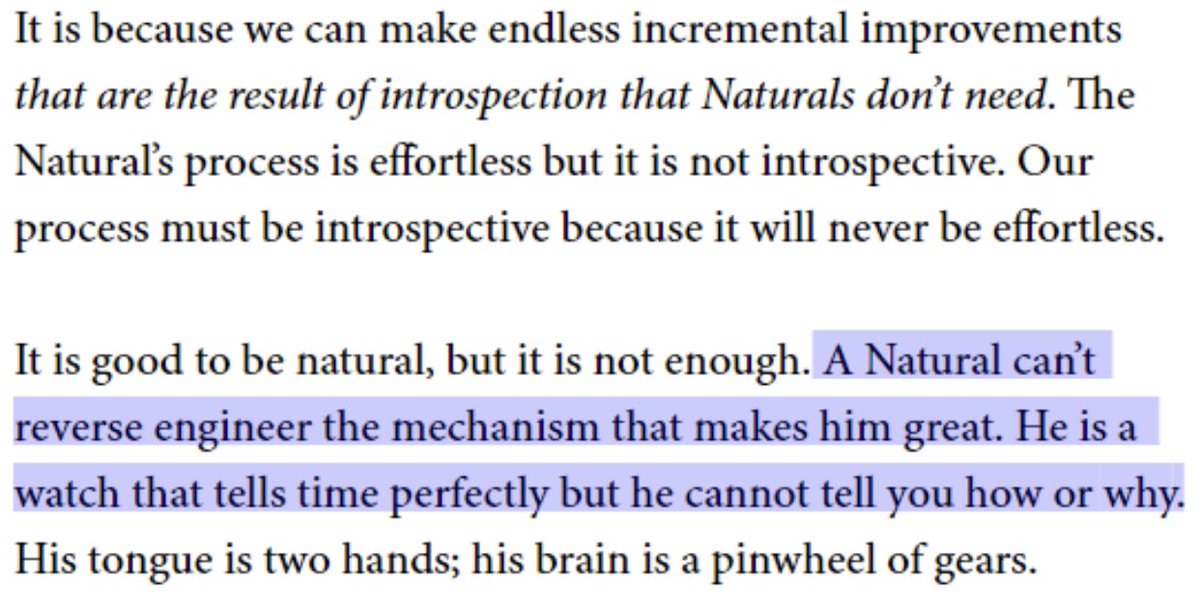
...it's hard for a discretionary trader to prove why it works. They'll be the first to admit they leave a lot to be desired, this is the panacea.
One of my favorite quotes from @autumnal_city in his book "The Natural", amazing must-read btw..(tinyurl.com)
End.
One of my favorite quotes from @autumnal_city in his book "The Natural", amazing must-read btw..(tinyurl.com)
End.
Loading suggestions...