

There are many techniques for investing:
Value investing, momentum investing, trading, etc..
One of the most quoted is for sure DCA..but very few can do it properly.
Here's a full breakdown of DCA + some alpha hidden technical strategies 🧵👇
Value investing, momentum investing, trading, etc..
One of the most quoted is for sure DCA..but very few can do it properly.
Here's a full breakdown of DCA + some alpha hidden technical strategies 🧵👇

1.
In Investing, one of the most critical things is to find the right strategy that suits our targets, abilities, and time horizon.
As we're all different, different strategies have been made over the past decades and one of the favorites is DCA (dollar-cost-averaging).
In Investing, one of the most critical things is to find the right strategy that suits our targets, abilities, and time horizon.
As we're all different, different strategies have been made over the past decades and one of the favorites is DCA (dollar-cost-averaging).
2.
So let's start from the basis..what is it?
Dollar-cost average is an investment strategy that allows you to build a position in the market over time, usually a long one.
It takes the emotions out of investing by buying a same small amount of an asset regularly.
So let's start from the basis..what is it?
Dollar-cost average is an investment strategy that allows you to build a position in the market over time, usually a long one.
It takes the emotions out of investing by buying a same small amount of an asset regularly.
3.
If you have a predetermined amount of money and you put it all in once in the market, you're running the risk of buying the local peak of that asset, increasing the possibility of losing more money in case the price falls.
If you have a predetermined amount of money and you put it all in once in the market, you're running the risk of buying the local peak of that asset, increasing the possibility of losing more money in case the price falls.
4.
Let's make an example to clarify this topic.
You decided that Bitcoin is a strong asset and something you believe in the long term and now is sitting at 30k while your investment budget is $1000.
Let's make an example to clarify this topic.
You decided that Bitcoin is a strong asset and something you believe in the long term and now is sitting at 30k while your investment budget is $1000.
5.
Instead of putting that $1000 in one single time you could dilute them over time by setting small purchases.
For example, every Monday no matter the price of Bitcoin you buy 100$.
By doing this, you're getting an average price that reduces your risk.
Instead of putting that $1000 in one single time you could dilute them over time by setting small purchases.
For example, every Monday no matter the price of Bitcoin you buy 100$.
By doing this, you're getting an average price that reduces your risk.
6.
Furthermore, you will be able to increase your stack if the price starts to drop more.
DCA strategy works very well with all markets but even more in the crypto market as volatility is very high.
Nobody knows which could be the price of an asset tomorrow or the next month.
Furthermore, you will be able to increase your stack if the price starts to drop more.
DCA strategy works very well with all markets but even more in the crypto market as volatility is very high.
Nobody knows which could be the price of an asset tomorrow or the next month.
7.
If you want to make some “experiments” I leave you the link to a nice site where you can calculate a DCA strategy with Bitcoin.
You'll see how powerful it has been with such an asset.👇
dcabtc.com
If you want to make some “experiments” I leave you the link to a nice site where you can calculate a DCA strategy with Bitcoin.
You'll see how powerful it has been with such an asset.👇
dcabtc.com
8.
You can also use the inverse strategy for taking profits.
When you're in profit on a position, you could simply scale out cutting a small amount of that position, so you will be able to secure your profits while your bag is still running.
You can also use the inverse strategy for taking profits.
When you're in profit on a position, you could simply scale out cutting a small amount of that position, so you will be able to secure your profits while your bag is still running.
9.
If your position continues to go up you'll be happy because you'll make money.
If your position starts to go down you'll be happy because you took profits.
Win/win situation.
If your position continues to go up you'll be happy because you'll make money.
If your position starts to go down you'll be happy because you took profits.
Win/win situation.
10.
Anyways, DCA must be contextualized and used to exploit its full potential.
You should NOT be using it when everything is rising to crazy prices and candles are starting to become parabolic.
Don't listen to people screaming “buy the dip” at every dip.
They're fooling you.
Anyways, DCA must be contextualized and used to exploit its full potential.
You should NOT be using it when everything is rising to crazy prices and candles are starting to become parabolic.
Don't listen to people screaming “buy the dip” at every dip.
They're fooling you.
11.
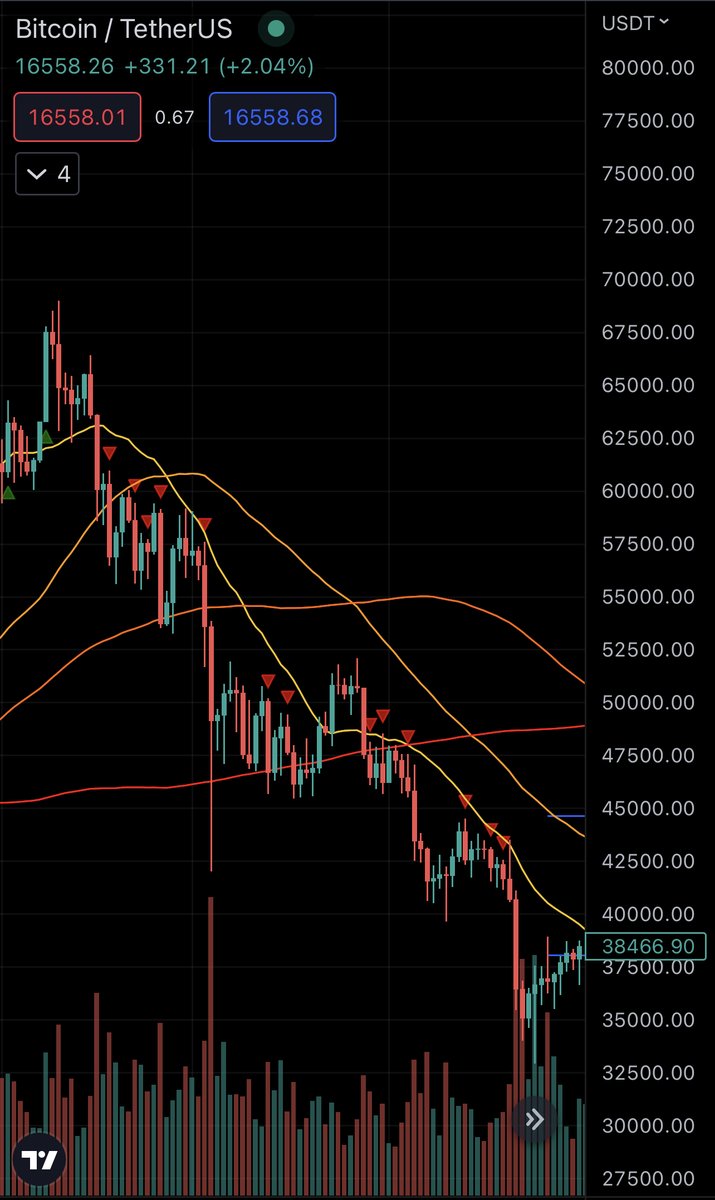
What if you were DCAing all the way down from 67k to the actual 16k..would you be happy?
You would be down heavy.
Sometimes selling and waiting are the best solution.
What if you were DCAing all the way down from 67k to the actual 16k..would you be happy?
You would be down heavy.
Sometimes selling and waiting are the best solution.
12.
“But bro, when do I need to start my DCA?”
Well, you don't need to be an expert to understand that it's always better to buy an asset after huge declines (60/70/80%).
If the asset is fundamentally strong it will rise again, it's a matter of time/market conditions.
“But bro, when do I need to start my DCA?”
Well, you don't need to be an expert to understand that it's always better to buy an asset after huge declines (60/70/80%).
If the asset is fundamentally strong it will rise again, it's a matter of time/market conditions.
13.
Time to share my alpha.🐺
My personal DCA starts using 2 indicators:
• 9-EMA
• Stochastic
These 2 indicators have been phenomenal at identifying bottoms and tops in Bitcoin and most large-caps.
Timeframes: 1 Week / 1 Day.
Time to share my alpha.🐺
My personal DCA starts using 2 indicators:
• 9-EMA
• Stochastic
These 2 indicators have been phenomenal at identifying bottoms and tops in Bitcoin and most large-caps.
Timeframes: 1 Week / 1 Day.
Loading suggestions...