

The Grayscale Bitcoin Trust refuses to show proof of reserves due to “security risks”
Why is this a big deal? Here’s why:
Why is this a big deal? Here’s why:
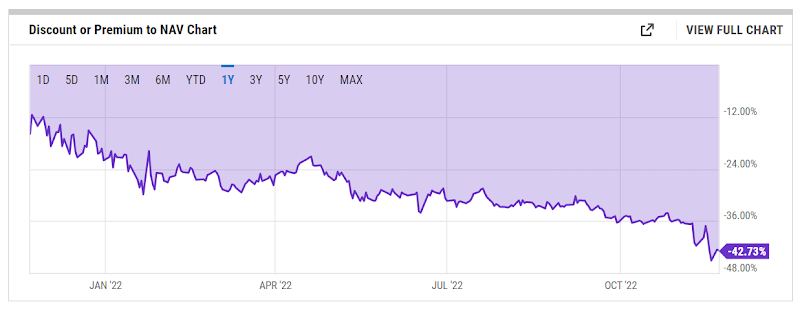
As of close yesterday, $GBTC is trading at a 42.73% discount to Net Asset Value (NAV)
In other words, one share of GBTC with about $14.70 in Bitcoin trades for only $8.44.
So is this a huge arbitrage opportunity?
In other words, one share of GBTC with about $14.70 in Bitcoin trades for only $8.44.
So is this a huge arbitrage opportunity?
Well, maybe. Here’s why it might not be:
The market has several reasons to price GBTC below NAV, including:
Holding GBTC is more expensive than just holding Bitcoin. There’s a 2% management fee and higher trading commissions because it’s a trust, not an ETF.
The market has several reasons to price GBTC below NAV, including:
Holding GBTC is more expensive than just holding Bitcoin. There’s a 2% management fee and higher trading commissions because it’s a trust, not an ETF.
Grayscale has made about $900 million since the start of 2021 from management fees on this trust.
So they may not want to “kill the golden goose”. In other words, they are not necessarily incentivized to change something that’s working well for them.
So they may not want to “kill the golden goose”. In other words, they are not necessarily incentivized to change something that’s working well for them.
The other concern: Reserves.
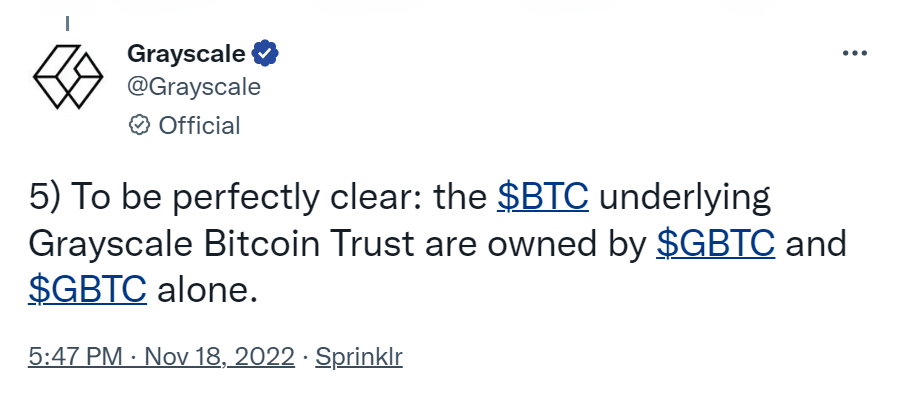
There is a huge question about GBTC’s holdings.
One of the key benefits of Bitcoin is being able to control your own money: GTBC eliminates this benefit because holders don’t actually own Bitcoin: They own a share of this trust which holds Bitcoin.
There is a huge question about GBTC’s holdings.
One of the key benefits of Bitcoin is being able to control your own money: GTBC eliminates this benefit because holders don’t actually own Bitcoin: They own a share of this trust which holds Bitcoin.
After FTX collapsed, several crypto exchanges and trusts immediately published proof of reserves to calm their customers.
However, Grayscale decided not to.
This was their reasoning:
However, Grayscale decided not to.
This was their reasoning:
“Due to security concerns, we do not make such on-chain wallet information and confirmation data publicly available through a cryptographic Proof-of-Reserve, or other advanced cryptographic accounting procedure,” Grayscale said in a statement.
Grayscale keeps its crypto assets “stored under the custody of Coinbase Custody Trust Company.”
Coinbase Custody holds over 635,000 Bitcoin for Grayscale and over 3 million ETH for its Ethereum Trust.
Coinbase Custody holds over 635,000 Bitcoin for Grayscale and over 3 million ETH for its Ethereum Trust.
Why is the market worried about Grayscale’s reserves?
Grayscale’s parent company is Digital Currency Group (DCG) - the same company that owns Genesis Global Capital, which lost $175 million on FTX and is exploring bankruptcy.
Grayscale’s parent company is Digital Currency Group (DCG) - the same company that owns Genesis Global Capital, which lost $175 million on FTX and is exploring bankruptcy.
The main question investors want to know: Are Grayscale and Genesis intertwined financially?
In other words, if Genesis fails, does it drag Grayscale down with it?
It’s hard to say if Genesis and Grayscale’s assets have been commingled, though the company denies it.
In other words, if Genesis fails, does it drag Grayscale down with it?
It’s hard to say if Genesis and Grayscale’s assets have been commingled, though the company denies it.
But here’s what might make this the greatest trade ever:
What if Grayscale is forced to liquidate, but all the Bitcoin is more or less safe?
You could buy GBTC for a 42% discount but receive 100% of the Bitcoin at liquidation.
What if Grayscale is forced to liquidate, but all the Bitcoin is more or less safe?
You could buy GBTC for a 42% discount but receive 100% of the Bitcoin at liquidation.
But investors are worried about a repeat of the FTX situation.
FTX customers assumed their deposits were being safely held, but they were actually being used for speculative trades, loans, and other risky business ventures.
FTX customers assumed their deposits were being safely held, but they were actually being used for speculative trades, loans, and other risky business ventures.
That’s not necessarily happening with Grayscale. They are much more regulated than FTX was, but publishing proof of reserves would do a lot to calm the market.
Otherwise, GBTC’s discount to NAV will continue and investors will be better off directly buying their own Bitcoin.
Otherwise, GBTC’s discount to NAV will continue and investors will be better off directly buying their own Bitcoin.
Loading suggestions...